Japanese tattoo meanings are not fixed rules: they are readings handed down through art and folklore, and a design is read by its main subject together with its background. The dragon, for example, is an imaginary creature said to rise into the sky, raise clouds and bring rain [1]. The koi comes from the Chinese legend that a carp which climbs the rapids of the Dragon Gate turns into a dragon, so it has long stood for success in life [2].
Artists do not all read these motifs the same way, and many meanings are attached after the fact. Plenty of people choose a design simply for its power on the skin, or for the way a particular artist draws it.
A Japanese traditional piece (wabori, also called irezumi; see Irezumi vs Tattoo for what the word means; it is a different thing from the tattoo traditions of the Ainu and Okinawa) is built from two parts: a main subject such as a dragon, koi or lion, and the background that fills the skin around it, such as waves, clouds, wind, rocks or fire. Some pairings of subject and background have been favored for centuries, and knowing them is the easiest way to read a piece.
Japanese Tattoo Symbols and Their Meanings at a Glance
The table lists the motifs you see most often in Japanese tattoos. "Traditional meaning" is what dictionaries and art history record. "How it is often read in tattoos" is an interpretation you will hear in the tattoo world. Neither is a rule.
| Motif | Traditional meaning | How it is often read in tattoos | Often paired with | Works |
|---|---|---|---|---|
| Dragon (ryu) | An imaginary creature that lives in water, rises to the sky, raises clouds and brings rain. In China it was honored as one of the four auspicious beasts [1] | Strength, protection or rising in life | Clouds, waves, a sacred jewel | Dragon |
| Koi | From the legend that a carp which climbs the Dragon Gate on the Yellow River becomes a dragon, a symbol of rising in the world [2][3] | Effort, perseverance and success | Waves, splashing water, cherry blossoms, peonies | Koi |
| Phoenix (hoo) | A sacred bird honored in ancient China as one of the four auspicious beasts. Said to nest in the Chinese parasol tree and eat bamboo seeds; in Japanese art it is usually paired with paulownia [4][23] | Good fortune and rebirth | Paulownia, peonies, cherry blossoms, fire, clouds | Phoenix |
| Karajishi (Chinese lion, "foo dog") | The lion stylized for painting and sculpture. Lions were believed to hold down evil, so they served as guardians against it [5] | Protection and warding off evil | Peonies (the classic "lion and peony") | Foo dog |
| Tiger (tora) | The dragon and tiger were seen as special creatures representing heaven and earth. Tigers were thought to live in bamboo groves [6] | Strength and courage | Bamboo, wind, rocks | Tiger |
| Snake (hebi) | A legend holds that the white snake in the crown of the goddess Benzaiten is worshipped as the deity Ugajin [7] | Sometimes linked with protection or with wealth | Hannya masks, flowers | Snake |
| Hannya | A Noh mask of a demon woman with two horns and a mouth split wide open, showing a woman's rage and jealousy [8] | Sometimes linked with warding off evil. Many choose it for the force of its expression | Fire, clouds, snakes, cherry blossoms, peonies | Hannya |
| Oni (demon) | Oni faces were once modeled on ridge-end roof tiles (onigawara) to keep evil away [9] | Said to be chosen by some as a protector | Clouds, fire, cherry blossoms | Oni |
| Noh masks | Masks used in Noh theater, including old men, women and vengeful spirits such as hannya [10] | The mood changes with the mask. No fixed meaning is usually given | Flowers, clouds | Noh mask |
| Warriors (musha) | Utagawa Kuniyoshi's warrior prints of the heroes of the Water Margin were so popular they are said to have set off a craze for tattoos [11] | Loyalty, courage or strength, though no meaning is fixed | Swords, cherry blossoms, waves, clouds | Samurai |
| Geisha | No traditional meaning recorded | Chosen as a subject of Japanese culture and feminine beauty | Cherry blossoms, fans, paper umbrellas | Geisha |
| Fudo Myoo | A Buddhist deity who drives off demons, cuts through worldly desires and protects practitioners. Shown with a sword and rope, wrapped in flames [12] | See the deities section | Fire, rocks | See below |
| Kannon | The bodhisattva who hears people's voices and saves them out of compassion [13] | See the deities section | Lotus, clouds | See below |
| Fujin and Raijin | The wind god releasing wind from a bag and the thunder god beating drums, also counted among the 28 attendants of the Thousand-Armed Kannon [14] | See the deities section | Clouds | See below |
| Benzaiten | One of the Seven Gods of Fortune, a goddess said to grant fortune and wealth, identified with the grain deity Ugajin [15] | See the deities section | Snakes, waves | See below |
| Cherry blossom (sakura) | Long a subject of Japanese poetry and painting, and regarded as Japan's national flower [16] | Chosen for the fleeting life its blooming and falling suggests | Background for dragons and koi | Cherry blossom |
| Peony (botan) | Native to China and called the king of flowers [17] | Wealth and splendor | Lions, dragons, koi | Peony |
| Chrysanthemum (kiku) | In China it was believed to bring long life. It is also regarded as a national flower of Japan [18] | Long life and nobility | Waves, flowing water | Chrysanthemum |
| Maple (momiji) | A classic image of autumn in Japan [19] | Used to show autumn | Koi, flowing water | Maple |
| Waves (nami) | No traditional meaning recorded | Background around the main subject. Also tattooed on their own | Dragons, koi | Waves |
| Clouds (kumo) | A painting of a dragon in clouds, or a dragon riding clouds into the sky, is called "cloud dragon" (unryu) [20] | Background that sets the flow and spacing of the piece | Dragons, tigers | Clouds |
| Fire (honoo) | Fudo Myoo is shown wrapped in flames [12] | Background that adds movement | Fudo Myoo, dragons, hannya | Fire |
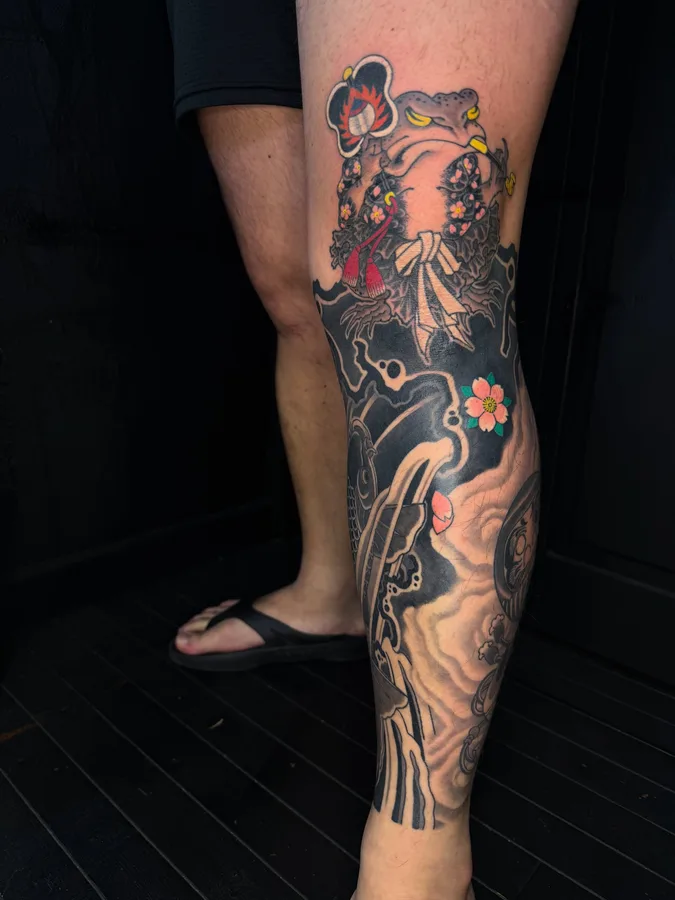
To see only Japanese traditional work, browse Japanese style tattoos on tattooers.jp. Here are main subjects from the table, from artists listed on the site.
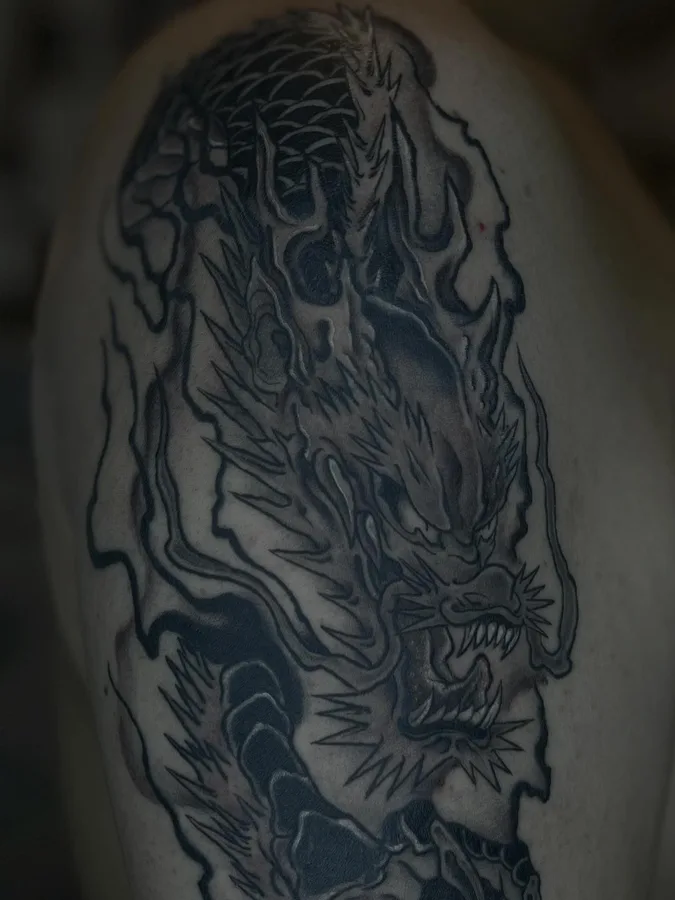
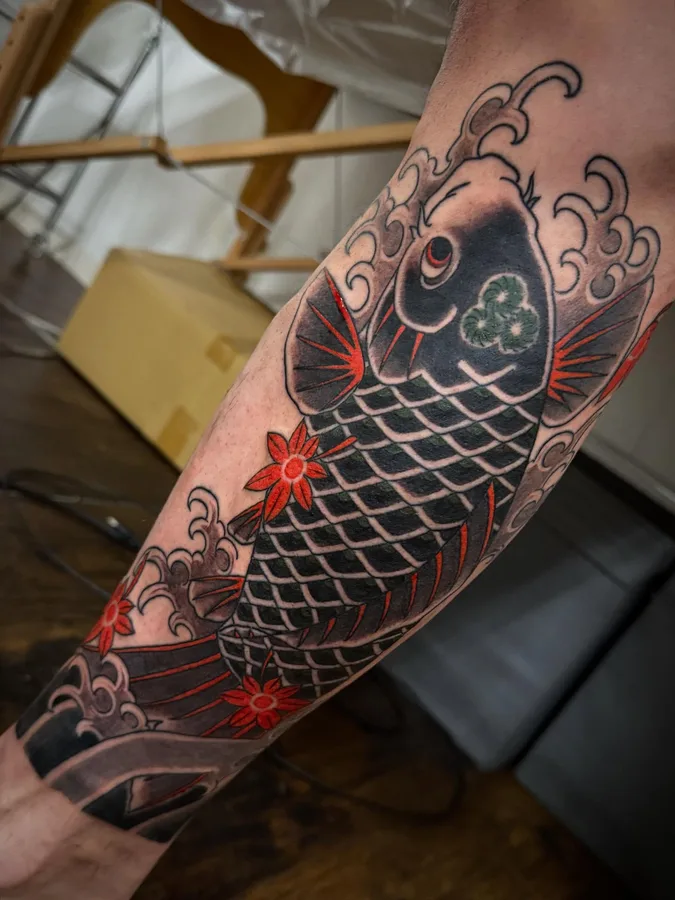
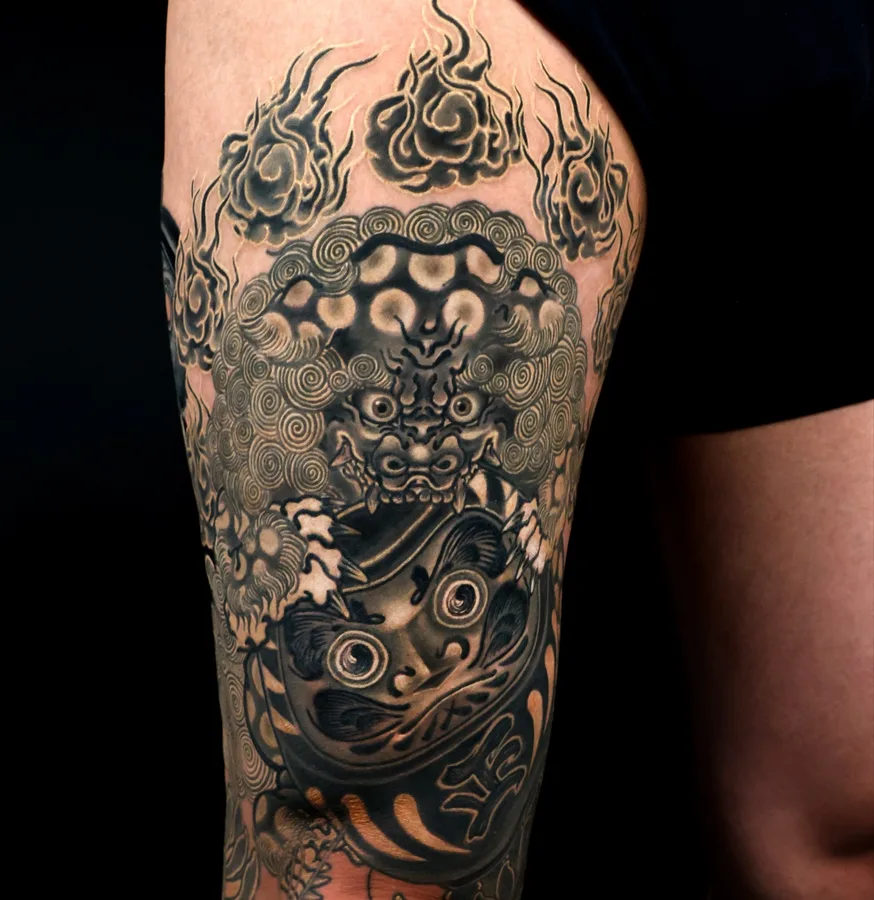
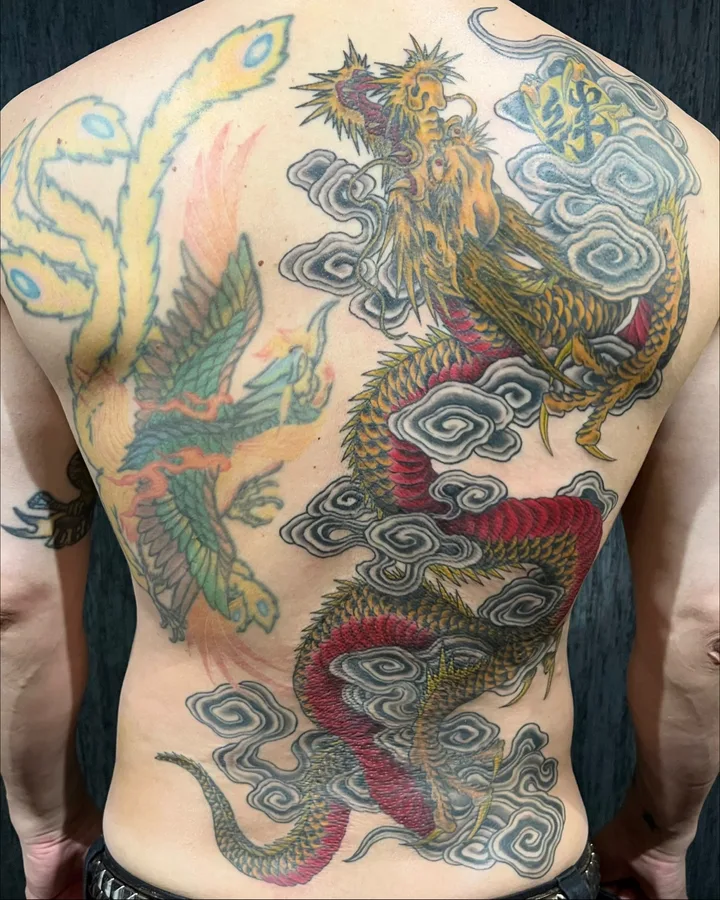
Images are quoted from works by artists listed on tattooers.jp (as of November 16, 2026). Tap an image to open the work.
Artist pages: RIKIMARU / Koji Nishimura / Shingun / kazz
Choosing by Meaning: Family, Strength, Success, Protection, Love
If you start from what you want the tattoo to say, these are the motifs most often linked with each idea. The links come from meanings recorded in art and dictionaries. None of them is required.
| What you want to express | Motifs often suggested | Where the reading comes from |
|---|---|---|
| Family | No set motif | No Japanese tattoo motif clearly stands for family. Some people link their family to carp streamers, flown in Japan to wish boys health and success [21], to the crane, a symbol of long life [22], or to the phoenix, which is described as a male and female pair [4] |
| Strength | Dragon, tiger, warriors | The dragon and tiger were seen as creatures of heaven and earth and were often painted together [6]. Kuniyoshi's warrior prints set off a tattoo craze [11]. Neither is recorded as meaning "strength"; that is how the tattoo world reads them |
| Success | Koi, dragon | The Dragon Gate legend: a carp that climbs the rapids becomes a dragon [2][3] |
| Protection | Karajishi lion, oni, Fudo Myoo | Lions were believed to hold down evil [5]. Oni faces were modeled on ridge-end roof tiles to keep evil away [9]. Fudo Myoo drives off demons and protects practitioners [12] |
| Love | Phoenix | The two characters of its name are said to mean the male and the female, and it is sometimes painted as a pair [4][23]. Few Japanese motifs carry a clear meaning of romance or marriage |
Motif is not the only way to add a personal meaning. Some people add a flower from a season that matters to their family, or the animal of their birth year in the Chinese zodiac. Whatever meaning you have in mind, tell your artist when you plan the design.
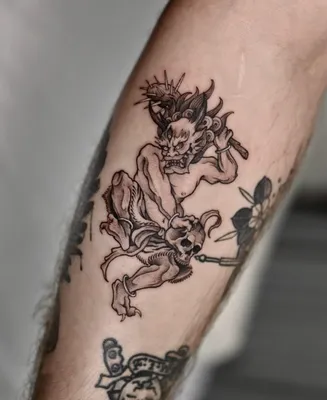
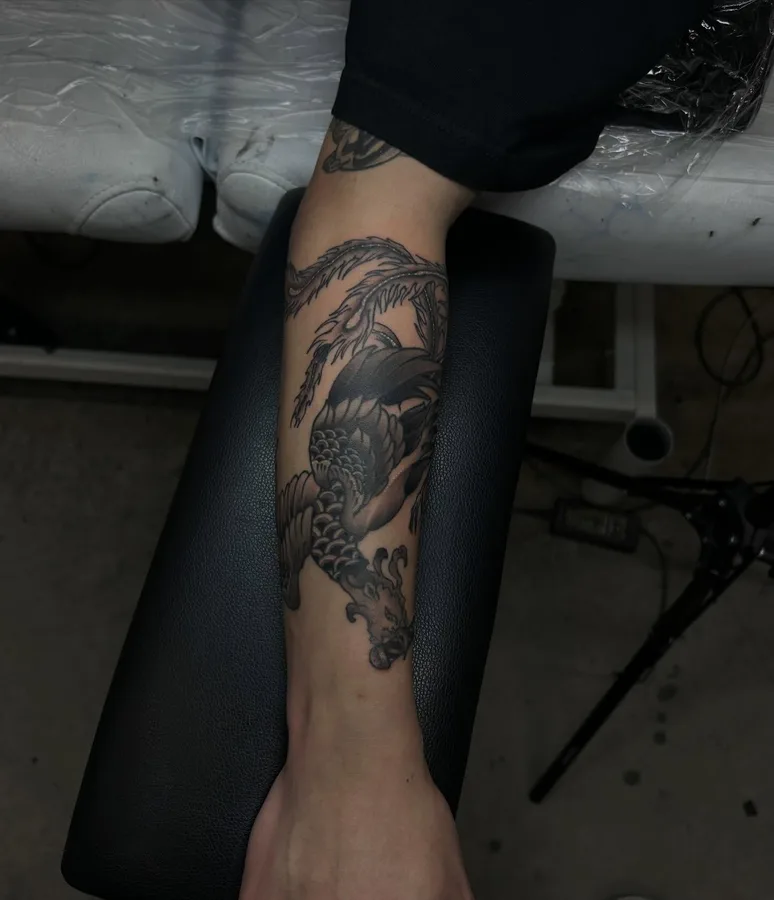
Images are quoted from works by artists listed on tattooers.jp (as of November 16, 2026). Tap an image to open the work.
Artist pages: SATOSHI / Kana / TOKI
Want one of these in Japan? Tell us your dates, the motif and the placement, and we match you with an artist. We message you on Instagram within 48 hours, and the ¥15,000 deposit is fully refunded if we can't match you. Only some artists in Japan specialize in the traditional style, so we choose among them for you.
Animals and Sacred Beasts: Dragon, Koi, Phoenix, Lion, Tiger, Snake
These are the animals that most often take the lead in a Japanese piece.
- Dragon: an imaginary creature that lives in water, rises to the sky, raises clouds and brings rain. In China it was honored with the qilin, phoenix and turtle as one of the four auspicious beasts [1]. In tattoos it is usually paired with clouds or waves, and a dragon in clouds is called a cloud dragon
- Phoenix: a sacred bird honored in ancient China, said to nest in the Chinese parasol tree and eat bamboo seeds [4]. In Japanese art it is usually paired with paulownia instead, and it became an image of good fortune painted with paulownia, bamboo and peonies [23]
- Karajishi (Chinese lion): the lion, stylized for painting and sculpture. Lions were believed to have the power to hold down evil, which is why lion statues guard shrines. Paired with peonies, it is considered one of the most splendid designs [5]. In English it is often called a foo dog
- Tiger: usually painted with bamboo, wind or rocks. A dragon and tiger facing each other is a classic pairing, covered below
- Snake: often paired with hannya masks or flowers. In Japan, the white snake in Benzaiten's crown is worshipped as the deity Ugajin [7]. For meanings, styles and placements, see our Japanese snake tattoo guide
Koi fish tattoo meaning
The koi stands for perseverance and success, from the legend of the carp that climbs a waterfall and becomes a dragon. The legend comes from China: a carp that makes it up the rapids of the Dragon Gate on the Yellow River turns into a dragon, which is why the gate became a symbol of passing a hard test and rising in life [2]. A koi swimming up a waterfall, "koi climbing the waterfall", is a set image of that idea [3].
In Japan the same wish shows up in carp streamers, flown for boys' health and success [21]. In tattoos, koi are usually set in waves and splashing water, often with cherry blossoms or peonies.
You will also hear that a koi swimming up means something different from one swimming down. There is no clear source for this, and artists see it differently, so if it matters to you, you can raise it with the artist in the group chat once you are matched.
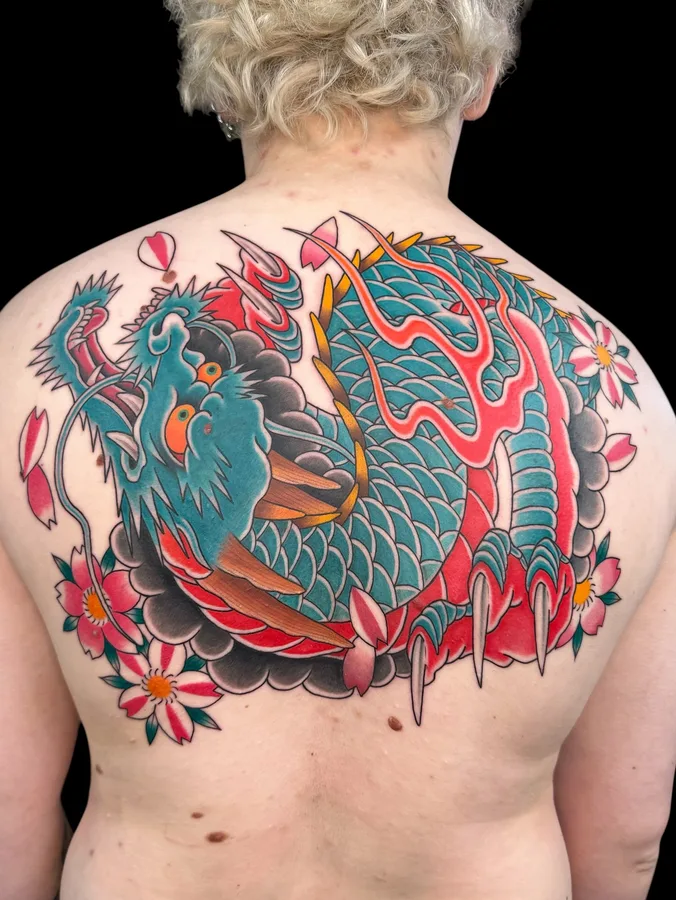 Dragon | 彫也 HORINARI
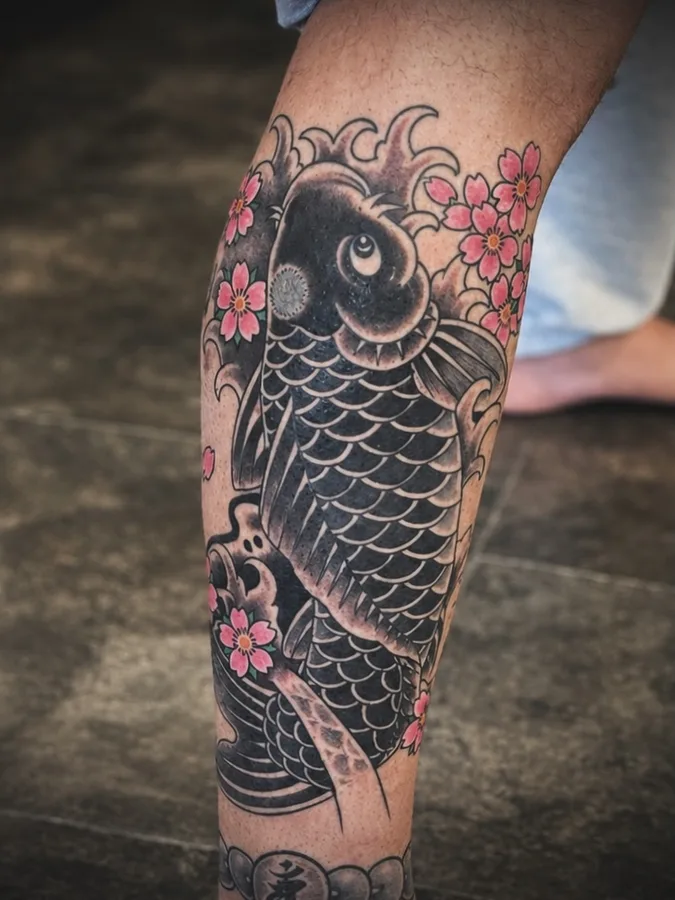 Koi | ToM [DRAGON HEART TATTOO]
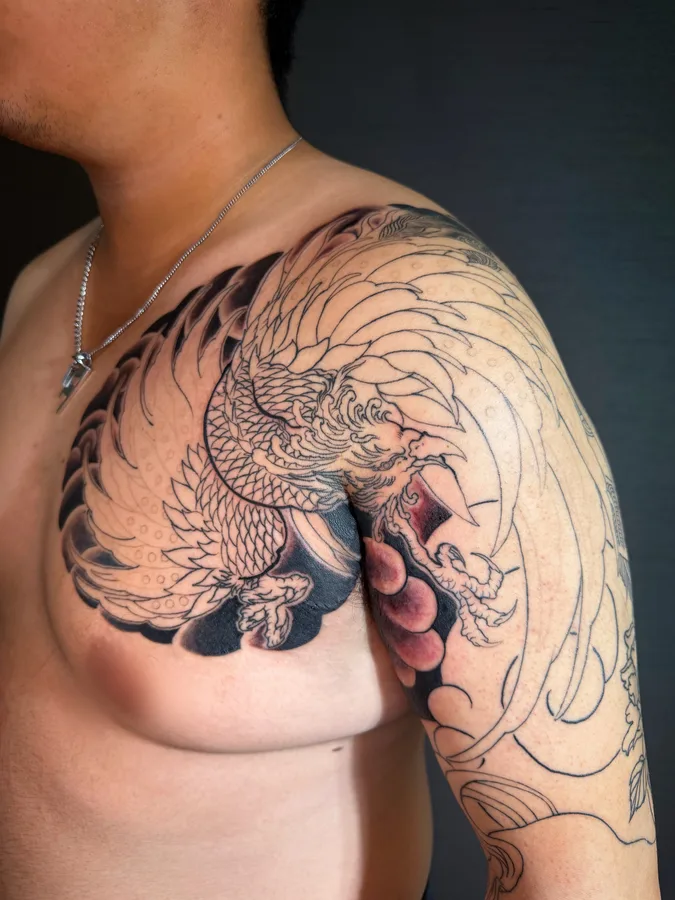 Phoenix, outline stage | 彫旭 Horiaki
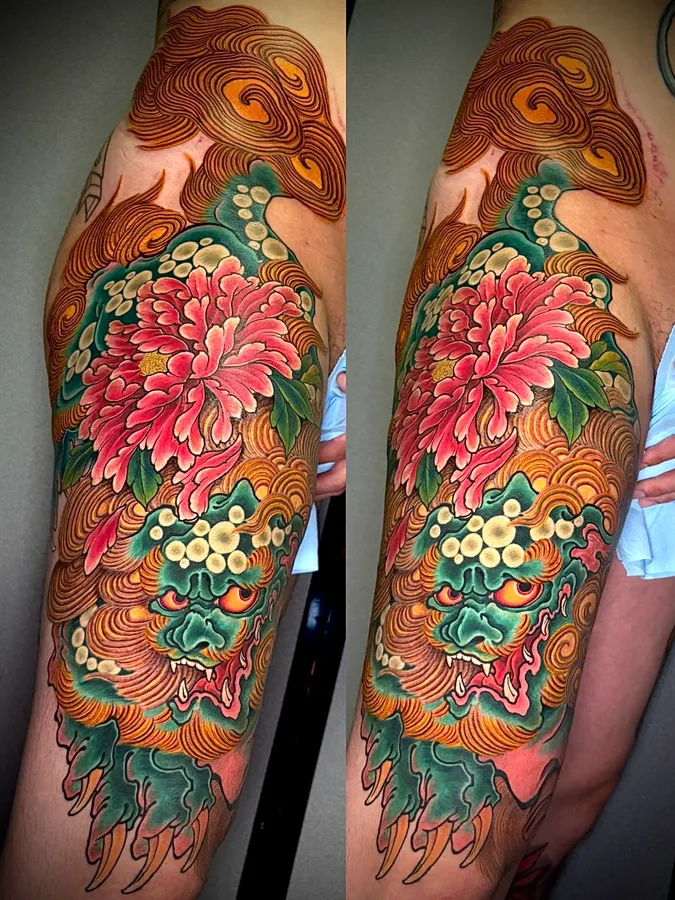 Karajishi lion | Manabu Shinshu
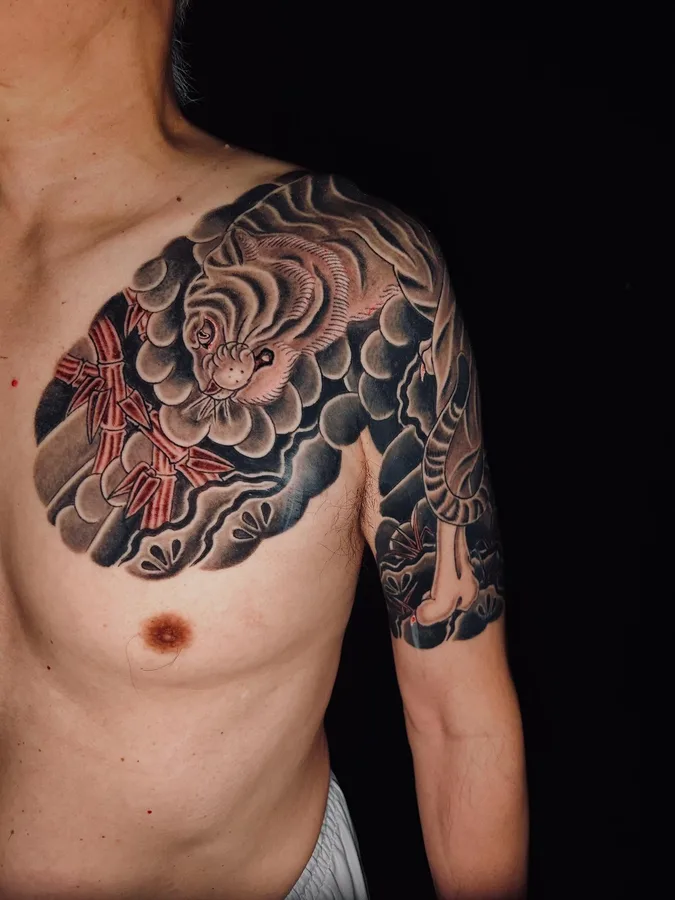 Tiger | 彫武 Horitake
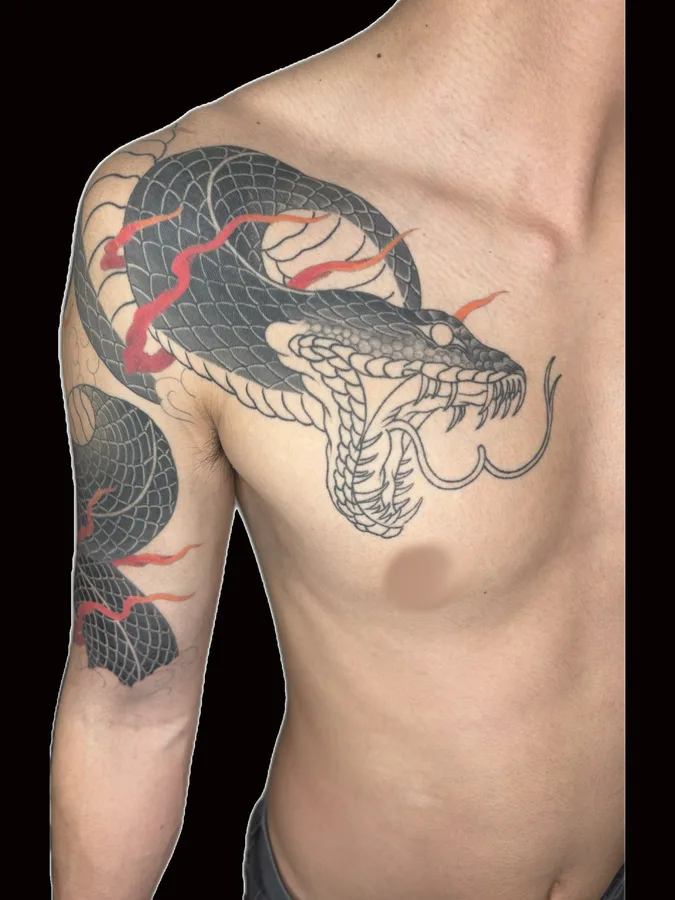 Snake | tomo
Images are quoted from works by artists listed on tattooers.jp (as of November 16, 2026). Tap an image to open the work.
Artist pages: HORINARI / ToM / Horiaki / Manabu Shinshu / Horitake / tomo
Masks and Figures: Hannya, Oni, Noh Masks, Warriors, Geisha
Hannya mask meaning
The hannya is a Noh theater mask of a woman turned demon by jealousy and rage. It has two horns and a mouth split wide open, and it expresses a woman's anger and jealousy. It is worn in plays such as Aoi no Ue and Dojoji [8]. In tattoos it is sometimes linked with warding off evil, but readings vary, and many people choose it simply for the force of its expression.
Oni and other Noh masks
Oni have long been told of as imaginary beings that harm people [24]. Yet oni faces were also modeled on ridge-end roof tiles (onigawara) to keep evil away [9], and some people are said to choose an oni tattoo as a protector.
Noh has many other masks besides hannya, including old men, young women and vengeful spirits [10]. Each has a different expression, so the mask you pick changes the whole mood of the piece.
Some people worry that frightening motifs such as hannya, oni and snakes are unlucky. As the sections above show, fierce faces such as oni and lions have a long history as guardians against evil. How you read them is up to you, and you can raise it with your artist in the group chat once you are matched if it is on your mind.
Warriors
One of the things that spread large figure designs in Japanese tattooing was the warrior prints of Utagawa Kuniyoshi (1797–1861), an artist of the Edo period. His first hit, a series on the heroes of the Chinese novel Water Margin, is said to have been so popular that it set off a craze for tattoos [11]. In the late Edo period (early 1800s), as woodblock prints flourished, laborers, firefighters and craftsmen are described as tattooing themselves with Water Margin heroes and lion-and-peony designs [5]. In Edo (old Tokyo), tattoos a person chose to get were called horimono [25].
Geisha
Geisha appear more in neo-Japanese work, which draws traditional subjects in a newer way, than in strictly traditional pieces. They are chosen as a subject of Japanese culture and feminine beauty, and many people pick them simply for how they look. Many pieces you will find under geisha actually show oiran, the high-ranking courtesans of the Edo period, who look similar at a glance.
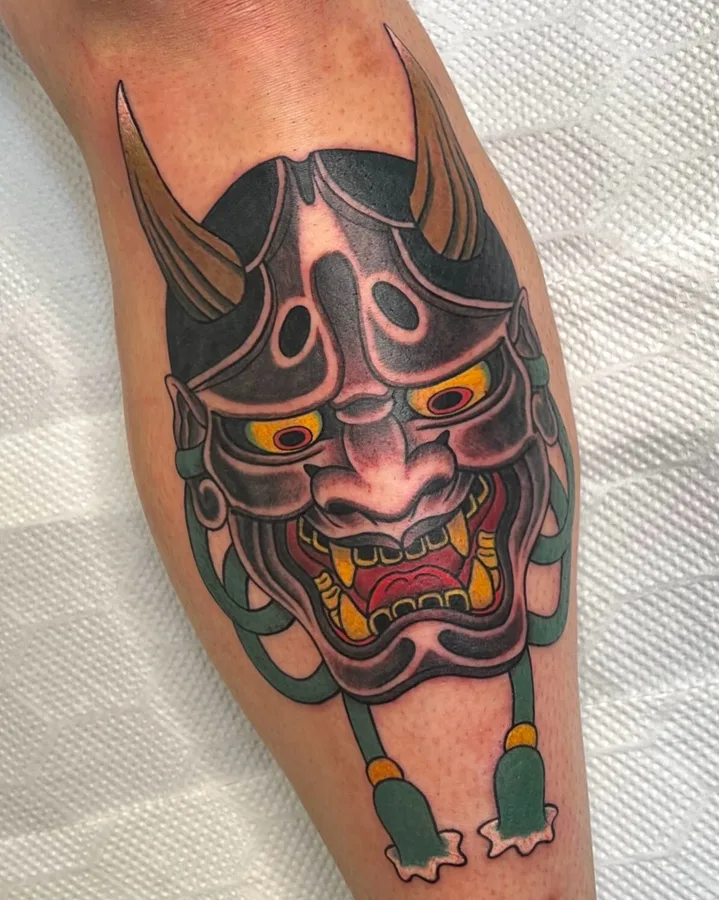 Hannya | 凌針 RYOSHIN
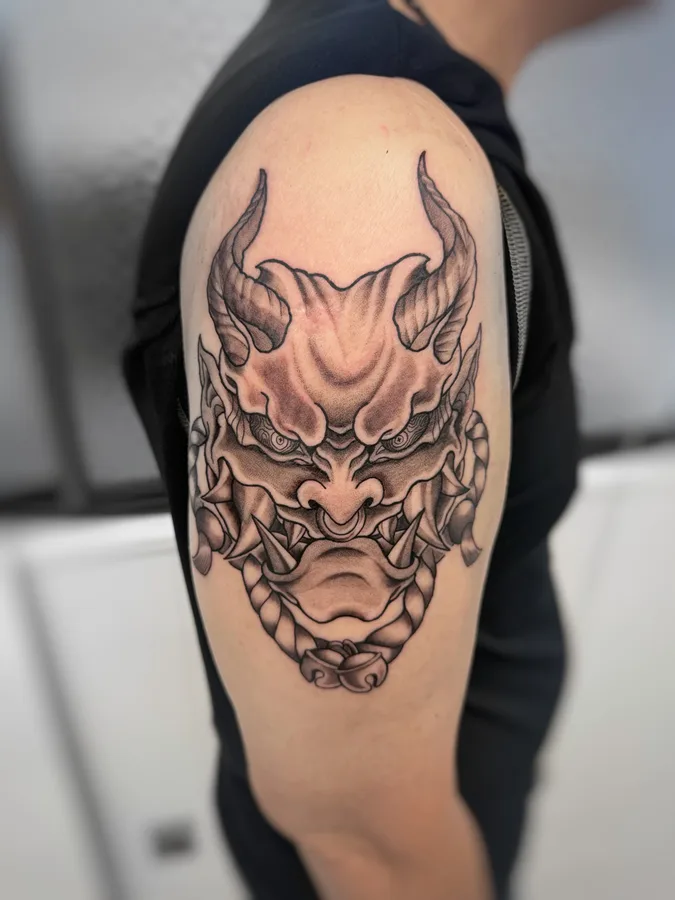 Oni | ALIEN TATTOO KOBE / 㐂 Ki
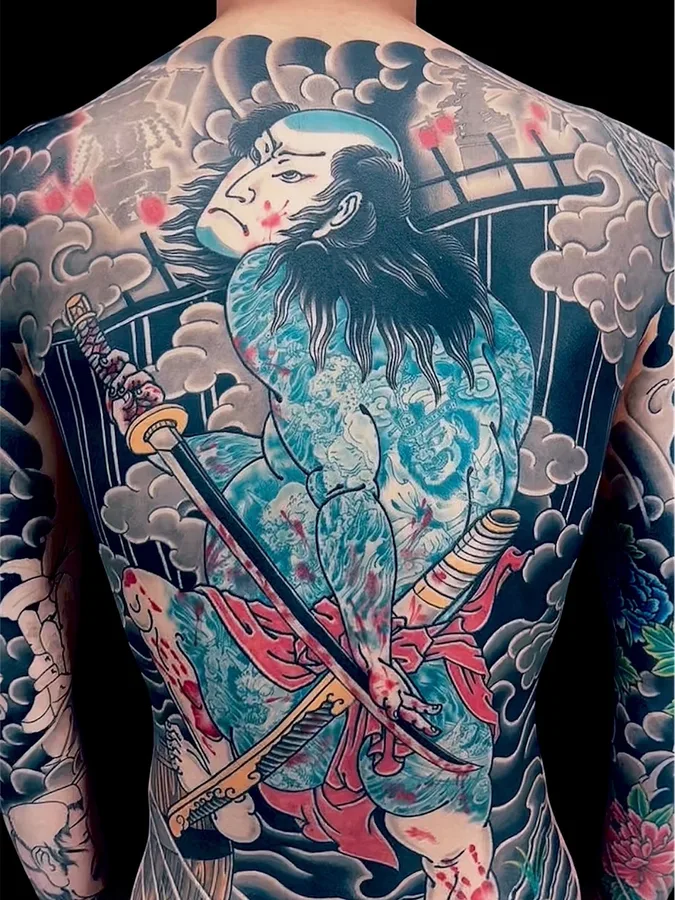 Kabuki hero Danshichi | KZ
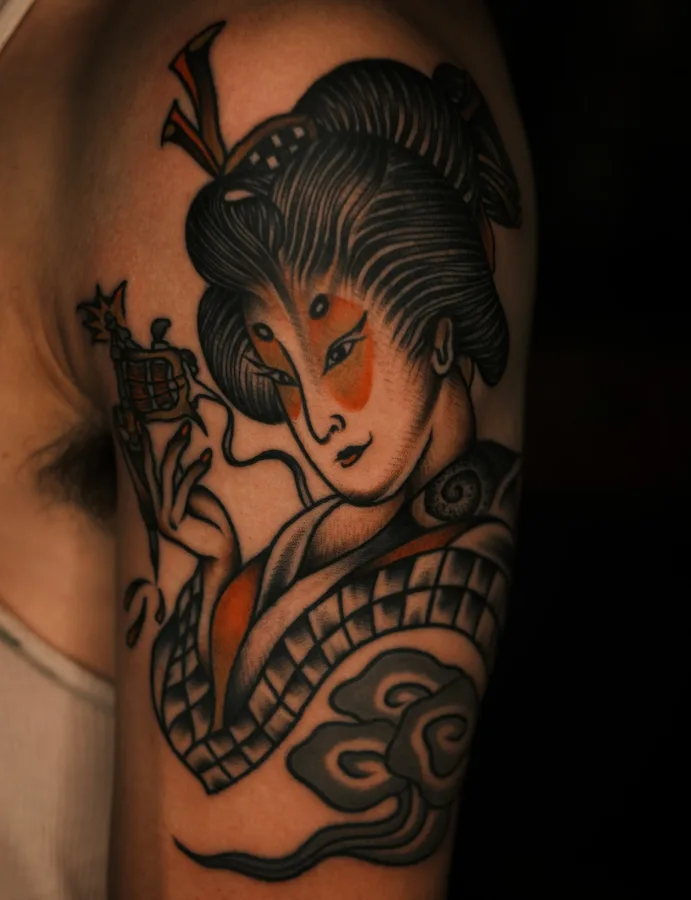 Oiran (courtesan) | Takaya Hashimoto
Images are quoted from works by artists listed on tattooers.jp (as of November 16, 2026). Tap an image to open the work.
Artist pages: RYOSHIN / ALIEN TATTOO KOBE / Ki / KZ / Takaya Hashimoto
Buddhist Deities and Gods: Fudo Myoo, Kannon, Fujin and Raijin, Benzaiten
Buddhist figures and gods are major subjects in Japanese tattooing. They are objects of faith first, rather than motifs you load with a meaning, so here is how dictionaries and art references describe their form and role.
- Fudo Myoo: on the orders of the cosmic Buddha Dainichi, he drives off demons, removes misfortune, cuts through worldly desires and protects practitioners. He is shown with an angry face, a sword in his right hand and a rope in his left, seated on a rock and wrapped in flames [12]. Pairing Fudo Myoo with fire in tattoos likely follows this image
- Kannon: short for Kanzeon Bosatsu, the bodhisattva who hears the voices of people calling out and saves them out of compassion. There are many forms, such as the Thousand-Armed Kannon and the Eleven-Headed Kannon [13]
- Fujin and Raijin: the wind god releasing wind from a large bag and the thunder god beating a ring of drums, also counted among the 28 attendants of the Thousand-Armed Kannon [14]. The best-known image is the folding screen by Tawaraya Sotatsu, a National Treasure held by Kennin-ji temple in Kyoto [26]
- Benzaiten: originally an Indian river goddess. In Japan she became one of the Seven Gods of Fortune, granting fortune and wealth, and was identified with the grain deity Ugajin [15]. A white snake is said to sit in her crown and is worshipped as Ugajin [7], which is likely why some pieces pair Benzaiten with a snake
Deities are usually tattooed large, often across the whole back, and may be set with lotus flowers, clouds or fire.
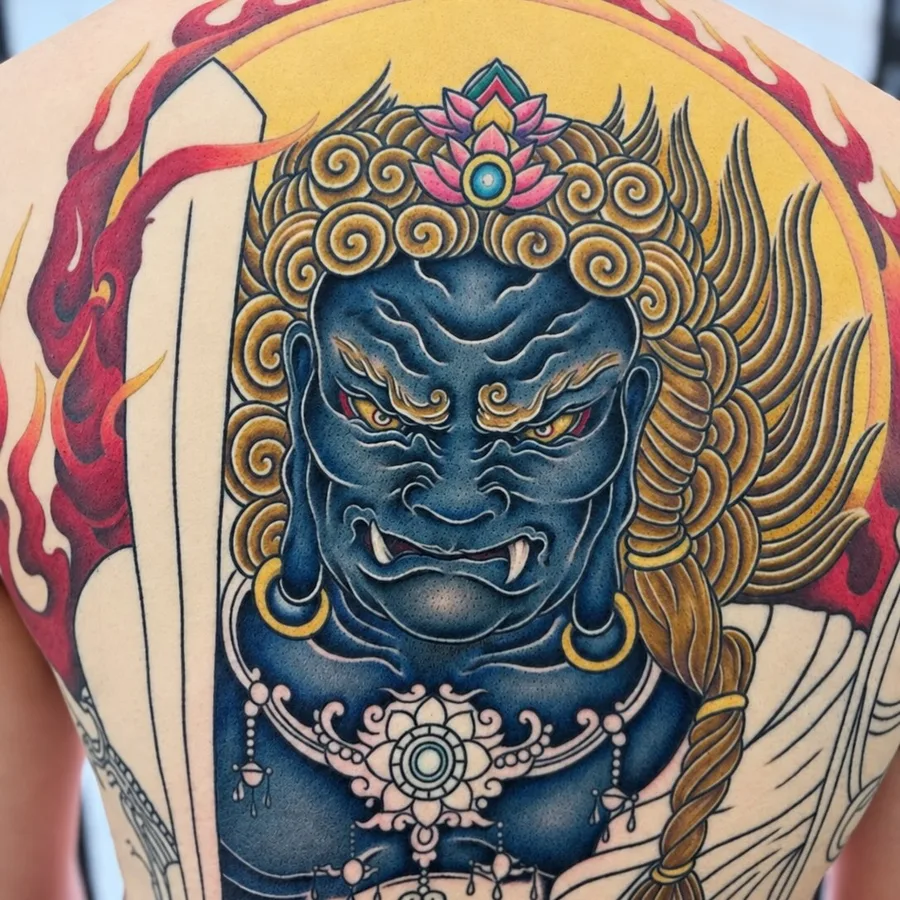
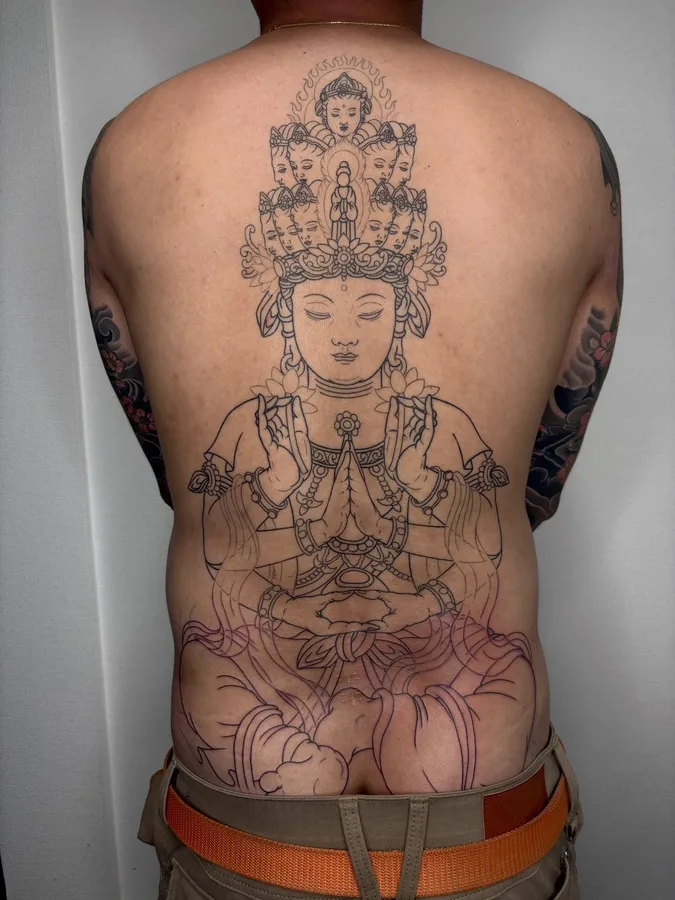
Images are quoted from works by artists listed on tattooers.jp (as of November 16, 2026). Tap an image to open the work.
Flowers: Cherry Blossom, Peony, Chrysanthemum, Maple
Flowers in Japanese tattoos can support an animal or figure, or take the lead on their own.
- Cherry blossom: long a subject of Japanese poetry and painting, and regarded as Japan's national flower [16]. In tattoos it most often appears around dragons and koi
- Peony: native to China and called the king of flowers [17]. The lion and peony is the best-known pairing, and peonies also go with dragons and koi
- Chrysanthemum: believed in China to bring long life. In Japan it is used in the imperial crest and is also regarded as a national flower [18]. It appears with waves and flowing water, or on its own as a small piece
- Maple: a classic image of autumn in Japan [19]. Maple leaves are often scattered around koi, dragons or flowing water
Some artists keep the flowers in one piece to a single season, for example not mixing spring cherry blossoms with autumn maple. Others paint flowers from different seasons together to show the whole year. If you are unsure which flower to add, choose it with your artist together with the main subject.
The lotus is closely tied to Buddhism and is often painted with Buddhist figures.
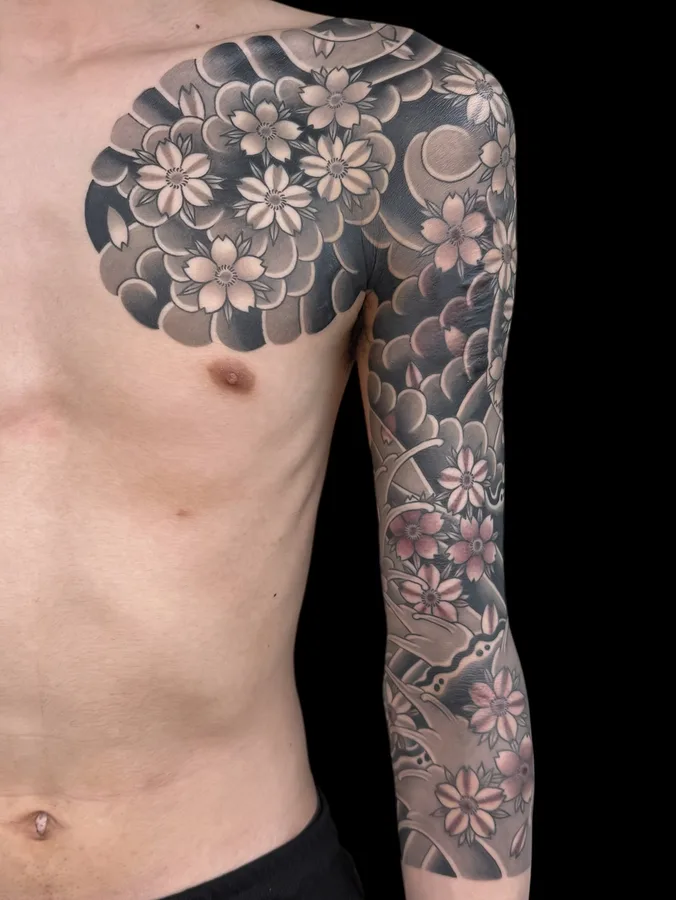
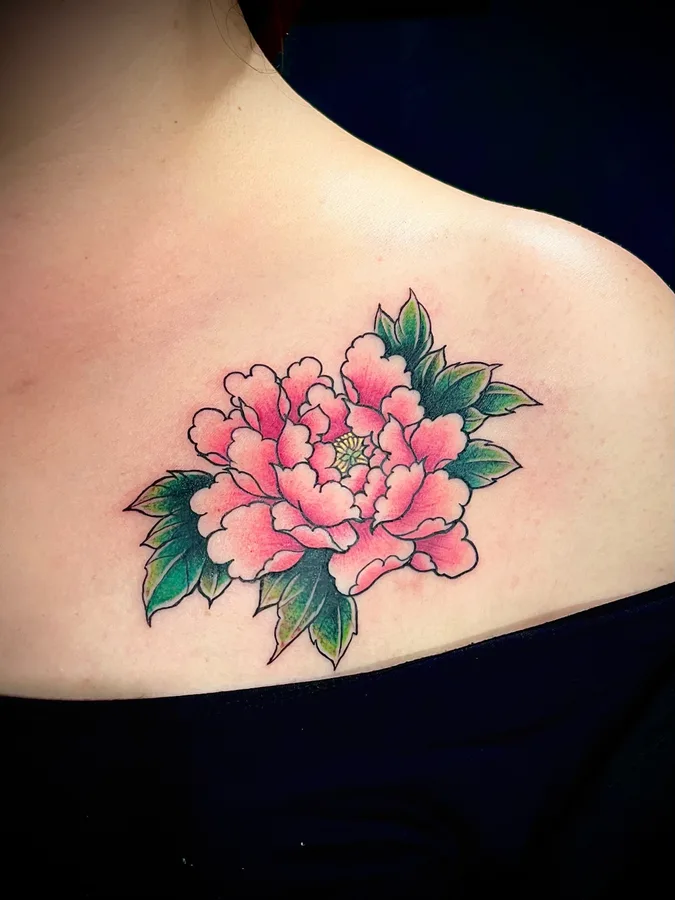
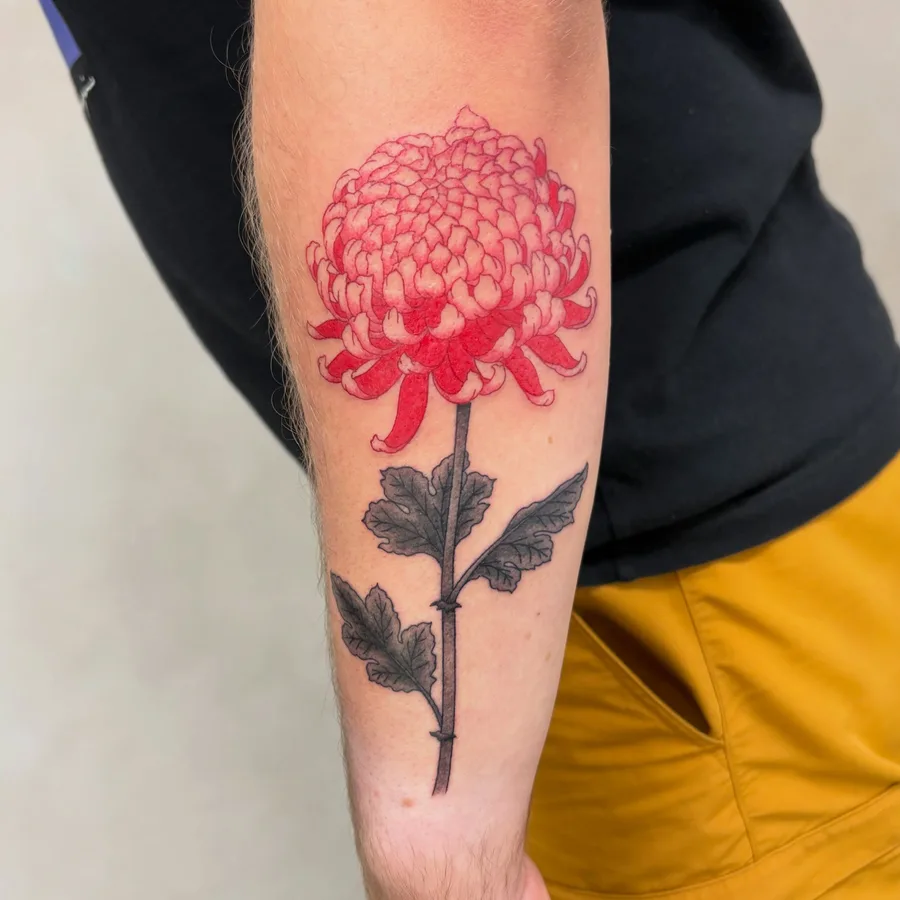
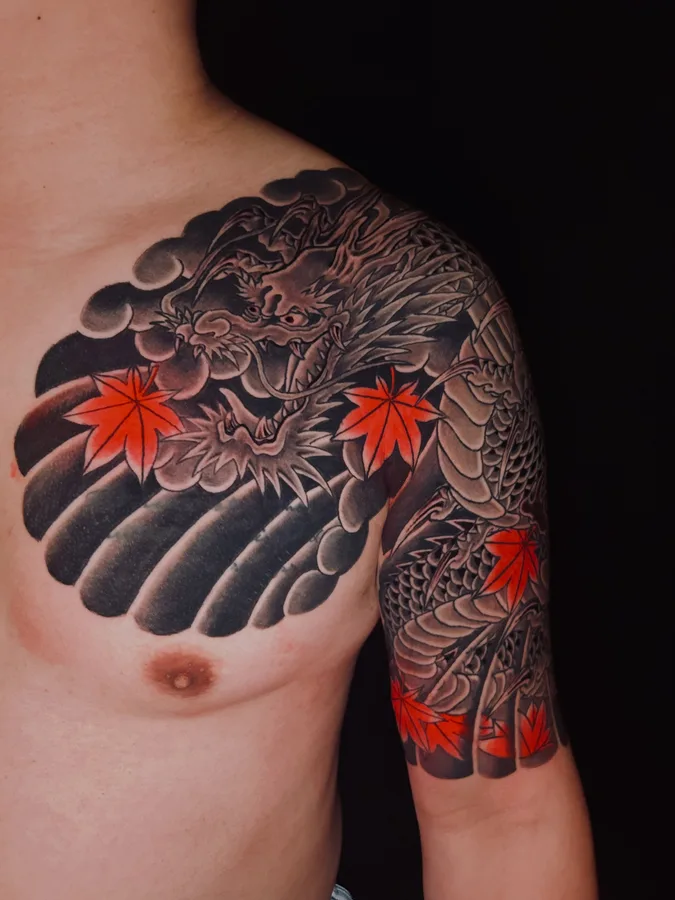
Images are quoted from works by artists listed on tattooers.jp (as of November 16, 2026). Tap an image to open the work.
Artist pages: HORINARI / NaO / Mizuki / Horitake
Two More Lucky Motifs: Crane and Frog
Two small motifs show up often in Japan, though they are not always the star of a large piece.
- Crane (tsuru): since ancient times the crane has been honored in Japan, together with the turtle, as a symbol of long life, and it is regarded as an auspicious bird [22]. How a given artist reads it varies. See works with a crane
- Frog (kaeru): the Japanese word kaeru also means "to return", so frogs are treated as a good-luck symbol and a charm for coming home safely. A Japan Tourism Agency explanation of a frog shrine in Gifu gives this as one of several reasons for the belief [28]. Some people carry a small frog charm for money to come back, too, though that reading is folk custom, not a recorded meaning. See works with a frog
Both are usually tattooed small, and the meaning is a pun or a wish, not a rule.
Religious Motifs and Travel
Some motifs are objects of faith in Japan or elsewhere, such as Buddhist deities, the lotus, mandalas and Sanskrit characters (bonji). The same motif can also be read differently from one country to another, so think about where you will live or travel. If you are unsure, mention it in the inbound request form and we will take it into account when we match you with an artist. For borrowing the traditional patterns of a people, such as the Ainu or Okinawa, read our guide to the Ainu and Okinawan traditions first.
How to Read a Japanese Tattoo: Main Subject and Background
Read a Japanese piece in two steps: first the main subject, then what surrounds it. The subject carries most of the meaning. The background sets the scene, ties several motifs into one picture and decides where the piece ends.
What the background tells you
- Waves: most often around koi and dragons. They put the subject in water or at the water's edge
- Clouds: most often around dragons and phoenixes. A dragon in clouds, or riding clouds into the sky, is the "cloud dragon" [20]
- Wind: sometimes painted with tigers. A Chinese classic says that "clouds follow the dragon, and wind follows the tiger" [20]
- Rocks: sometimes under tigers and lions. Fudo Myoo is also shown seated on a rock [12]
- Fire: most often with Fudo Myoo, hannya and dragons, where it adds movement
- Flowers: add a season and a mood, as in the flower section above
Classic pairings
Some pairings have been painted for centuries in Japanese art and crafts. They are traditions, not rules, and artists combine motifs in their own ways.
| Pairing | Where it comes from |
|---|---|
| Dragon and clouds (cloud dragon) | A painting of a dragon in clouds, or riding clouds into the sky, is called a cloud dragon [20]. The dragon rises to the sky, raises clouds and brings rain [1] |
| Tiger and bamboo | Tigers were thought to live in bamboo groves. A Kyoto museum notes that with bamboo beside it, even a cat-like figure reads as a tiger [6] |
| Phoenix and paulownia | The phoenix is said to nest in the Chinese parasol tree and eat bamboo seeds; in Japanese art it is usually paired with paulownia. "Paulownia and phoenix" is also the name of a family crest [4]. On folding screens the phoenix appears with paulownia, bamboo and peonies [23] |
| Lion and peony (karajishi botan) | Lions with peonies appear from the Kamakura period (1185–1333) and were very popular in the Muromachi period (1336–1573) [27]. In the Noh play Shakkyo, a sacred lion dances among peony flowers [5] |
| Koi climbing a waterfall | From the legend that a carp which climbs the Dragon Gate becomes a dragon, a symbol of success [3] |
| Hannya and fire | No clear traditional meaning. In tattoos, hannya masks appear with fire, clouds, snakes, cherry blossoms and peonies |
| Snake | Paired with Benzaiten through the legend of the white snake Ugajin [7]. Also seen with hannya masks and flowers |
Dragon and tiger
The dragon and tiger were seen as special creatures representing heaven and earth, and have long been painted together [6]. In tattoos, the pair can face each other within one picture, or be split across the body, for example a dragon on the back and a tiger on the chest, or one on each arm, so that they face each other across the whole body.
How a full back piece is built
A large Japanese piece is roughly built in three layers. Names and boundaries differ a little from artist to artist.
| Layer | What it is | Examples |
|---|---|---|
| Main subject | The center of the picture | Dragon, koi, lion, phoenix, Fudo Myoo, warriors |
| Background | Fills the skin around the subject | Waves, clouds, wind, rocks, fire, seasonal flowers |
| Edge (mikiri) | Where and in what shape the picture ends | Gakubori, munewari, shichibu, gobu |
There are two broad ways to handle the background: fill it with shaded black and gray (bokashi) around the subject, or leave it out and tattoo only the subject (nukibori).
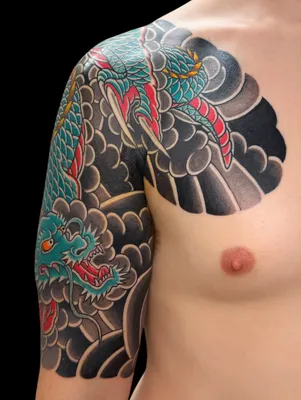 Cloud dragon | 彫也 HORINARI
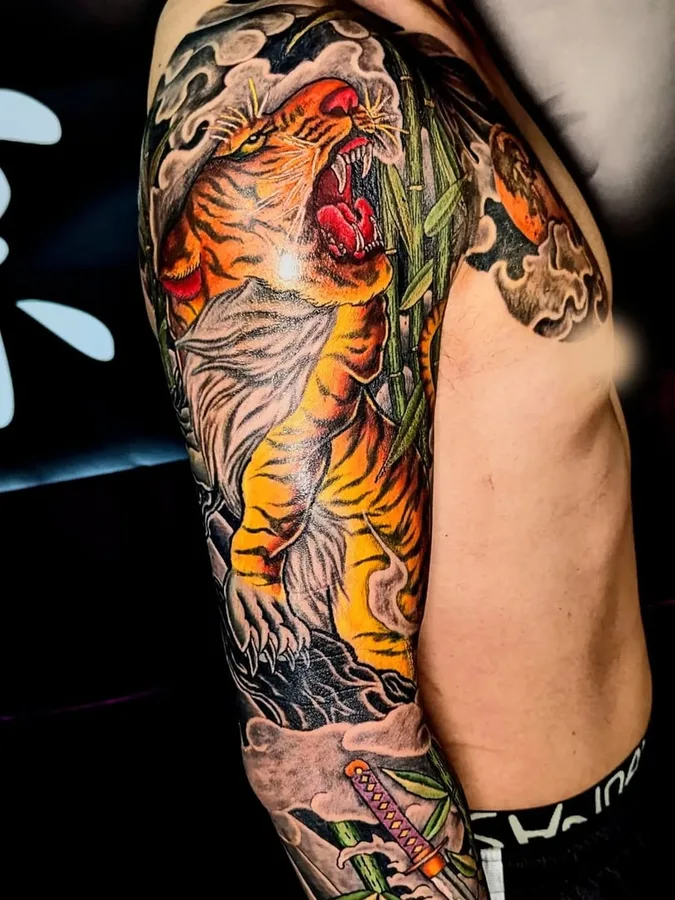 Tiger and bamboo | 左京 Sakyo
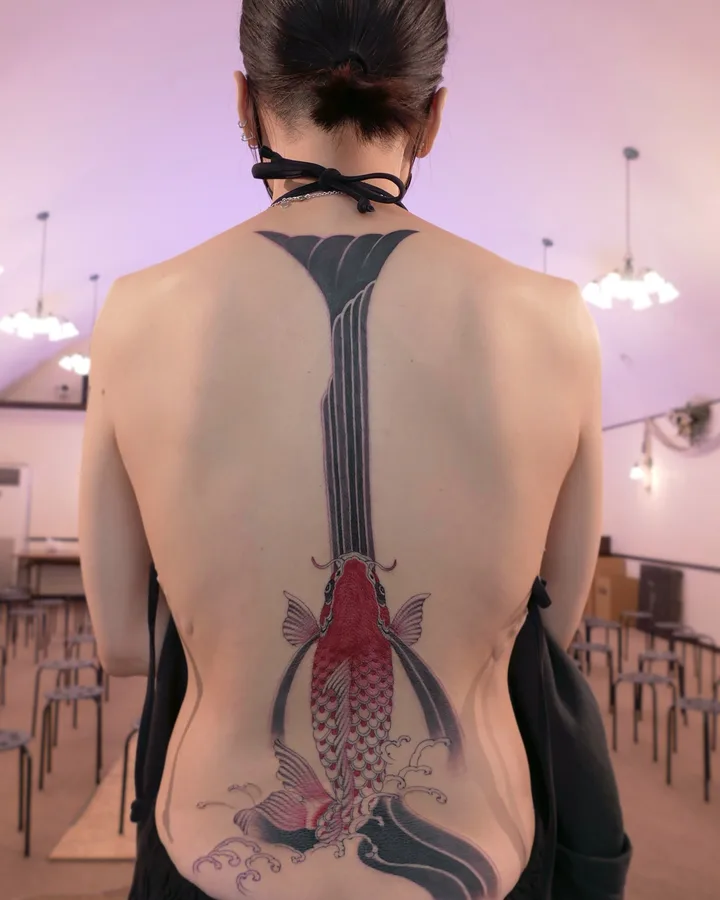 Koi climbing a waterfall | 彫ぺこ Horipeco
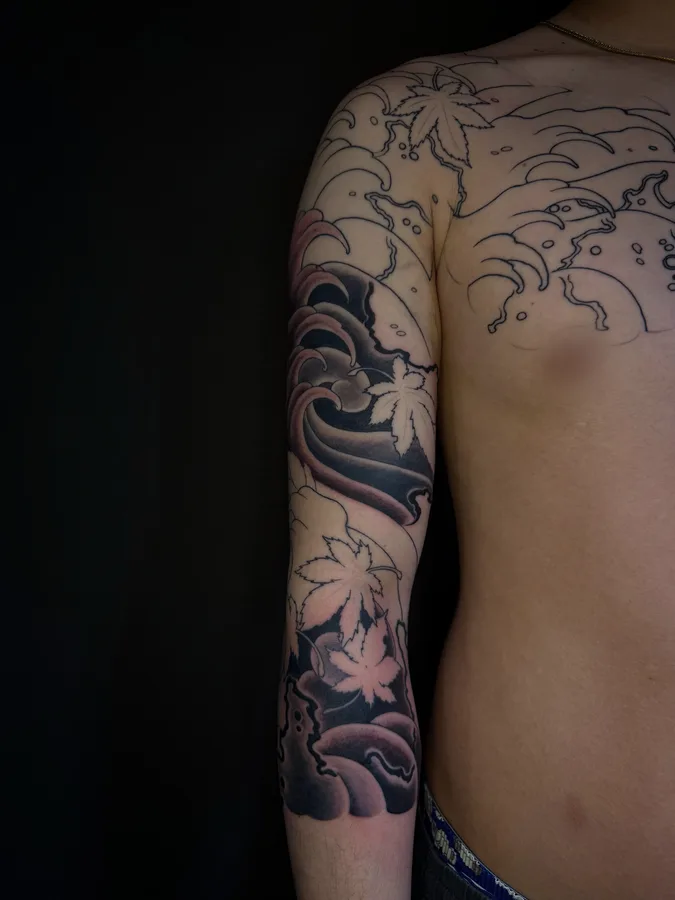 Waves | 彫旭 Horiaki
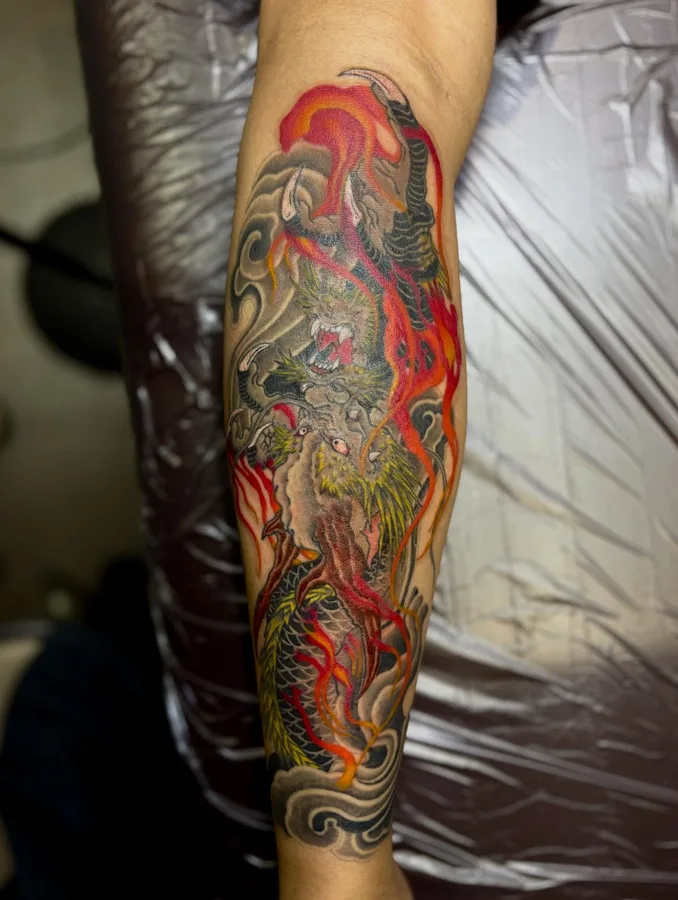 Dragon and fire | Ken
Images are quoted from works by artists listed on tattooers.jp (as of November 16, 2026). Tap an image to open the work.
Artist pages: HORINARI / Sakyo / Horipeco / Horiaki / Ken
Japanese Tattoo Terms You May Hear
These words come up when you plan a Japanese piece. Artists use them in slightly different ways, so when one comes up, confirm on the body or a sketch exactly where it starts and ends.
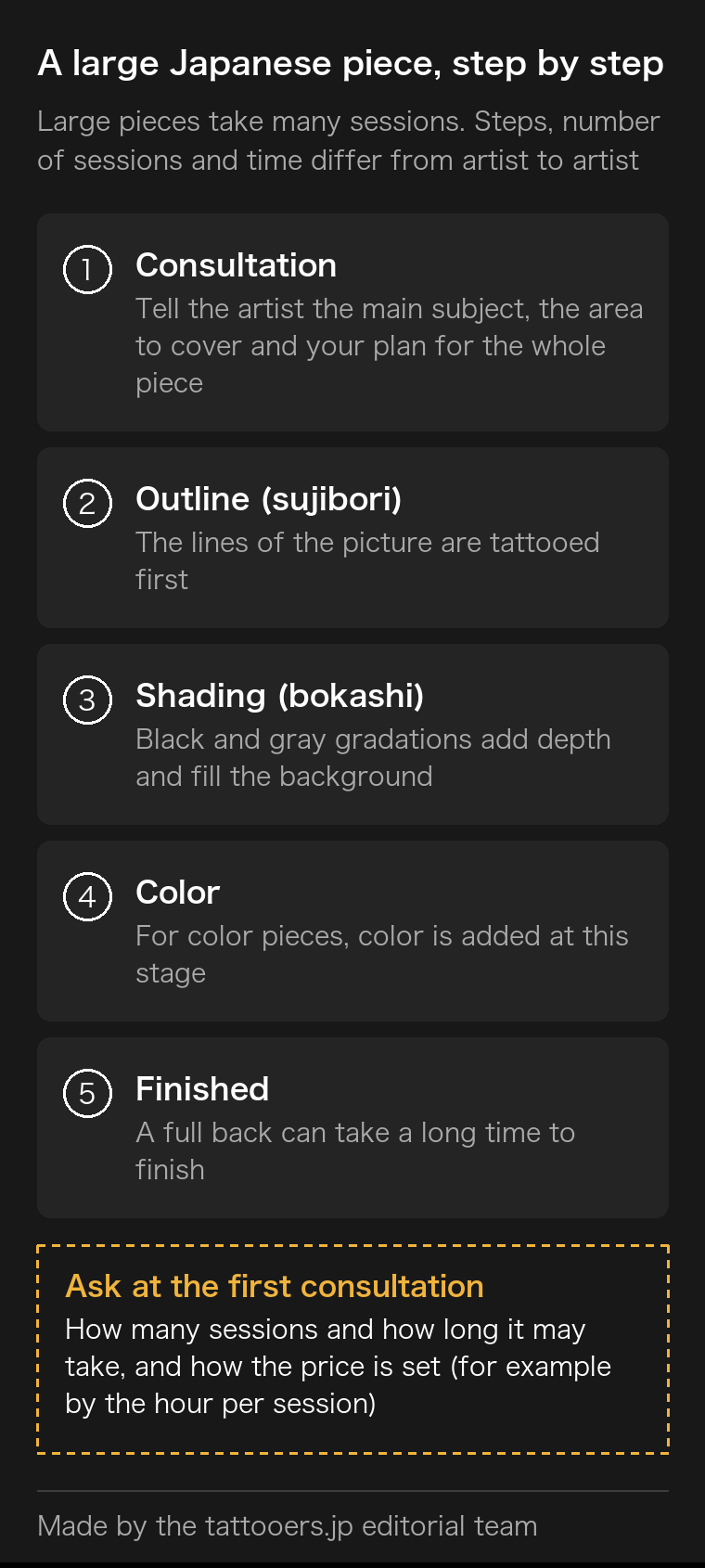
- Sujibori: the outline. Many Japanese pieces are outlined first, then shaded and colored in later sessions. The phoenix and Kannon above are at this stage
- Bokashi: shading, mainly gradations of black and gray. It can also mean fading out the edge of the background
- Nukibori: tattooing only the main subject, with no background
- Gakubori: on the chest and front of the body, leaving untattooed skin in the shape of a picture frame
- Munewari: leaving a vertical strip of bare skin down the middle of the chest, splitting the picture left and right
- Gobu and shichibu: literally "five-tenths" and "seven-tenths", how far a sleeve runs. Gobu is often described as reaching about the elbow, shichibu as running partway down the forearm
- Soshinbori: a body suit, linking the back, chest, arms and legs into one piece
- Tebori: tattooing by hand, pushing needles on a hand-held rod instead of using a machine. Some Japanese traditional artists still work this way
How to Describe Your Japanese Tattoo Idea
Describe the picture, not the meaning: the main subject, where it goes and how big. On tattooers.jp you do not need to contact artists yourself: put these in the inbound request form with your dates, and we match you with an artist who fits. Here is what helps, based on how Japanese traditional work is usually planned.
- Choose the artist before the motif. The same dragon looks very different from artist to artist, in the face, the scales and the way clouds and waves are drawn. Look through work first and find a style you love. Browse Japanese style tattoos to compare
- Give the subject, placement and size. "A koi with waves, outer forearm, about 15 cm" is more useful than "something that means perseverance". Add color or black and gray, and whether you want it to grow into a larger piece later
- Leave room for the artist's composition. In Japanese tattooing it is common to name only the main subject, such as "a dragon" or "lion and peony", and let the artist propose the background and where the piece ends. Many artists prefer to design it with you
- If you want to go big later, say so now. A small piece placed first can be hard to fit into a full back or sleeve afterwards, and it limits where the larger picture can go
- Expect several sessions for large work. Big Japanese pieces are usually done over many sessions: outline, then shading, then color. A full back can take a long time to finish, so it will not be done in one short trip. Ask how many sessions to expect
- Ask how the price is set. Large pieces are often charged by the hour or by the session, so the total may not be fixed at the start
- Do not ask one artist to copy another artist's piece. Classic motifs belong to everyone, but a specific artist's composition does not. Show favorites as references and let your artist draw something for you
- Plan around onsen and pain. Stay out of onsen (hot springs) and other baths until a new tattoo heals, so visit them early in your trip (aftercare while traveling in Japan). See the tattoo-friendly onsen map, how to cover tattoos in Japan and tattoo pain by body part
We message you on Instagram within 48 hours, and the ¥15,000 deposit is fully refunded if we can't match you. You can also browse all artists or artists in Tokyo and Osaka.
Frequently Asked Questions
Q. How do I find out what my Japanese tattoo means?
Find the main subject and the background in the table at the top of this guide. But meanings are not fixed, and they also depend on how the artist built the picture. The surest way is to talk it over with your artist in the group chat once you are matched.
Q. Are there small Japanese designs that suit an arm or leg?
Yes. A single cherry blossom, peony, chrysanthemum or lotus, or a koi or lion on its own, all work at smaller sizes. How small a design can go depends on its detail and on the artist. See works for cherry blossom, peony, chrysanthemum, lotus and koi.
Q. Are there motifs I should think twice about when I travel?
Motifs tied to a religion, such as Buddhist deities, the lotus, mandalas and Sanskrit characters, deserve extra thought, because the people who see them may care. The same motif can be read differently in different countries too. If you are unsure, mention it in the inbound request form and we will take it into account when we match you with an artist.
Q. Are any Japanese tattoo motifs unlucky?
Some people worry about fierce motifs such as hannya, oni and snakes. Yet oni faces were put on ridge-end roof tiles to keep evil away [9], and lions were believed to hold down evil [5]. How you read a motif is up to you, and once you are matched you can talk it over with your artist in the group chat.
Q. Does a half or three-quarter sleeve need a background?
Even a single-arm piece often has waves or clouds around the subject. Artists usually balance the size of the subject and the amount of background to the length and thickness of your arm, so it is worth hearing their proposal first. With too little background, the subject can look like it is floating and the piece may not hold together.
Q. What does the koi swimming up or down mean?
You will hear that it changes the meaning, but there is no clear source for this and artists see it differently. The recorded meaning of the koi comes from the Dragon Gate legend: climbing the waterfall and becoming a dragon [2][3].
Summary
Japanese tattoo meanings are readings from art and folklore, and a piece is read by its main subject together with its background.
- Dragons rise and bring rain, koi climb the Dragon Gate toward success, lions and oni guard against evil, and the hannya shows a woman's rage and jealousy
- The background sets the scene: waves for water, clouds for sky, fire for movement, flowers for the season
- Classic pairings such as cloud dragon, tiger and bamboo, lion and peony, and koi climbing a waterfall have centuries of art behind them
- When you ask an artist, give the subject, placement and size, and let them propose the composition
Planning a Japanese piece in Japan? Get matched with an artist in Japan: tell us your dates and idea, and we message you on Instagram within 48 hours. English is fine, and the ¥15,000 deposit is fully refunded if we can't match you. You can also browse Japanese style tattoos and tattoo artists in Japan on tattooers.jp.
References
Most sources are Japanese dictionaries and museum pages; titles are our translations. Links open external sites.
- Kotobank (Shogakukan Digital Daijisen; Heibonsha World Encyclopedia, revised edition). "Dragon" (Japanese). Accessed October 29, 2026.
- Kotobank (Shogakukan Digital Daijisen, Nipponica; Heibonsha Mypedia). "Toryumon (Dragon Gate)" (Japanese). Accessed October 29, 2026.
- Kotobank (Shogakukan Digital Daijisen, Nihon Kokugo Daijiten). "Koi climbing the waterfall" (Japanese). Accessed October 29, 2026.
- Kotobank (Shogakukan Digital Daijisen). "Phoenix (hoo)" (Japanese). Accessed October 29, 2026.
- Kotobank (Heibonsha World Encyclopedia, revised edition, karajishi entry by Takada Mamoru; Shogakukan Nipponica). "Lion (shishi)" (Japanese). Accessed October 29, 2026.
- Kyoto National Museum (2022). New Year special exhibition: Tigers, celebrating the zodiac animal (January 2 to February 13, 2022, Japanese). Accessed October 29, 2026.
- Kotobank (Shogakukan Digital Daijisen, Nihon Kokugo Daijiten). "Ugajin" (Japanese). Accessed October 29, 2026.
- Kotobank (Shogakukan Digital Daijisen, Nipponica). "Hannya" (Japanese). Accessed October 29, 2026.
- Kotobank (Shogakukan Nihon Kokugo Daijiten). "Onigawara (oni ridge-end roof tile)" (Japanese). Accessed October 29, 2026.
- Kotobank (Shogakukan Nihon Kokugo Daijiten). "Noh mask" (Japanese). Accessed October 29, 2026.
- Ota Memorial Museum of Art (2016). Kuniyoshi Heroes: The Water Margin All Together (September 3 to October 30, 2016, Japanese; archived copy on the Wayback Machine). Accessed November 16, 2026.
- Kotobank (Shogakukan Digital Daijisen, Nihon Kokugo Daijiten). "Fudo Myoo" (Japanese). Accessed October 29, 2026.
- Kotobank (Shogakukan Nihon Kokugo Daijiten). "Kannon" (Japanese). Accessed October 29, 2026.
- JAANUS (Japanese Architecture and Art Net Users System). Fujin Raijin (English). Accessed October 29, 2026.
- Kotobank (Shogakukan Digital Daijisen, Nihon Kokugo Daijiten). "Benzaiten" (Japanese). Accessed October 29, 2026.
- Kotobank (Shogakukan Nihon Kokugo Daijiten). "Cherry blossom" (Japanese). Accessed October 29, 2026.
- Kotobank (Shogakukan Digital Daijisen). "Peony" (Japanese). Accessed October 29, 2026.
- Kotobank (Shogakukan Nihon Kokugo Daijiten). "Chrysanthemum" (Japanese). Accessed October 29, 2026.
- Kotobank (Shogakukan Digital Daijisen). "Autumn leaves (momiji)" (Japanese). Accessed October 29, 2026.
- Kotobank (Shogakukan Digital Daijisen; Heibonsha Jitsu). "Unryu (cloud dragon)" (Japanese). Accessed October 29, 2026.
- Kotobank (Heibonsha World Encyclopedia, revised edition; Shogakukan Nipponica). "Koinobori (carp streamers)" (Japanese). Accessed October 29, 2026.
- Kotobank (Shogakukan Digital Daijisen, Nihon Kokugo Daijiten). "Crane" (Japanese). Accessed October 29, 2026.
- Tokyo Fuji Art Museum. Phoenix folding screens, work commentary (on Japan Search, Japanese). Accessed October 29, 2026.
- Kotobank (Heibonsha World Encyclopedia, revised edition). "Oni" (Japanese). Accessed October 29, 2026.
- Kotobank (Shogakukan Nihon Kokugo Daijiten). "Irezumi (tattoo)" (Japanese). Accessed October 29, 2026.
- Kotobank (Shogakukan Digital Daijisen). "Wind God and Thunder God screens" (Japanese). Accessed October 29, 2026.
- Cultural Heritage Online (Agency for Cultural Affairs). Mirror box with lion and peony in maki-e, commentary (Tokyo National Museum, Japanese). Accessed October 29, 2026.
- Japan Tourism Agency (2019). Kaeru Shrine (Multilingual database of regional tourism resources, English). Accessed November 16, 2026.
Meanings here combine readings recorded in art, crafts and dictionaries with interpretations heard in the tattoo world. They are not fixed meanings, and how motifs and terms are used differs from artist to artist.
