There are four ways to cover a tattoo for a day in Japan: skin-colored cover stickers, concealer or foundation, clothing such as rash guards and arm sleeves, and tape. Which one makes sense depends on where you are going: an onsen, a pool, a gym or the office.
The catch is that the facility decides what counts as covered. Some onsen accept only the stickers they sell at the front desk. Others turn away tattoos even under stickers or tape. Before you go, always check the facility's own rules.
This guide is about hiding a tattoo you already have, not about removing it or tattooing over it. Information is as of November 13, 2026.
Four Ways to Cover, and Where Each One Works
As a rule of thumb: clothing for large designs, stickers for small ones, makeup when you are dressed, and tape at gyms that allow it. Whether you can actually use a method is up to each facility, as the next section shows.
| Method | Works well for | Not suited to | Watch out for |
|---|---|---|---|
| Cover stickers (skin-colored patches) | Onsen and sento that accept your own stickers, pools, small designs | Large designs, places that accept only their own stickers | They peel after long soaks or heavy sweating |
| Concealer and foundation | Work and sightseeing with clothes on, a few hours | Baths, pools, sweaty workouts | Rubs off. Remove it the same day |
| Clothing (rash guards, arm sleeves, supports) | Pools, beaches, gyms, work, large designs | The baths at onsen and sento | Check whether the pool allows rash guards |
| Tape | Gyms that allow it, small designs | Onsen and sento (some refuse it) | Test it on your skin first |
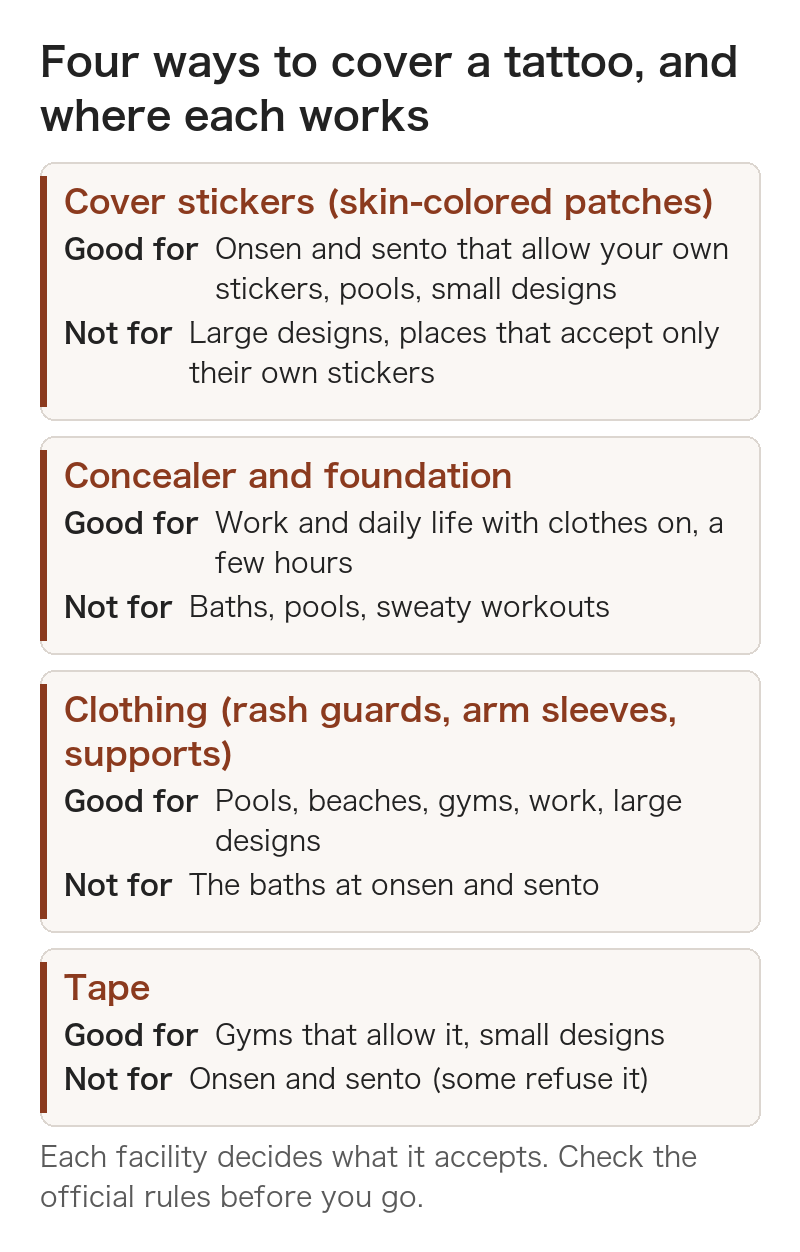
Spray-on foundation works the same way as concealer, so we treat it as part of that group.
None of these should go on a fresh tattoo that has not healed yet. More on that at the end.
Check the Facility's Rules Before You Go
"Tattoos must be covered" does not tell you what you may cover them with. Reading official facility pages, we found that the rules fall into four types.
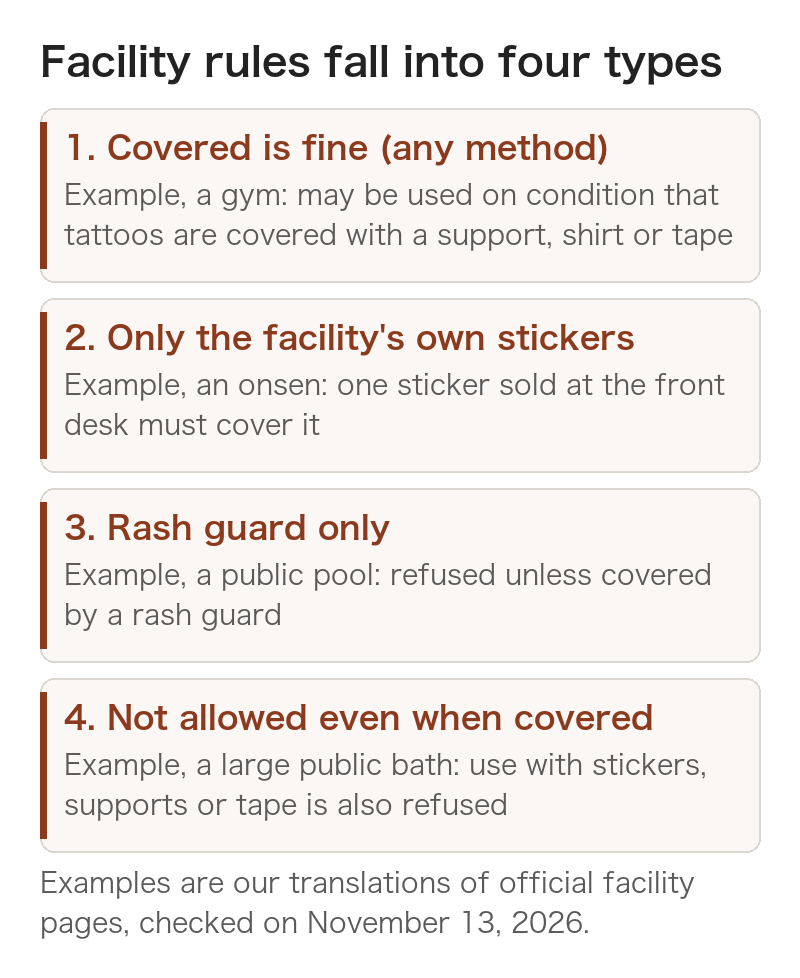
Here is what the official pages say, in our translation.
| Type | What the facility says | Facility |
|---|---|---|
| Covered is fine | Members with tattoos may use the gym on condition that they cover them with supports, shirts, tape and so on | JOYFIT (gym chain) [1] |
| Covered is fine | Members must promise not to expose tattoos (including body paint) | World Plus Gym [2] |
| Own stickers only | A one-point tattoo is accepted only if one of the cover stickers sold at the front desk covers it | Spadium Japon (day spa, Tokyo) [3] |
| Own stickers only | Entry is allowed if up to two of the facility's cover stickers (11 x 20 cm, 310 yen each) cover the tattoo completely | Sayano Yudokoro (onsen, Tokyo) [4] |
| Rash guard only | People with tattoos are refused, except those who wear a rash guard that covers them | Kunitachi City Gymnasium indoor pool (Tokyo) [5] |
| Not allowed even when covered | Use with stickers, supports or tape is also refused | Yudokoro Kasai (large public bath, Tokyo) [7] |
| Not allowed even when covered | Bathing with tape or stickers is refused for hygiene reasons | Keio Takaosan Onsen Gokurakuyu (Tokyo) [8] |
Three things are easy to miss:
- "Our stickers" or "sold at the front desk" means your own stickers may not be enough, even if they cover the tattoo [3][4]
- Size and number limits are common. Look for phrases like "completely covered" or "one spot only"
- Rules can differ inside the same facility. The baths and the swimsuit area of one resort may have different rules, so ask about the specific bath
To see what individual places allow, use our tattoo-friendly onsen, sento and sauna map. Each entry shows the facility's official wording and the date we checked it. If you are staying in Tokyo, start with the Tokyo map, or read our guide to tattoo-friendly onsen, sento and saunas in Tokyo, which compares their sticker rules. Rules change, so look at the official page again shortly before you go.
Choosing Tattoo Cover Stickers
Pick stickers by size, skin tone, how they handle water and sweat, and how they come off. They are thin, skin-colored patches, sometimes sold as foundation tape.
The smaller the design, the easier it is to cover with a sticker. These wrist and ankle pieces are the kind of size that works.
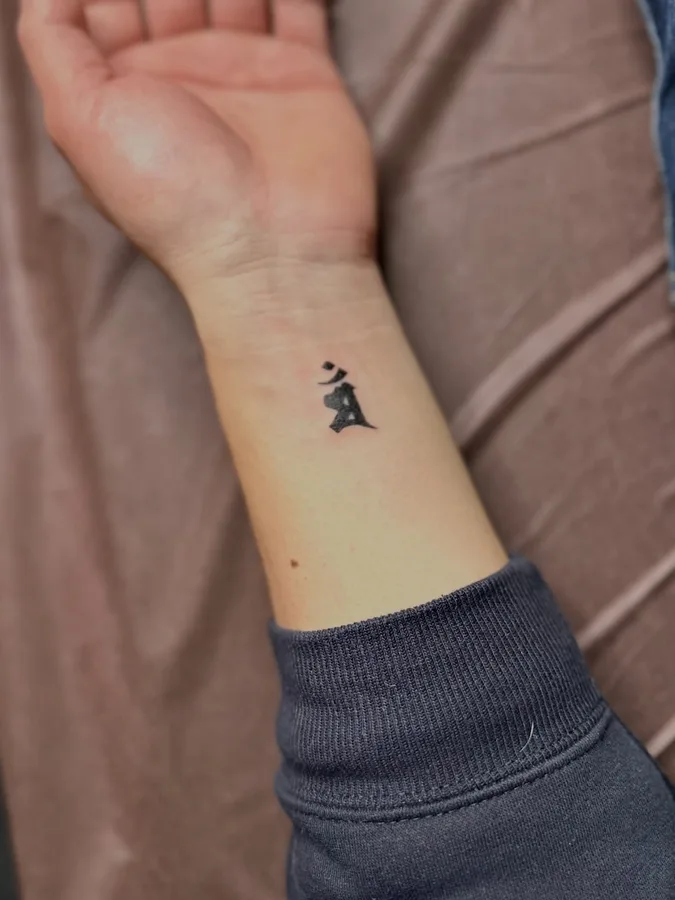
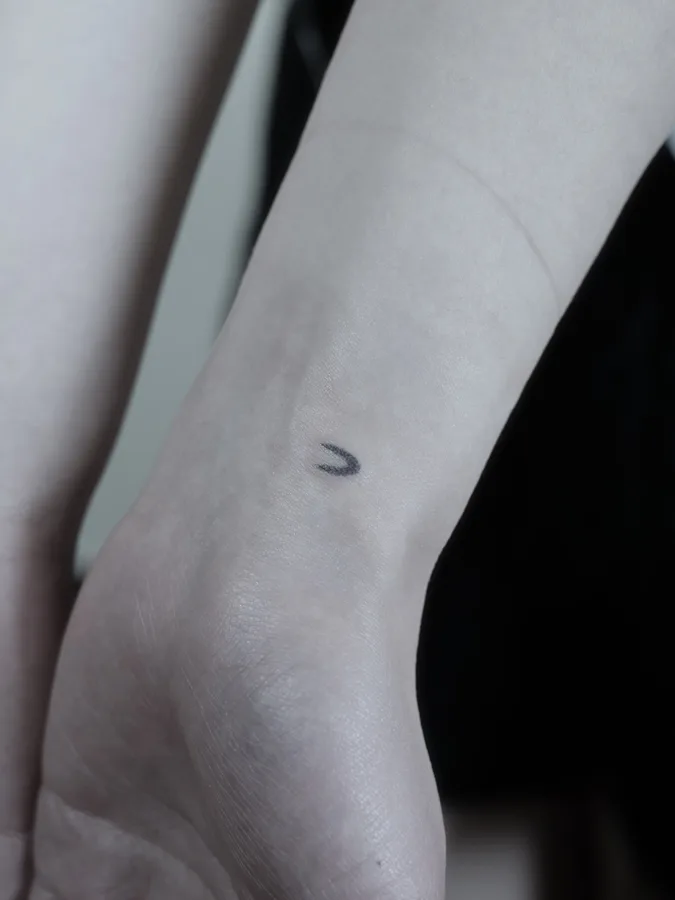
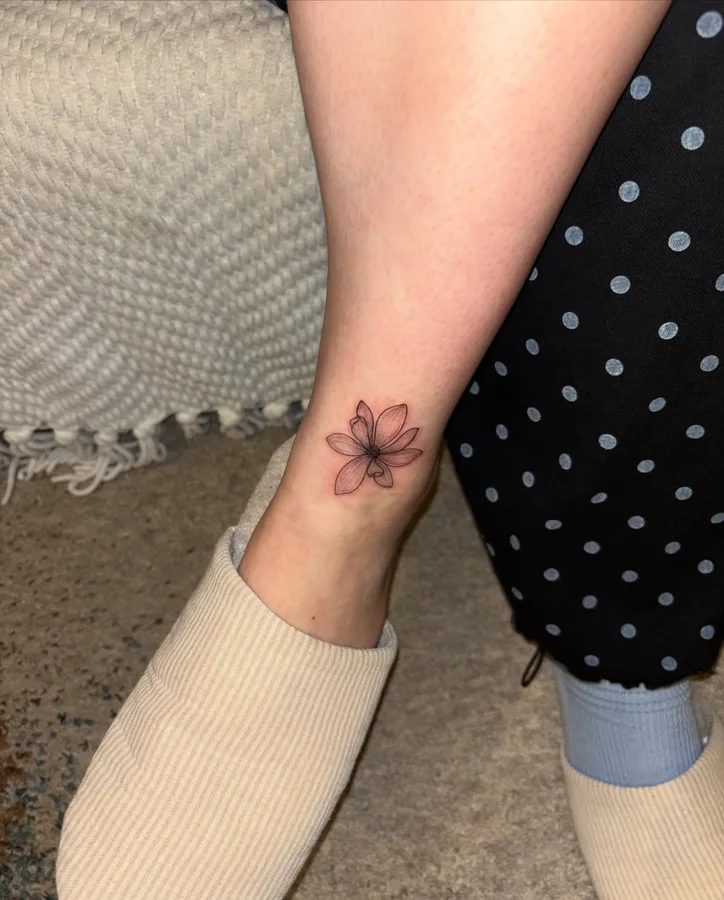
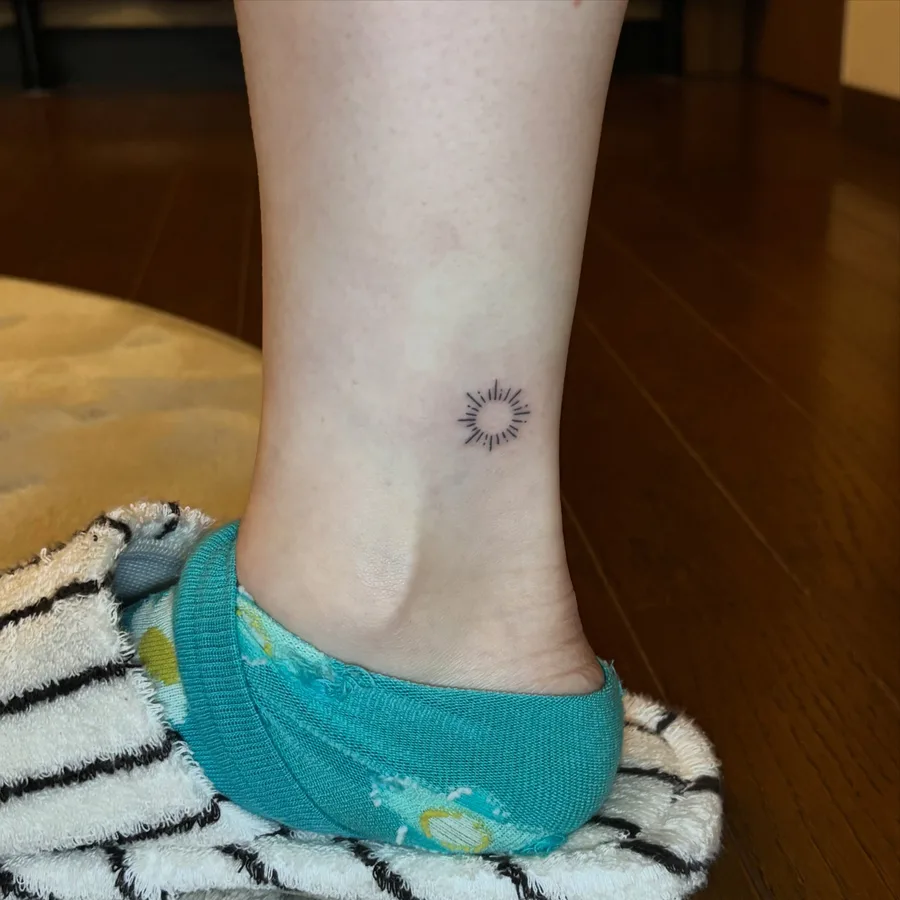
Images are quoted from works by artists listed on tattooers.jp (as of November 13, 2026). Tap an image to open the work.
Artist pages: Horiaki / flat / AM / kana. More small pieces are in one-point tattoos.
Size: a little larger than the design
Measure the longest length and width of the tattoo and choose a sticker a bit bigger. Edges that sit on ink tend to lift first.
Long, thin designs and clusters of small tattoos can fit the area of a sticker but not its shape. If a facility sets a sticker size and number, cut a piece of paper to that size and hold it over the tattoo to see if it fits.
Skin tone: layer over dark ink
Choose a shade close to your skin where the sticker will go. The inside and outside of the arm are often different.
Solid black areas and bold lines can show through a single layer. One seller's guide suggests using two layers for dark designs [10].
Water and sweat: bring spares
Even water-resistant stickers peel more easily after long soaks or heavy sweating. One seller notes that skin softens after a few hours in water and the sticker lifts with it, and recommends carrying spares [10]. If a sticker comes off in an onsen, get out of the bath and replace it. If the facility requires its own stickers, ask whether you can buy more at the desk.
Removing them: slowly, holding the skin
Hold the skin down with your fingers and peel slowly. Pulling only on the sticker lifts the skin and can hurt [9]. Some stickers are meant to be taken off with a remover, so read the instructions [10].
Concealer and Foundation: For When You Are Dressed
Concealer and foundation work best for the office, dinners and sightseeing, when you have clothes on. They suit small tattoos on the wrist or neck that clothing does not reach.
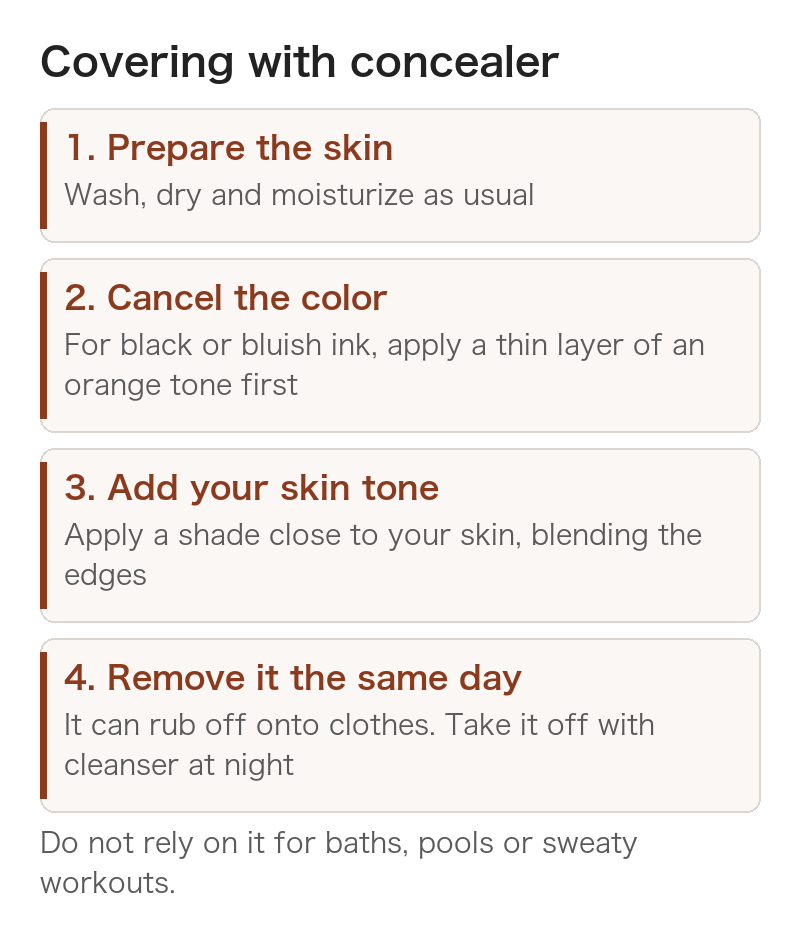
A single skin-tone layer often leaves dark ink looking gray. Cancelling the color first helps; one cosmetics maker suggests an orange tone for strong bluish or dark areas [11]. Even products sold as water- and sweat-resistant rub off with friction, and cuffs and collars can pick up color.
Skip makeup for baths and pools. Water and rubbing take it off, so it stops doing its job. For onsen and pools, use stickers or clothing instead.
Rash Guards, Arm Sleeves and Supports
For large designs, clothing is the most reliable option. A full sleeve is usually too big for the sticker size and number a facility allows.
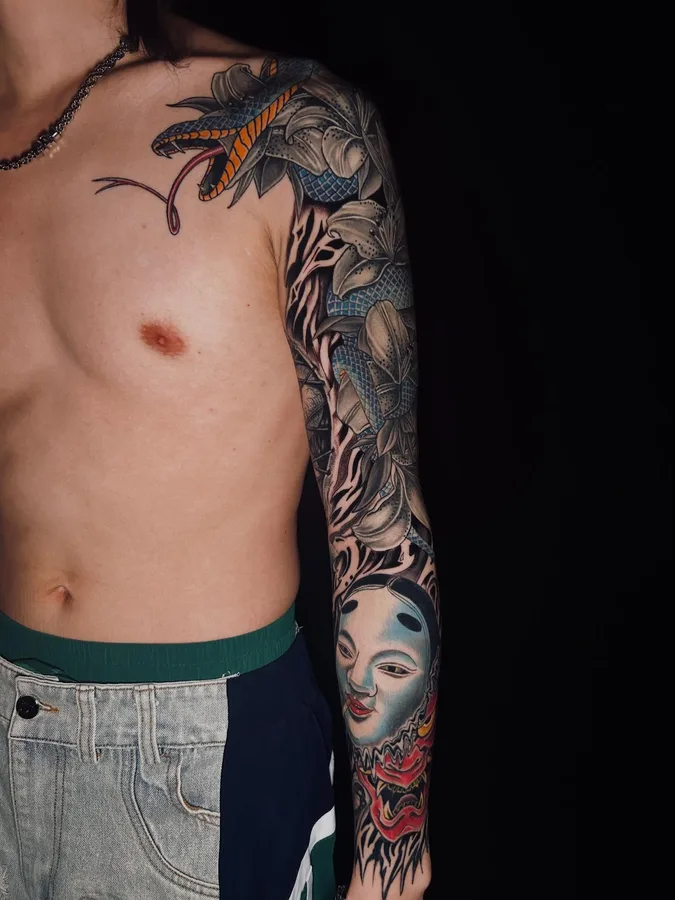 Japanese full sleeve | 彫武 Horitake
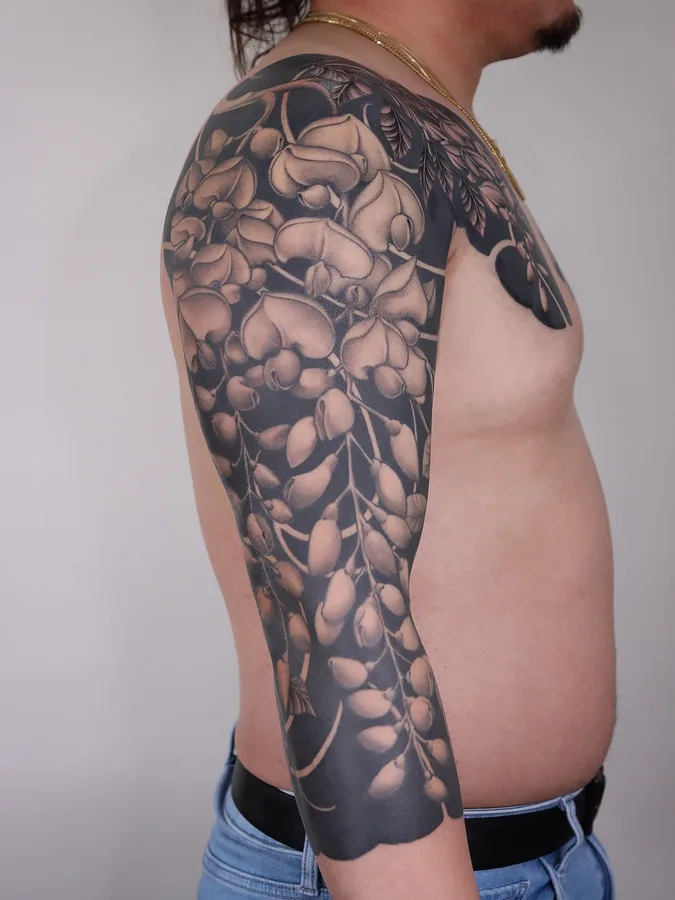 Wisteria three-quarter sleeve | せいご seigo
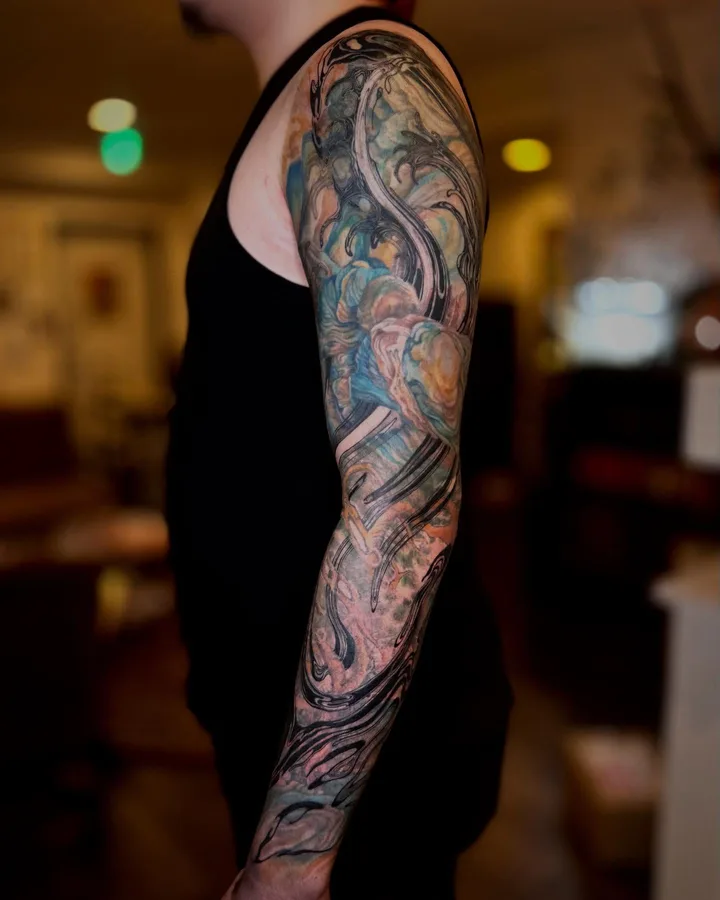 Painting full sleeve | セム THEM
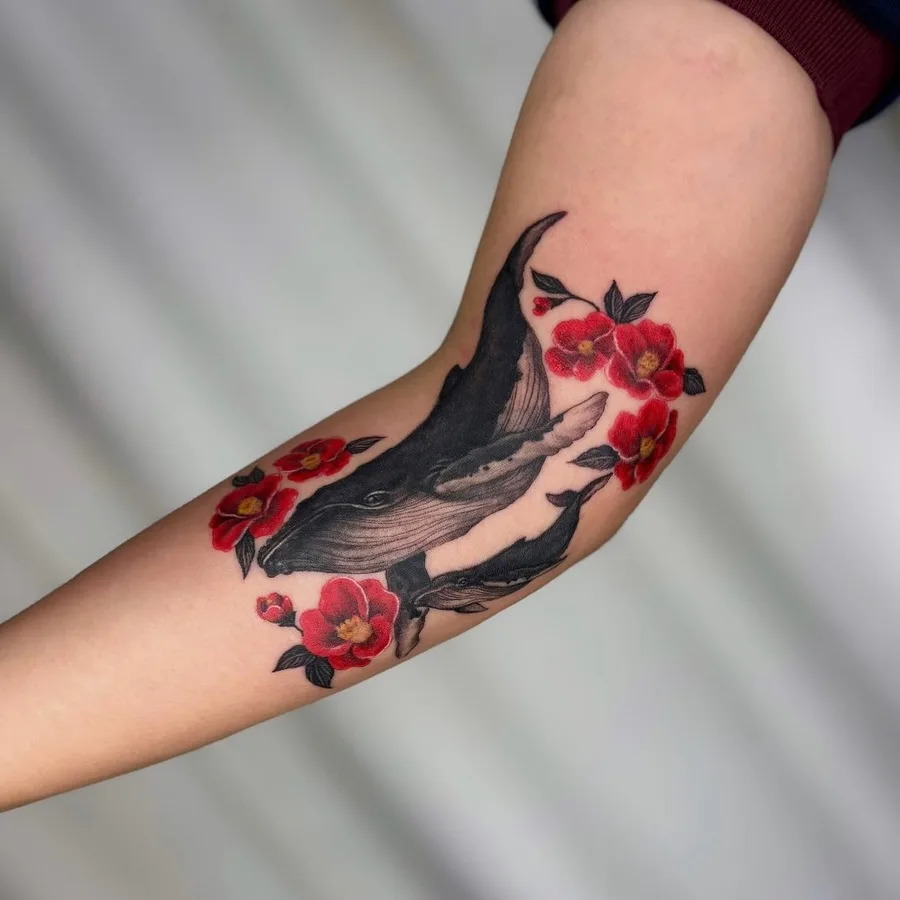 Whale and camellia | 緑 Midori
Images are quoted from works by artists listed on tattooers.jp (as of November 13, 2026). Tap an image to open the work.
Artist pages: Horitake / seigo / THEM / Midori. See more in arm tattoos.
- Rash guard: a fitted swim top. Long sleeves cover the arms, and leggings cover the legs. Some public pools in Tokyo require one for people with tattoos and lend them out for free [6]
- Arm sleeves: tubes of fabric that cover just the arm. Handy at work in summer or for workouts
- Supports: stretchy bands for the wrist, elbow, knee or ankle. They can hide a small design
- A thin long-sleeve base layer: often all you need at work
None of these can be worn into the baths at an onsen or sento. If you want to bathe, look for a place that accepts stickers, or book a private bath. How to ask about private baths is covered in our Japanese guide to tattoos and onsen (in Japanese).
Tape: Only Where It Is Allowed
Tape is cheap and easy, but where you can use it is limited. Some gyms list it as an accepted way to cover tattoos [1]. Some onsen and public baths refuse it even when the tattoo is fully covered [7][8].
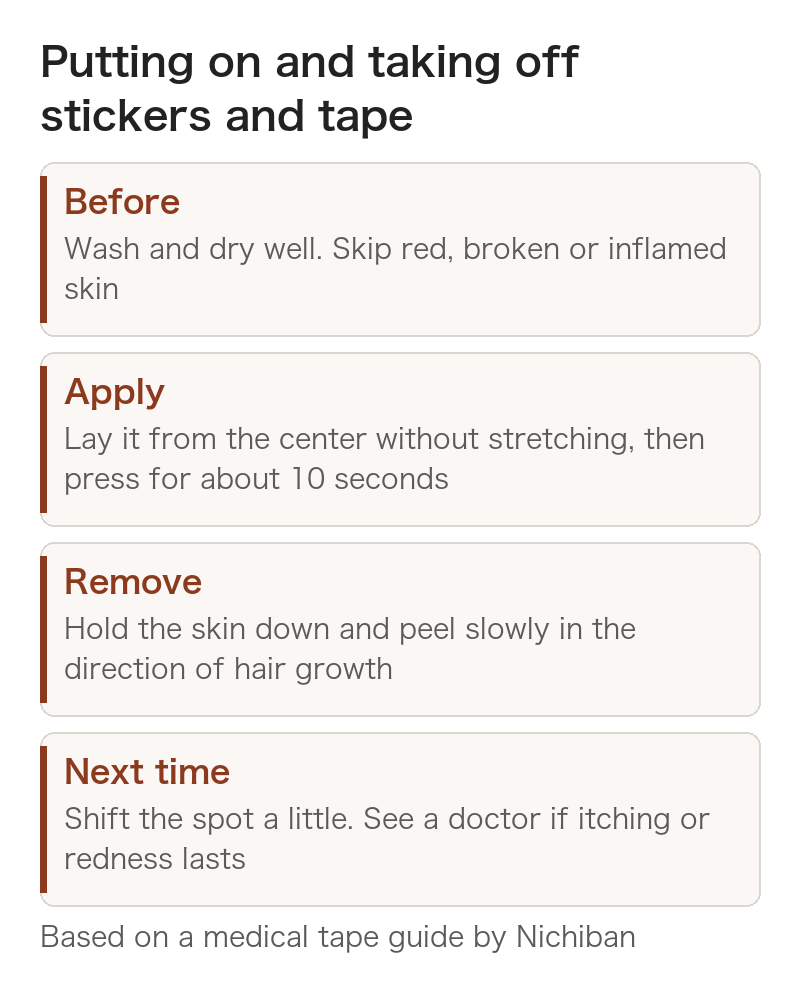
The same tips used for medical tape keep your skin happy [9]:
- Wash and dry the skin first. Tape does not stick well to damp skin
- Lay it from the center without stretching, then press for about 10 seconds. Stretched tape can irritate the skin
- Peel slowly in the direction of hair growth while holding the skin down
- If you tape often, move the spot a little each time
- Try a new tape on a small patch, such as the inner upper arm, first
Skin-tone tape still shows a little through its color and sheen. It is fine when the aim is "not visible," less so when you do not want anyone to notice.
What to Check First, by Place
Each place has a different question to ask first.
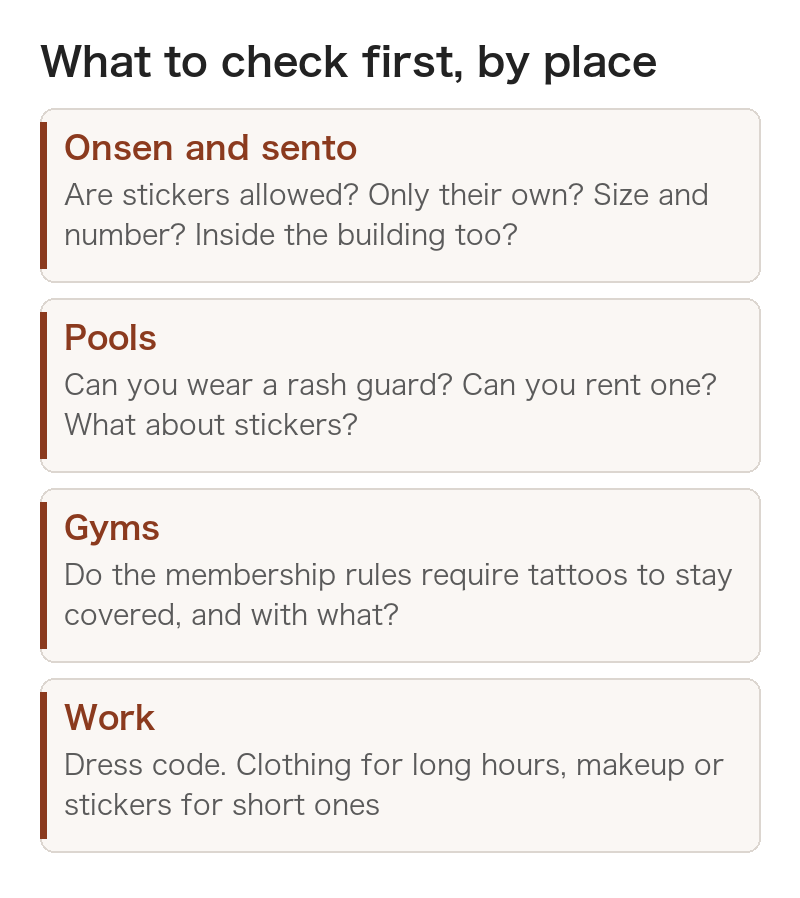
Onsen and sento
The strictest setting. Find out whether stickers are allowed, whether they must be the facility's own, the size and number limits, and whether they must stay on outside the bath too. Where stickers are not enough, look for an inn with a private bath or an in-room bath. Our tattoo-friendly map lists the official rules facility by facility.
In 2016, Japan's tourism agency asked bathing facilities to consider ways to welcome foreign visitors with tattoos, giving covering with stickers as one example [12]. It was a request, not a rule, and each facility still decides for itself.
Pools
Some pools accept a rash guard, and stickers are handled differently from place to place. Even among public pools, one refuses tattoos unless they are under a rash guard [5], while another lends rash guards for free [6]. Check the pool's guide before deciding what to pack.
Gyms
Gyms follow their membership rules. Some make "no visible tattoos" a condition of membership [2]; others accept supports, shirts or tape [1]. If the gym has showers or a bath, check how those areas handle tattoos too.
Work
Check the dress code first. Clothing suits long days; concealer or stickers suit a few hours.
Fresh Tattoos and Skin Reactions
Do not put stickers, tape or concealer on a tattoo that has not healed. Medical tape guidance says not to apply tape to red, broken or inflamed skin [9]. Until it heals, cover it with loose clothing that does not rub. Ask your artist when it is safe to start, and see our aftercare guide (in Japanese).
Getting tattooed in Japan during your trip? Plan your onsen days before the session, not after. Tell us your dates and idea, and we match you with an artist within 48 hours. If itching or redness from a sticker or tape does not go away, stop using it and see a doctor [9].
Frequently Asked Questions
Q. Can I get into any onsen if I use a cover sticker?
No. Some onsen accept only the stickers they sell [3][4], and some refuse tattoos even under stickers [7][8]. Check the official rules before you go.
Q. Can I use a regular adhesive bandage?
It may hide a very small tattoo, but whether it is accepted is up to the facility. Some onsen and public baths refuse anything stuck on the skin, the same as tape and stickers [7][8].
Q. Does covering my tattoo mean I will not be turned away?
If you follow the facility's rules, you are much less likely to be. The tourism agency has suggested covering with stickers as one option for foreign visitors [12], but each facility makes its own decision.
Q. How do I find onsen that accept tattoos?
Start with our tattoo-friendly onsen, sento and sauna map, which shows each facility's official wording and the date we checked it.
Summary
There are four ways to cover a tattoo: stickers, concealer or foundation, clothing, and tape.
- Clothing for large designs, stickers for small ones, makeup when you are dressed, tape at gyms that allow it
- The facility decides what is accepted. Some take only their own stickers; some refuse covered tattoos
- Choose stickers by size, skin tone, water and sweat resistance, and how they come off
- Never cover a fresh tattoo. See a doctor if a rash does not go away
Planning a tattoo in Japan, and want it to fit under a sticker? Tell your artist when you book. For typical prices by size, see how much a tattoo costs in Japan. Get matched with an artist in Japan: tell us your dates and idea, and we reply within 48 hours in English. The ¥15,000 deposit is refunded in full if we can't match you. You can also browse tattoo artists in Japan on tattooers.jp. For how much each spot hurts and how easy it is to hide, see tattoo pain by body part.
References
Facility rules are as shown on each official page on the date checked. Product details are the sellers' own descriptions; we did not test them.
- JOYFIT. FAQ: tattoos (Japanese). Accessed November 13, 2026.
- World Plus Gym. Membership rules (PDF, Japanese). Accessed November 13, 2026.
- Spadium Japon. FAQ (Japanese). Accessed November 13, 2026.
- Maenohara Onsen Sayano Yudokoro. FAQ (Japanese). Accessed November 13, 2026.
- Kunitachi City Gymnasium. Indoor pool guide (PDF, Japanese). Accessed November 13, 2026.
- Meguro City. Southern district pool public opening (Japanese). Accessed November 13, 2026.
- Yudokoro Kasai. FAQ (Japanese). Accessed November 13, 2026.
- Keio Takaosan Onsen Gokurakuyu. FAQ (Japanese). Accessed November 13, 2026.
- Nichiban. Guide to using medical tape (Japanese). Accessed November 13, 2026.
- ALAE. Tattoo cover Q&A (Japanese). Seller's description. Accessed November 13, 2026.
- Shiseido Life Quality Makeup. Perfect Cover Foundation MC n (Japanese). Seller's description. Accessed November 13, 2026.
- Ministry of Health, Labour and Welfare, notice of March 18, 2016, attaching the Japan Tourism Agency notice of March 16, 2016. Responding to foreign travelers with tattoos at bathing facilities (PDF, Japanese). Accessed November 13, 2026.
