Irezumi (入れ墨) is the Japanese word for a tattoo: ink put into the skin. In Japanese dictionaries, irezumi and tattoo mean the same thing, and dictionaries list "tattoo" as a synonym [1]. Outside Japan, though, "irezumi" usually means one style: traditional Japanese tattooing, with dragons, koi, waves and large back pieces. In Japan, that style is called wabori (和彫り).
So the difference between irezumi and tattoo is not in the ink or the needle. It is in history, in who uses the word, and in the image it carries. One common claim, that irezumi goes deeper into the skin than a tattoo, has no support in any dictionary, court ruling or official notice we checked.
This guide covers what the words mean, how tattooing went from punishment to art to a ban, how hand-carving (tebori) differs from machine work, and where the law stands today, including the 2020 Supreme Court decision. Information is as of November 16, 2026.
To see the style itself, browse Japanese traditional tattoos by artists in Japan.
Irezumi Meaning: What the Japanese Words Say
Japanese has several words for a tattoo, and they all point to the same thing. What changes is the era and the feeling.
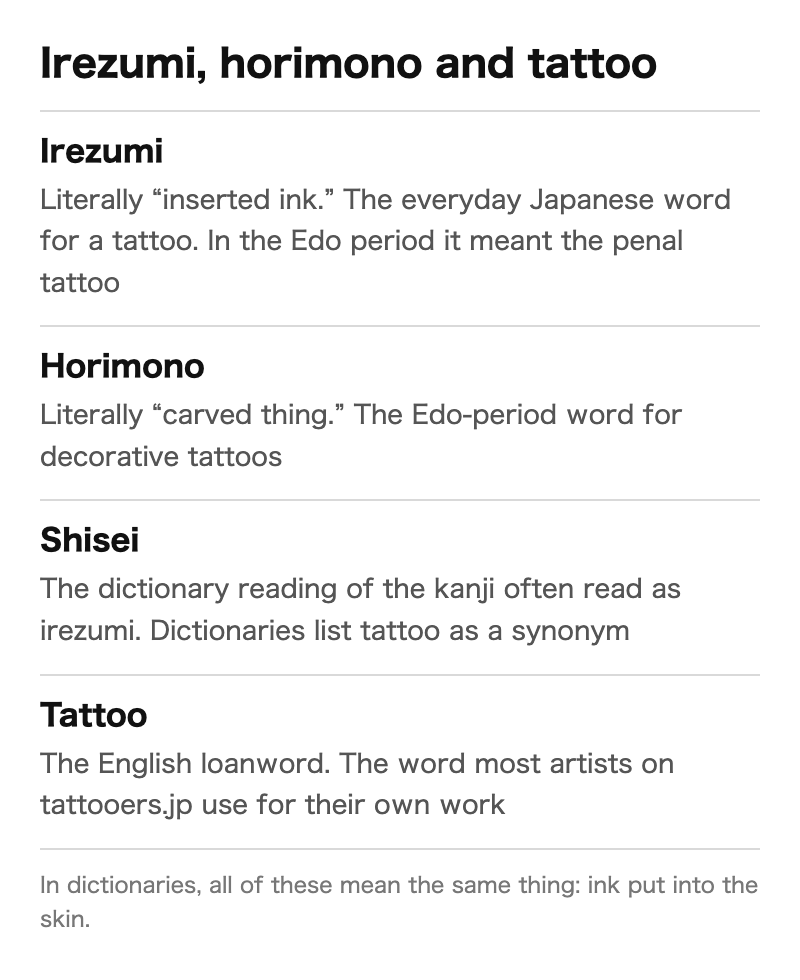
| Word | Literal sense | How it is used |
|---|---|---|
| Irezumi (入れ墨, 入墨) | "Inserted ink" | The general word for a tattoo. In the Edo period (1603 to 1868), it meant a tattoo given as punishment [2] |
| Horimono (彫物) | "Carved thing" | The Edo-period word for decorative tattoos, as opposed to penal ones [2] |
| Shisei (刺青) | Written form | A written word, often read aloud as irezumi. The dictionary lists it as meaning irezumi or horimono, with tattoo as a synonym [1] |
| Tattoo (タトゥー) | English loanword | The word most artists on tattooers.jp use for their own work (see the data below) |
Two points matter for English readers:
- "Irezumi" in English usually means the traditional Japanese style. Japanese speakers use the word for any tattoo, and some use it for the traditional style in particular. The style name is wabori
- "Horimono" is the older, more artistic word. It is the word for the decorative tattoos of the Edo period. You will still see it in the names of some studios and in writing about the tradition
The writer Tanizaki Jun'ichirō used the kanji 刺青 for the title of his 1910 short story, usually translated as "The Tattooer." The title is read "shisei," and in the text he glosses the word as "horimono" [5].
Irezumi vs Tattoo: Is There a Real Difference?
Not in the dictionary. But people in and around the tattoo world often draw a line. Here is what can be checked and what is only said.
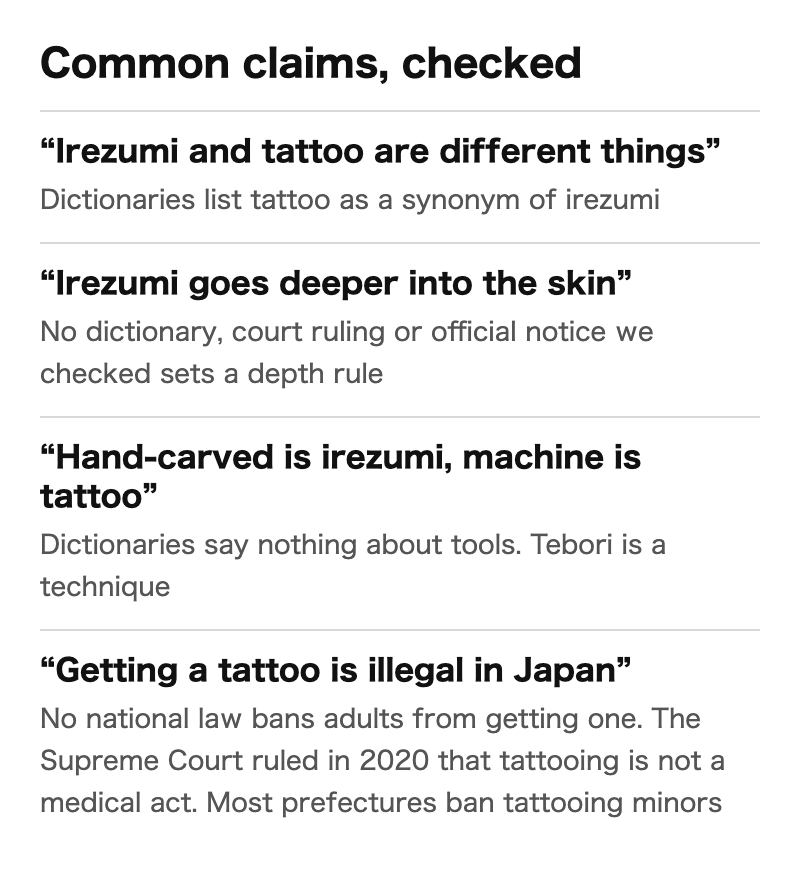
| Point | What sources confirm | What people often say |
|---|---|---|
| Meaning | Shisei means irezumi or horimono; tattoo is a synonym [1] | Irezumi is Japanese style, a tattoo is Western style |
| Needle depth | No dictionary, ruling or notice we checked separates them by depth | Irezumi goes deeper, tattoos are shallower |
| Tools | Dictionary definitions say nothing about tools or technique [1] | Hand-carved means irezumi, machine means tattoo |
| Law | Youth ordinances do not define "irezumi," but official guidance (e.g. Kanagawa's) says it includes tattoos [9][11]. The 2020 Supreme Court decision dealt with "tattoo" work [7] | Irezumi is linked to crime, tattoos are fashion |
The idea that the difference lies in needle depth still appears in many articles, but we found no source that sets a depth rule. How a piece turns out depends on the design, the artist's skill and the tools they use.
In practice, the line people draw is about style. Large, traditional Japanese designs tend to be called irezumi, and smaller or Western-style pieces tend to be called tattoos. Even that is a habit of speech, not a rule.
Tebori vs Machine: How Irezumi Is Done
Tebori (手彫り, "hand-carving") is the traditional Japanese way of tattooing by hand. It is a technique, not a different kind of tattoo. A wabori piece can be done by hand or by machine.
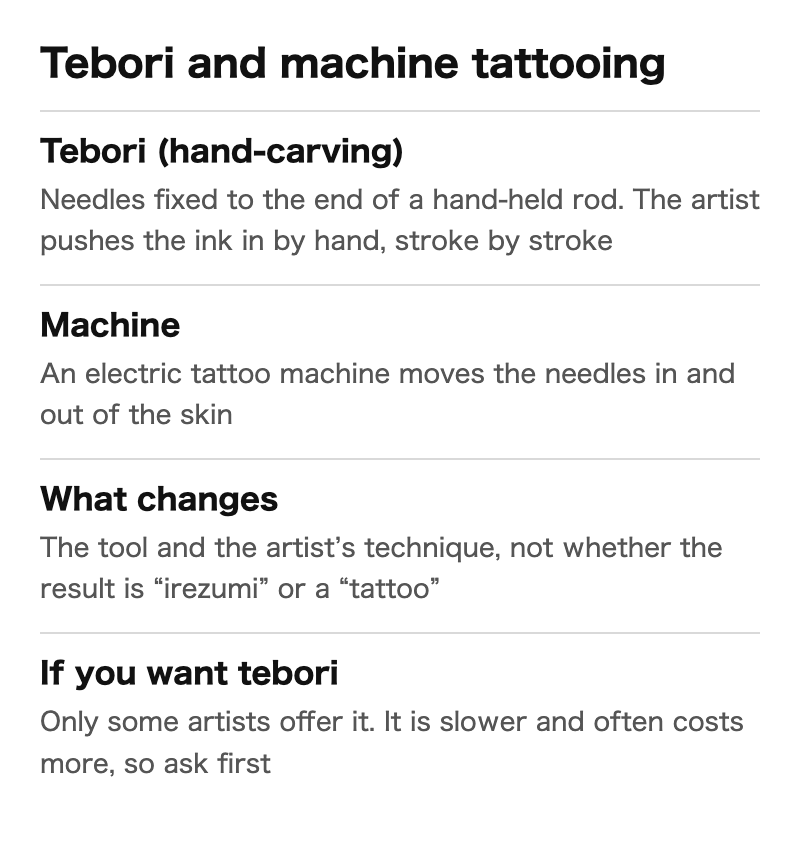
| Tebori | Machine | |
|---|---|---|
| Tool | A group of needles fixed to the end of a hand-held rod | An electric tattoo machine |
| How the ink goes in | The artist pushes it in by hand, stroke by stroke | The machine moves the needles in and out |
| Who offers it | Only some artists | Almost every studio |
| Time and cost | Usually slower, often more expensive | Usually faster |
Some tebori artists say hand work hurts less or heals faster than machine work. These are artists' own accounts, and we have not checked them. If it matters to you, tell us in the form and we will ask the artist.
If you want tebori, say so up front: only some artists offer it. Browse tebori artists in Japan to see their work, then mention "tebori" in the visitor booking form and we will match you with one of them.
A Short History of Irezumi and the Law
Tattoos in Japan have been a punishment, a decoration, a banned practice and an art form, depending on the era.
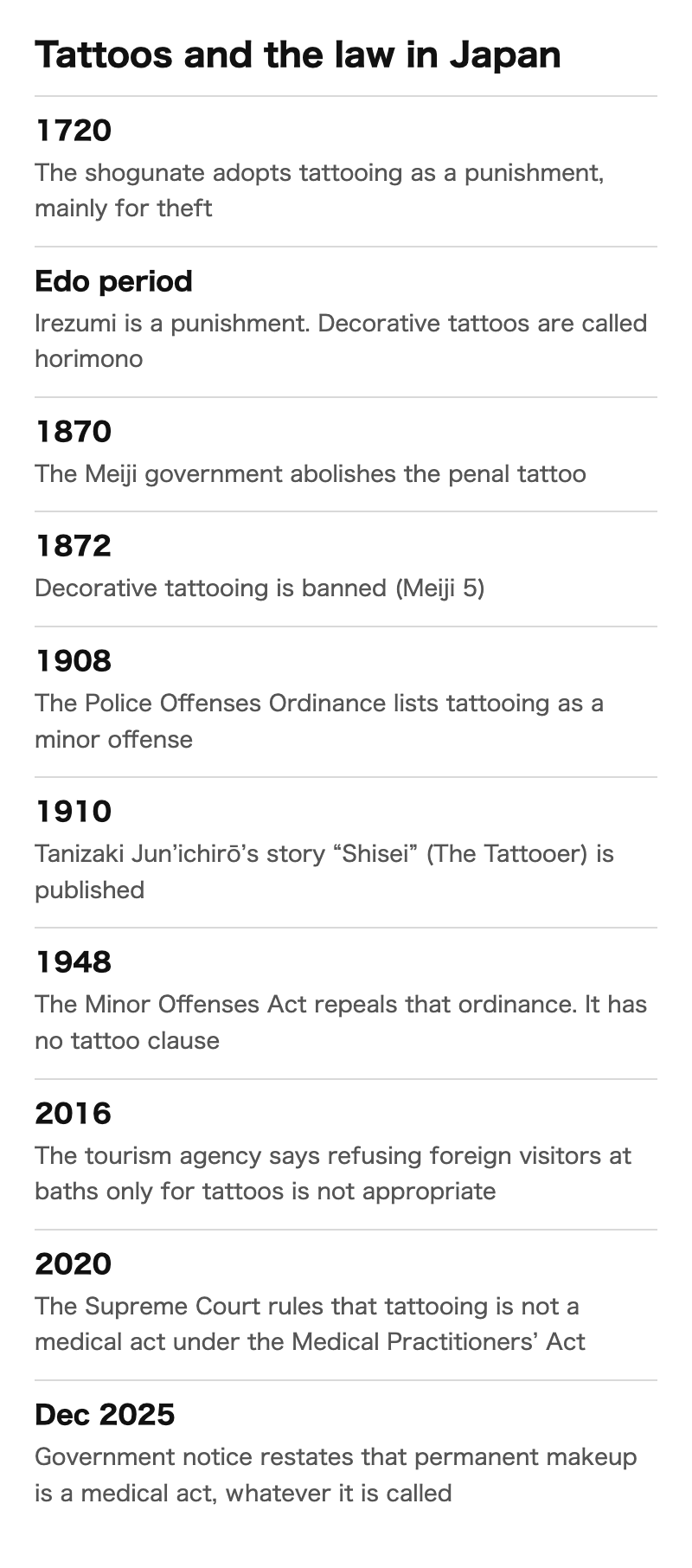
| Year | What happened | Source |
|---|---|---|
| 1720 | The shogun Tokugawa Yoshimune adopts tattooing as a punishment, mainly for theft | [2][3] |
| Edo period | "Irezumi" means the penal tattoo. Decorative tattoos are called "horimono" | [2] |
| 1870 | The Meiji government abolishes the penal tattoo | [2] |
| 1872 | Decorative tattooing is banned. In Tokyo, an 1872 ordinance on minor offenses covered it (secondary source) | [2][4] |
| 1910 | Tanizaki's story "Shisei" (The Tattooer) is published | [5] |
| 1908 | The Police Offenses Ordinance lists tattooing oneself or others as a minor offense | [12][13] |
| 1948 | The Minor Offenses Act repeals the Police Offenses Ordinance. It has no clause on tattoos | [6][12] |
| 2016 | The Japan Tourism Agency says refusing foreign visitors at baths only because of tattoos is not appropriate | [10] |
| 2020 | The Supreme Court decides that tattooing is not a medical act under the Medical Practitioners' Act | [7] |
| December 2025 | The health and trade ministries restate that permanent makeup is a medical act, whatever it is called | [8] |
Edo: punishment and decoration
According to a standard Japanese encyclopedia, in the Edo period "irezumi" meant a tattoo given as a criminal punishment, while decorative tattoos were called "horimono" [2]. The same encyclopedia says the shogun Tokugawa Yoshimune adopted the penal tattoo in 1720, in place of cutting off ears or noses, and that it became one of the most common punishments for theft [2][3].
Some say that this split, punishment on one side and art on the other, is why tattoos in Japan still carry two very different images. We did not find a source that makes that argument directly, so take it as a reading rather than a fact. For the meanings of the classic horimono motifs, see our Japanese tattoo meanings guide.
Meiji: the ban
The new Meiji government abolished the penal tattoo in 1870. Decorative tattoos were then banned, and one encyclopedia gives the year as 1872 [2]. A researcher's site points to Article 11 of Tokyo's 1872 ordinance on minor offenses as the rule that covered tattooing (a secondary source; we did not check the original text) [4]. Separate bans targeted the tattoos of Ainu women in Hokkaido (1871) and hajichi in Amami and Okinawa (1899); see Ainu tattoo and hajichi.
The ban continued through the 1908 Police Offenses Ordinance, which the 1948 Minor Offenses Act repealed. The 1908 ordinance listed "tattooing one's own or another person's body" as a minor offense [13]. The 1948 act repealed the ordinance in its supplementary provisions and has no clause about tattoos [6]. In the Diet debate on the bill, a speaker noted that the old tattoo clause was being dropped [12].
Is Tattooing Legal in Japan? The 2020 Supreme Court Decision
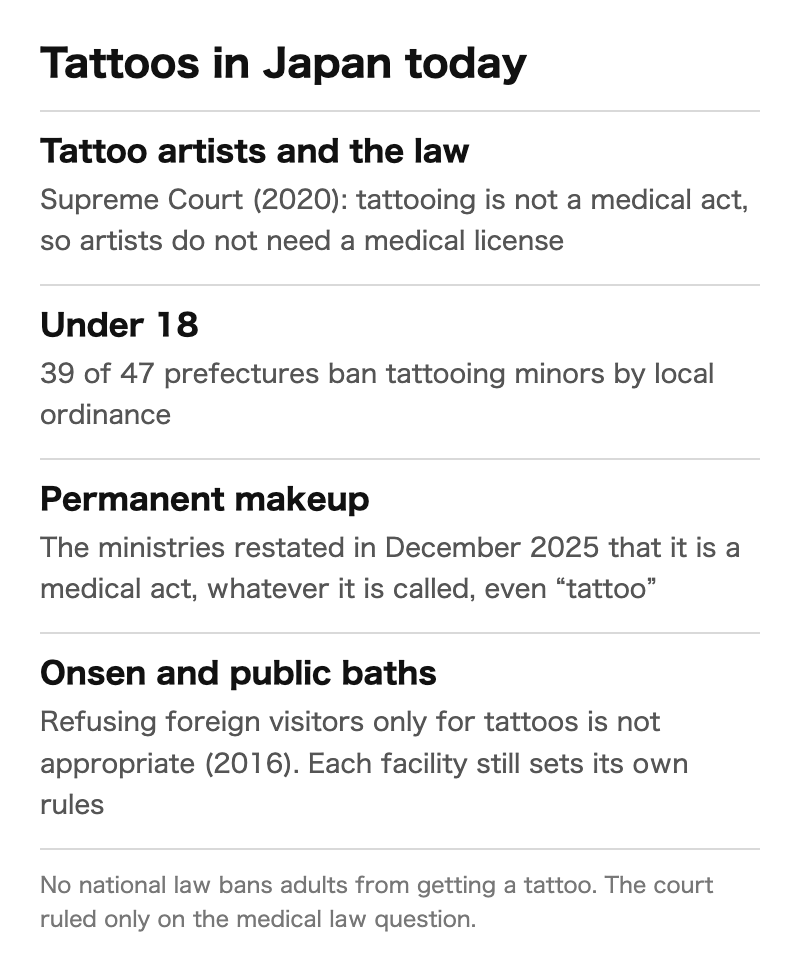
No national law in Japan bans adults from getting a tattoo. The old tattoo clause disappeared in 1948 [6][12], and in 2020 the Supreme Court ruled that a tattoo artist does not need a medical license [7]. The one national law we found that mentions tattoos is narrow: Article 24 of the Anti-Organized Crime Act bars designated gang members from tattooing minors or pressuring them into getting tattoos [14].
What the case was about
The case started when a tattoo artist in Osaka was charged under Article 17 of the Medical Practitioners' Act, which says only doctors may practice medicine. The question was whether tattooing counts as a medical act.
| Court | Decision |
|---|---|
| Osaka District Court (first instance) | Found that tattooing is a medical act and fined the artist 150,000 yen |
| Osaka High Court (November 14, 2018) | Overturned that ruling and acquitted the artist: tattooing is not a medical act |
| Supreme Court, Second Petty Bench (September 16, 2020) | Dismissed the prosecutors' appeal, so the acquittal stands |
Source: the Supreme Court's decision and its full text [7].
What the court said
The court said that whether something is a "medical act" depends not only on what is done, but also on its purpose, the relationship between the people involved, the specific circumstances and actual practice, and how society sees it [7]. On tattooing, it found that:
- Tattooing has long been seen as a social custom with decorative, symbolic or artistic meaning, not as medical care
- It needs knowledge and skills in art and design that are different from medicine, and doctors are not trained in them
- Historically, tattooing in Japan has been done by tattoo artists without a medical license for a long time
Under these circumstances, the court held that the defendant's tattooing, done as a tattoo artist at clients' request, was not a medical act, so Article 17 did not apply [7].
In a supplementary opinion, Justice Kusano Kōichi added that if the health risks of tattooing call for rules, they should come from new legislation [7].
What the decision does not say
It is easy to read too much into the ruling.
- It answered one question: whether the medical law applies to tattoo artists. It did not create a license or set hygiene rules for tattoo studios
- It is not a blanket approval. The court said tattooing carries health risks that must be handled by means other than a medical license, and Justice Kusano added that, depending on how it is done, tattooing can still amount to bodily injury under the Penal Code [7]
- Minors are a separate matter. 39 of Japan's 47 prefectures ban tattooing anyone under 18 under local youth ordinances, with penalties [9]
- Permanent makeup is treated differently. In a December 2025 notice, the health and trade ministries restated their view that permanent makeup (eyebrows, eyeliner, lips and similar) is a medical act, whatever it is called, such as a "tattoo" [8]
- It did not change how gyms, pools or onsen treat tattoos. Each facility still sets its own rules
Tattoos at Onsen and Sento
Whether you can bathe with a tattoo is up to each facility. Each onsen and sento sets its own rules.
In March 2016, the Japan Tourism Agency told bathing and lodging associations that refusing foreign visitors only because they have tattoos is not appropriate. It said tattoos pose no hygiene problem and gave examples such as covering them with stickers. The health ministry passed the notice on to local governments [10]. It was a request, not a rule.
In practice, policies vary widely. Some places welcome tattoos, some accept them under a cover sticker, some accept only their own stickers, and some refuse them even when covered. A few places even treat the two words differently: they refuse "irezumi" but accept small "fashion tattoos," and the facility decides which yours is. Our Tokyo onsen guide has an example.
- To see each facility's official rules, use our tattoo-friendly onsen, sento and sauna map
- Staying in Tokyo? Read our guide to tattoo-friendly onsen, sento and saunas in Tokyo
- For stickers, rash guards and other options, see how to cover tattoos in Japan
If you are getting tattooed during your trip, plan your onsen days before the session. A fresh tattoo should not go into a bath until it has healed, so ask your artist when it is safe. Our guide to tattoo aftercare while traveling in Japan covers the first weeks day by day.
What 7,626 Works on tattooers.jp Show
We looked at the 7,626 works listed on tattooers.jp as of November 12, 2026. We compared works tagged "Japanese" (1,587) with works tagged neither Japanese nor neo-Japanese (5,927).
The back is the one clear difference
Among works with a body part set, 15.1% of Japanese-style works were on the back, compared with 6.1% of other styles, about 2.5 times as many. The arm was the most common spot for both (51.0% and 56.4%), and the leg, chest and shoulder were close to even.
That does not prove that irezumi is always a large piece. Full back pieces take many sessions, so they appear less often as finished posts, and our data records the body part but not the size.
Japanese-style work on the back and arm:
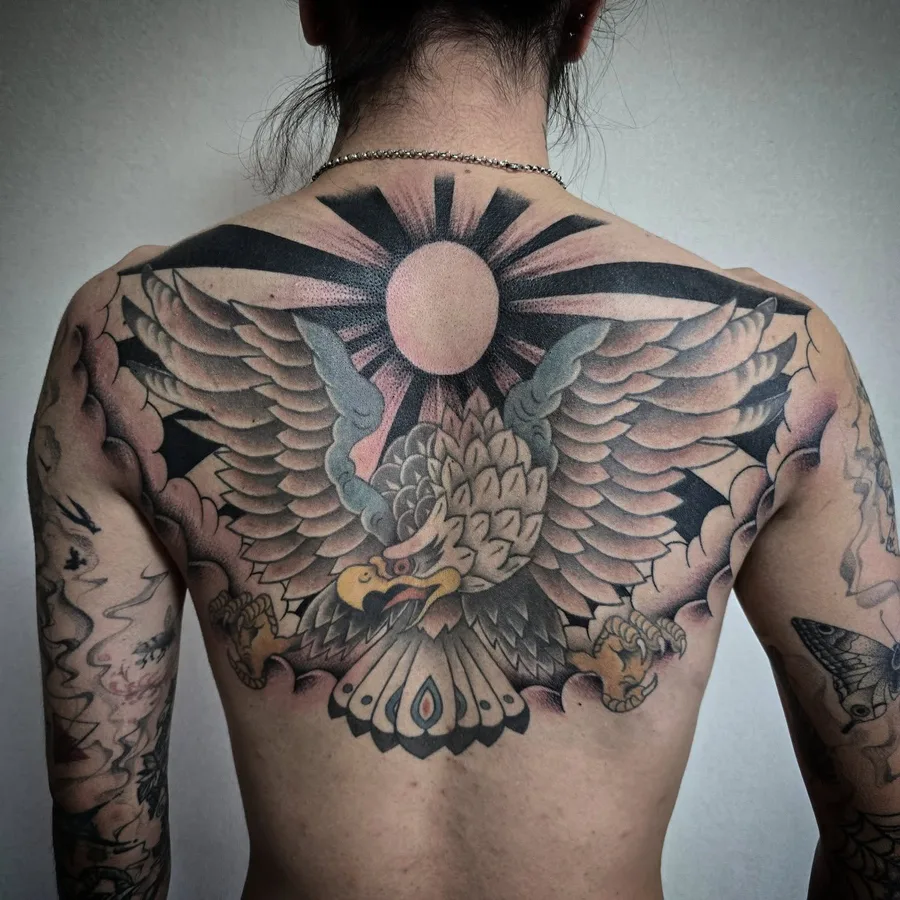 Eagle and sun (back) | MIYO
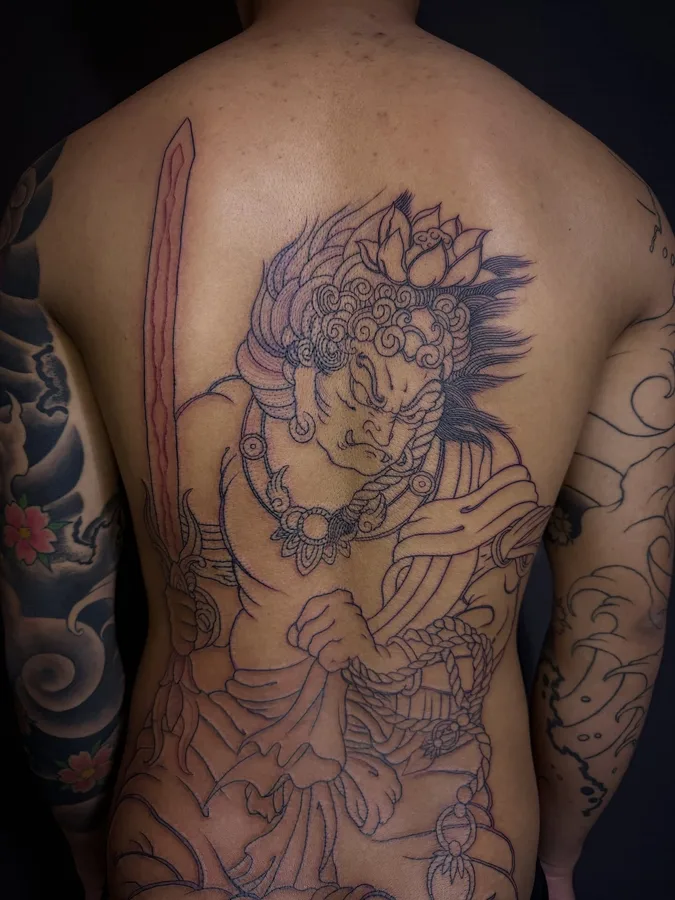 Mythological figure and sword (back) | 彫旭 Horiaki
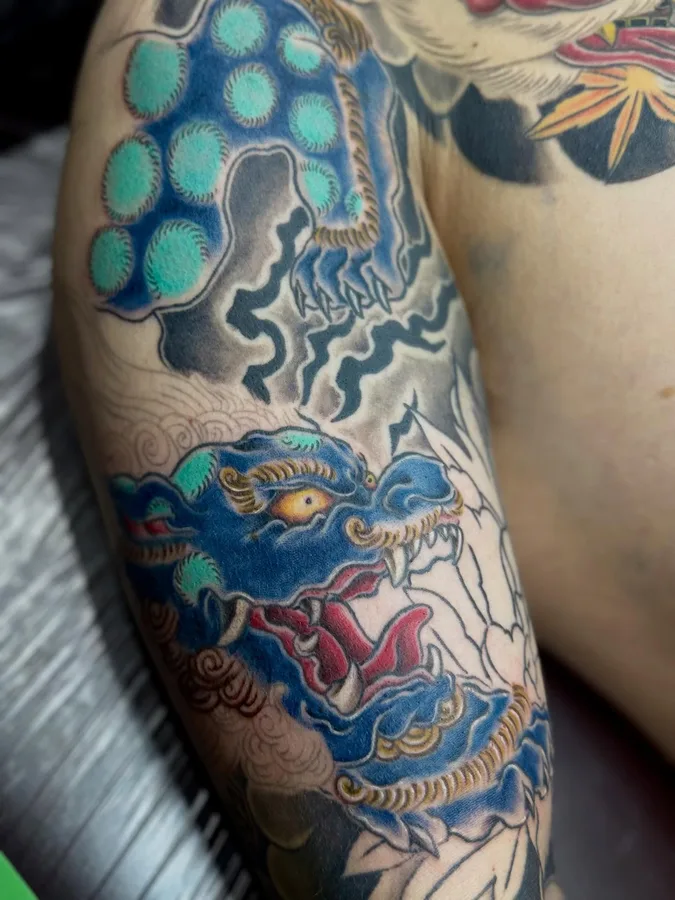 Dragon (arm) | 彫音 Horine
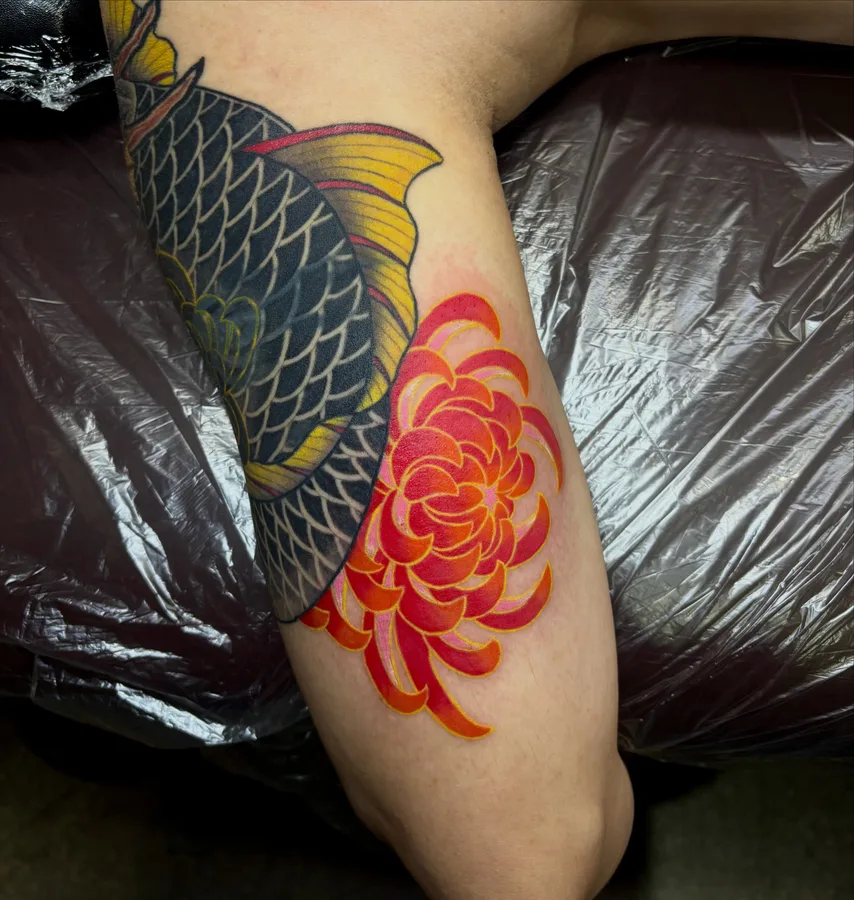 Koi and chrysanthemum (arm) | Ken
Images are quoted from works by artists listed on tattooers.jp (as of November 16, 2026). Tap an image to open the work.
Artist pages: MIYO / Horiaki / Horine / Ken. More back pieces are in back tattoos, and two classic motifs have their own pages: dragon and koi.
Japanese style mixes with other styles
97% of Japanese-style works also carried another style tag. About 48% were tagged color, about 46% black and grey, and about 34% neo-Japanese. Wabori today is split roughly evenly between color and black and grey, and a third of it borrows Western drawing techniques. Neo-Japanese is the name for traditional Japanese motifs drawn in a Western way.
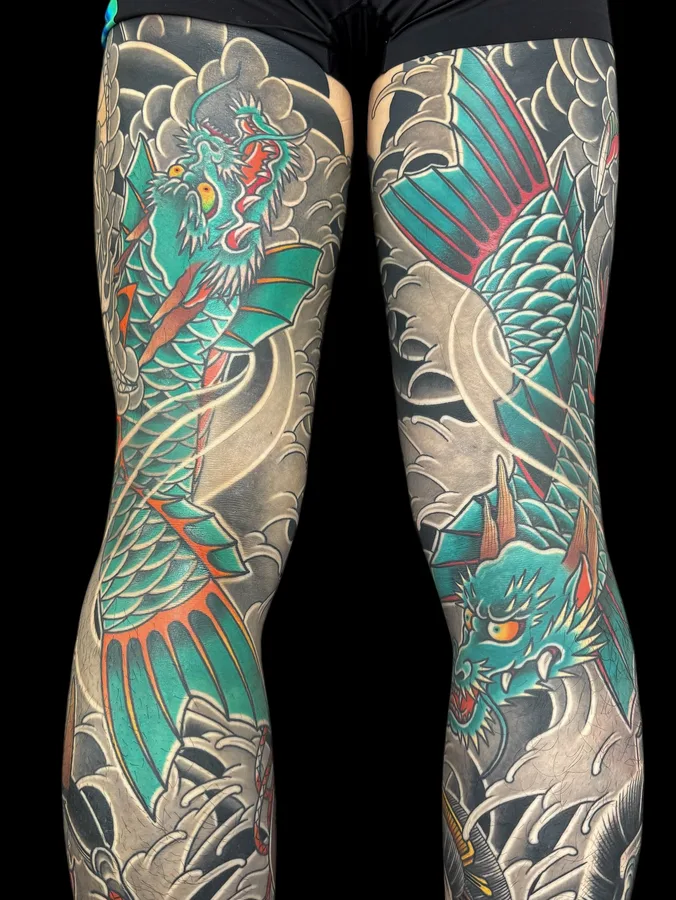 Dragon and koi (leg) | 彫也 HORINARI
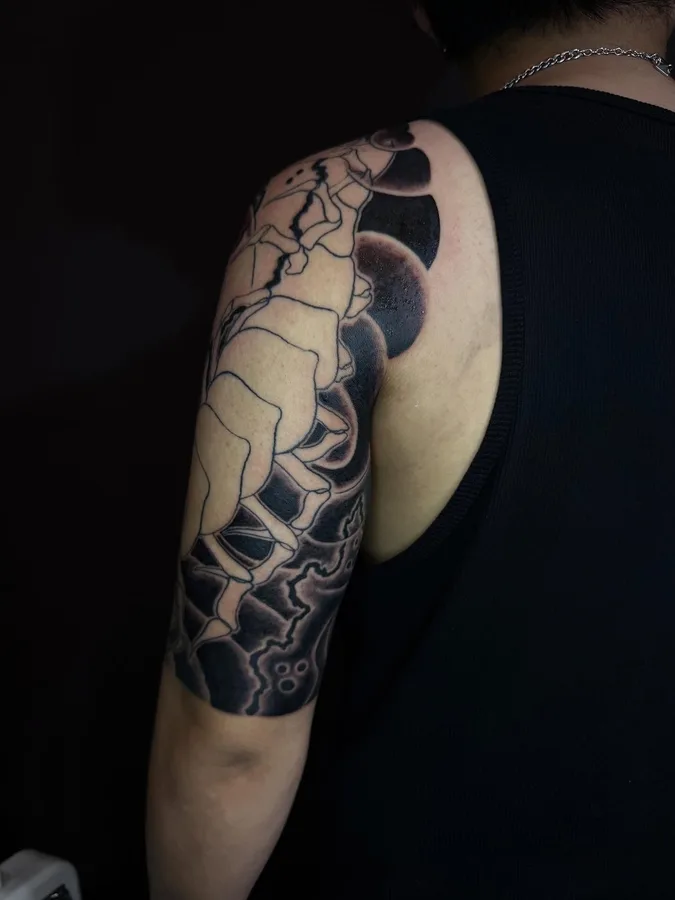 Peony and waves (arm) | 彫旭 Horiaki
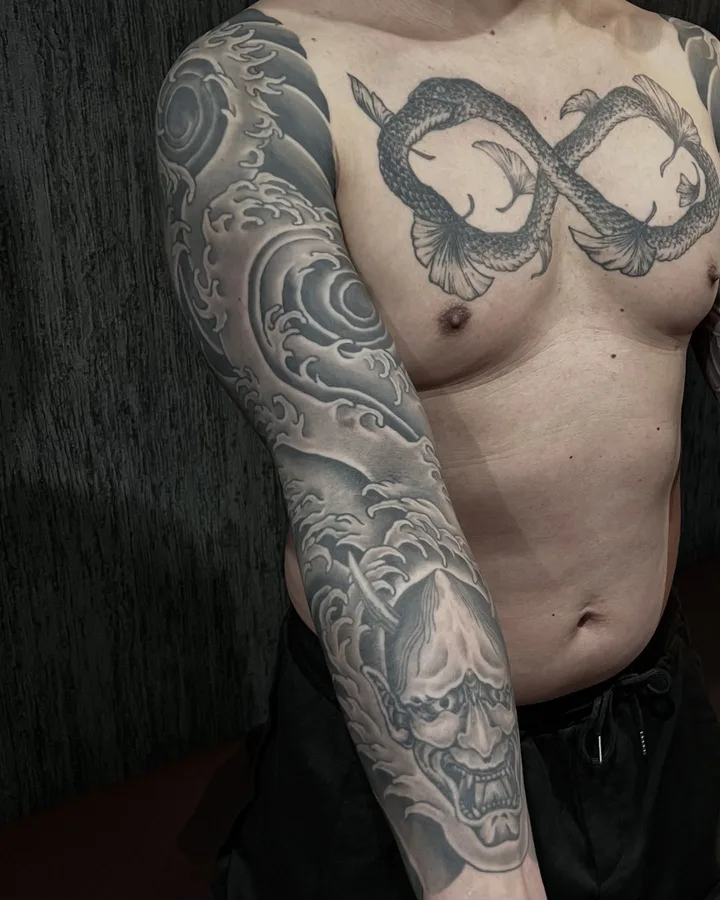 Hannya and waves (arm) | kazz
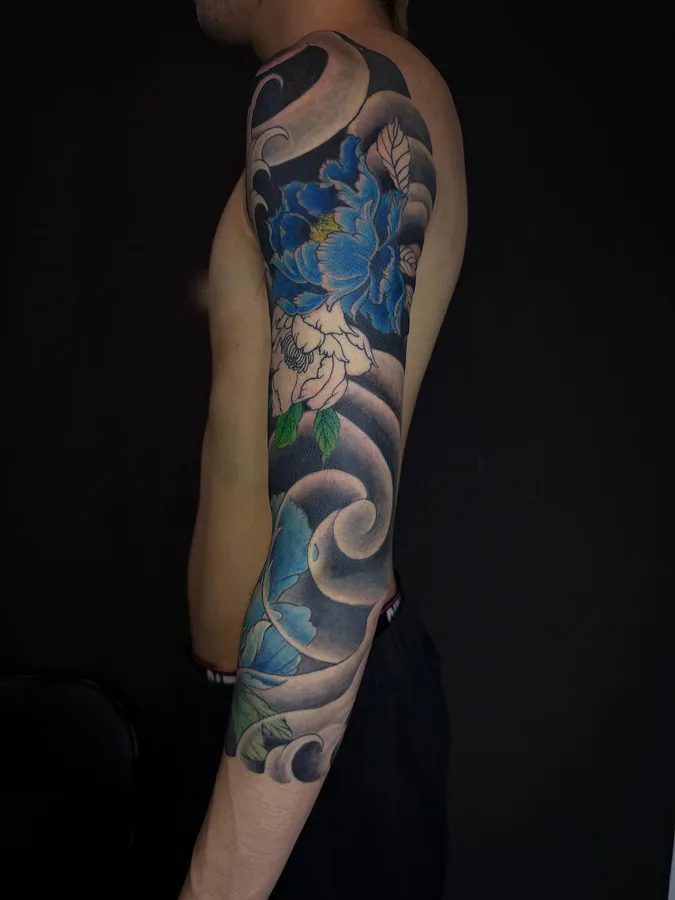 Peony and waves (arm) | 彫旭 Horiaki
Images are quoted from works by artists listed on tattooers.jp (as of November 16, 2026). Tap an image to open the work.
Artist pages: HORINARI / kazz. The most common motifs on Japanese-style works were waves, flowers, dragons, cherry blossoms, figures, oni (demons) and clouds.
Most artists call their work "tattoo"
We also counted which word artists use for their own work, in work captions and profile text. Studio and account names were left out.
| Word | Work captions | Artist profiles |
|---|---|---|
| Tattoo (タトゥー) | 19.8% | 56.2% |
| Shisei / irezumi (刺青) | 3.7% | 5.6% |
| Irezumi (入れ墨, 入墨) | 0.2% | 0% |
| Horimono (彫り物, 彫物) | almost 0% | 0.6% |
"Tattoo" is by far the most common word, even among artists who work in the Japanese style. The kanji 刺青 is more common among Japanese-style artists: it appears in 11.7% of captions on Japanese-style works against 1.5% on the rest, mostly as a hashtag. Still, about a third of artists who mainly do Japanese style write "tattoo" in their profile, more than those who write 刺青. You cannot tell an artist's style from the word they use.
Getting Irezumi in Japan as a Visitor
What you call it does not matter. Irezumi or tattoo, artists will understand. What helps is being clear about these four things:
- Style: traditional Japanese (wabori), neo-Japanese or something else. If you are not sure, show works you like
- Size and placement: a forearm piece, a sleeve or a full back. Large pieces need several sessions, so tell us how long you are in Japan
- Tebori or machine: if you want hand-carving, say so first. Only some artists offer it
- Motifs: dragon, koi, peony, hannya and so on, plus any reference images
A sleeve or a back piece is a project over several sessions. These show the scale:
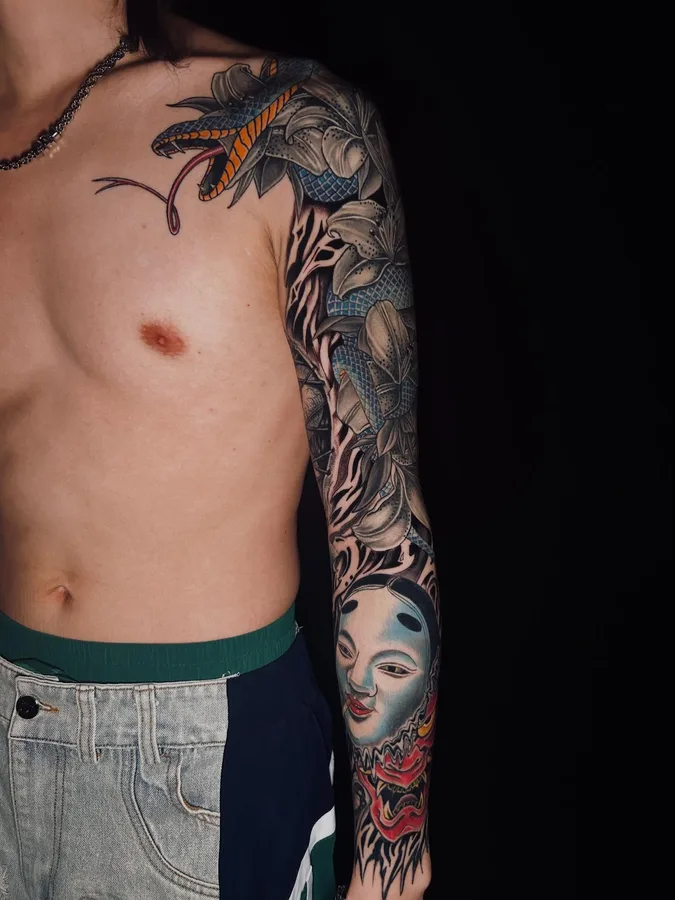 Snake and Noh mask full sleeve (arm) | 彫武 Horitake
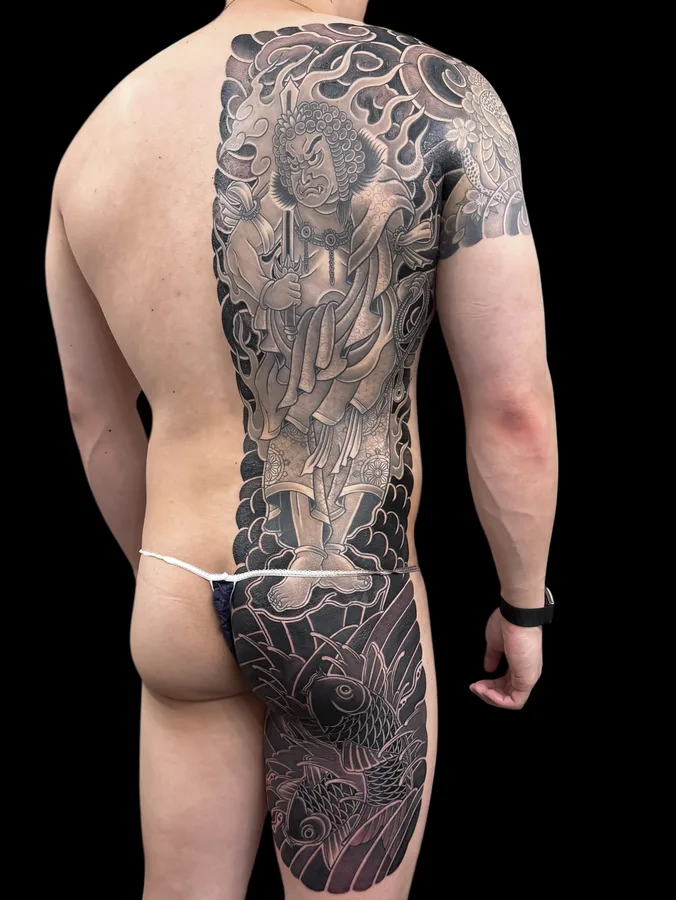 Six-day back piece (back) | 彫也 HORINARI
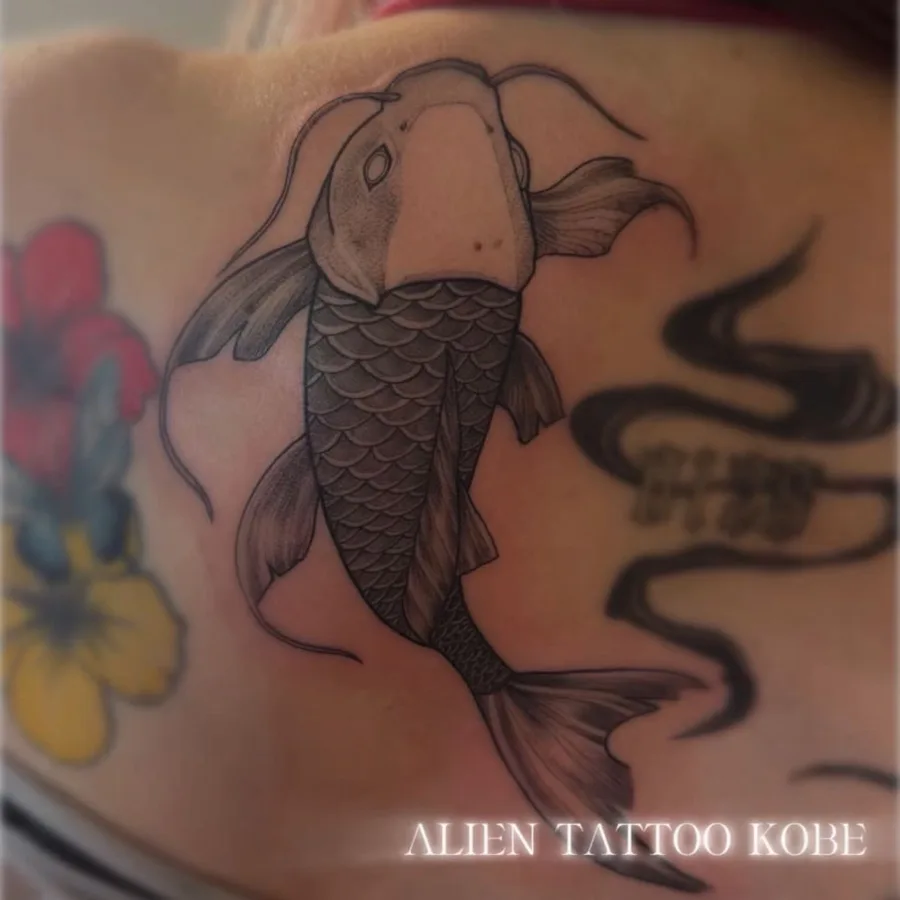 Koi (back) | Ki
Images are quoted from works by artists listed on tattooers.jp (as of November 16, 2026). Tap an image to open the work.
Artist pages: Horitake / HORINARI / Ki
Popular artists and large Japanese-style pieces can be booked months ahead, so start as soon as you know your dates. For which spots hurt most and which are easiest to hide afterward, see tattoo pain by body part.
Want irezumi from an artist in Japan? Tell us your dates and idea, and we match you with an artist who fits. We message you on Instagram within 48 hours and handle the back-and-forth in Japanese for you.
Frequently Asked Questions
Q. What is irezumi?
Irezumi is the Japanese word for a tattoo, written 入れ墨 ("inserted ink") or 刺青. In Japanese it can mean any tattoo. In English it usually means the traditional Japanese style, with motifs such as dragons, koi and waves, which in Japan is called wabori.
Q. What is the difference between irezumi and a tattoo?
In Japanese dictionaries there is none: tattoo is listed as a synonym [1]. In everyday use, "irezumi" tends to mean large traditional Japanese work and "tattoo" smaller or Western-style work. The claim that irezumi goes deeper into the skin has no support in the sources we checked.
Q. What does horimono mean?
Horimono means "carved thing." In the Edo period it was the word for decorative tattoos, as opposed to "irezumi," which then meant a tattoo given as punishment [2].
Q. What is tebori?
Tebori is Japanese hand-carved tattooing. The artist uses a group of needles fixed to a hand-held rod and pushes the ink in by hand instead of using a machine. It is a technique, not a separate kind of tattoo. Only some artists offer it, and it usually takes longer.
Q. Is it legal to get a tattoo in Japan?
Yes, for adults. No national law bans adults from getting a tattoo [6], and in 2020 the Supreme Court ruled that tattooing is not a medical act, so tattoo artists do not need a medical license [7]. Most prefectures ban tattooing anyone under 18 [9], and a national law bars gang members from tattooing minors [14].
Q. Can I go to an onsen with tattoos?
It depends on the facility. Some accept tattoos, some accept them under a cover sticker, and some refuse them. Check our tattoo-friendly map for each facility's official rules.
Summary
- Irezumi is the Japanese word for a tattoo. Dictionaries treat irezumi and tattoo as the same thing [1]
- In English, irezumi usually means the traditional Japanese style, called wabori in Japan
- In the Edo period, "irezumi" was a punishment and "horimono" was decoration. The penal tattoo ended in 1870, and decorative tattooing was banned from 1872 until 1948 [2][6][13]
- Tebori is a hand technique, not a different kind of tattoo
- In 2020 the Supreme Court ruled that tattooing is not a medical act. Minors and permanent makeup are separate rules [7][8][9]
- Onsen and sento decide for themselves whether to accept tattoos
Ready to get one? Browse Japanese traditional tattoos and tattoo artists in Japan. Get matched with an artist in Japan: tell us your dates and idea, and we message you on Instagram within 48 hours. The ¥15,000 deposit is refunded in full if we can't match you.
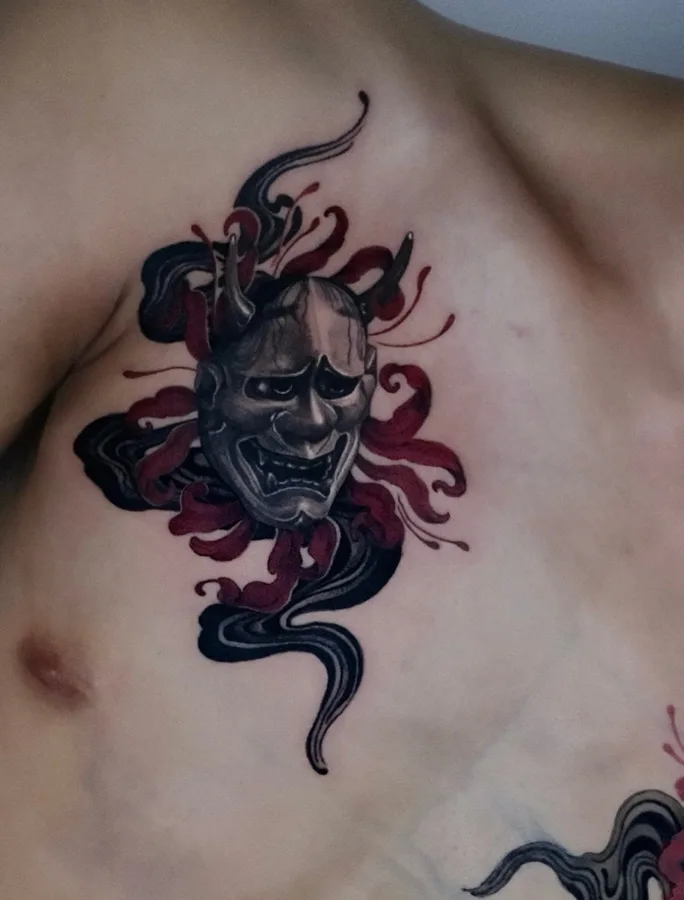 Hannya and spider lily (chest) | 緑 Midori
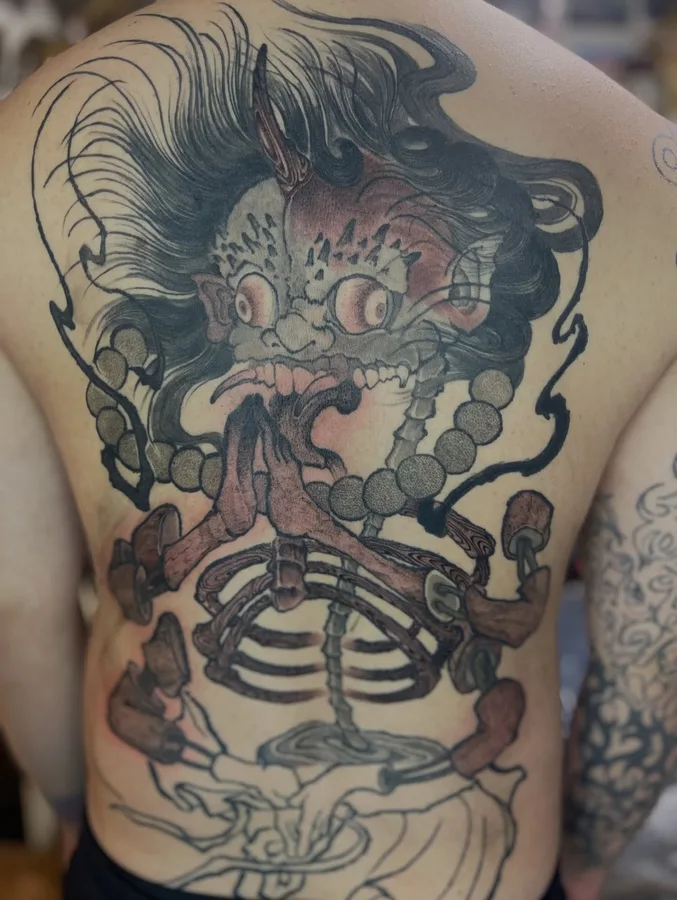 Oni and skull (back) | 宇賀 Uga
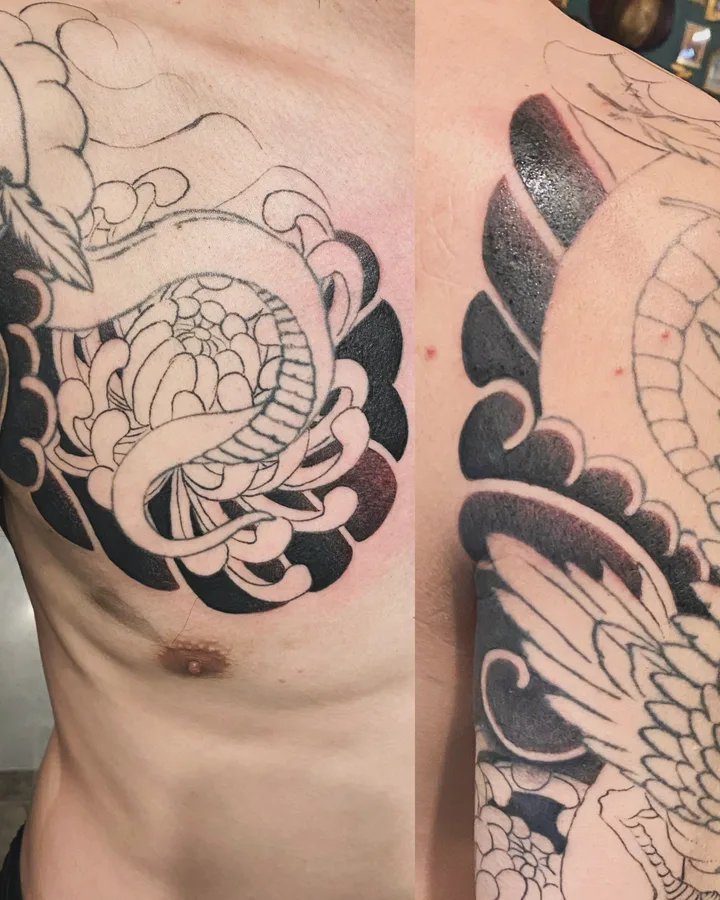 Chrysanthemum and waves (chest) | ToM
Images are quoted from works by artists listed on tattooers.jp (as of November 16, 2026). Tap an image to open the work.
Artist pages: Midori / Uga / ToM
References
Sources marked "secondary" are a dictionary of period terms, a researcher's site or a volunteer transcription; we did not check every original text behind them. Japanese-language sources are marked.
- Kotobank (Shogakukan, Digital Daijisen; Seisen-ban Nihon Kokugo Daijiten). Entry: shisei (Japanese). Accessed November 12, 2026.
- Kotobank (Kaitei Shinpan Sekai Dai Hyakka Jiten; Mypedia). Entry: irezumi (Japanese). Accessed November 12, 2026.
- imidas Jidaigeki Yogo Jiten (secondary, supporting [2]). Penal tattooing (Japanese). Accessed November 12, 2026.
- yoshabunko (secondary). Tokyo's 1872 Ishiki kaii jorei. Accessed November 12, 2026.
- Aozora Bunko. Tanizaki Jun'ichirō, "Shisei" (Japanese). Accessed November 12, 2026.
- House of Representatives of Japan. Minor Offenses Act (Act No. 39 of 1948) (Japanese). Accessed November 12, 2026.
- Supreme Court of Japan, Second Petty Bench. Decision of September 16, 2020, 2018 (A) No. 1790, Medical Practitioners' Act case (Japanese); full text (PDF, Japanese). Keishu Vol. 74, No. 6, p. 581. Accessed November 16, 2026.
- Ministry of Health, Labour and Welfare and Ministry of Economy, Trade and Industry. On permanent makeup at beauty salons (PDF, Japanese), December 26, 2025. Accessed November 12, 2026.
- Research Institute for Local Government. Youth protection ordinances (Japanese), updated June 13, 2026. Accessed November 12, 2026.
- Ministry of Health, Labour and Welfare, notice of March 18, 2016, attaching the Japan Tourism Agency notice of March 16, 2016. Responding to foreign travelers with tattoos at bathing facilities (PDF, Japanese). Accessed November 12, 2026.
- Kanagawa Prefecture. Guide to the Youth Protection and Development Ordinance (PDF, Japanese), section "Ban on irezumi (tattoos), Article 30." Accessed November 16, 2026.
- National Diet Library, Diet Record Search. House of Councillors Judicial Affairs Committee, No. 16, April 26, 1948 (Japanese). Accessed November 16, 2026.
- Wikisource (secondary transcription). Police Offenses Ordinance (Home Ministry Ordinance No. 16 of 1908), Article 2, item 24 (Japanese). Accessed November 16, 2026.
- e-Gov Law Search. Act on Prevention of Unjust Acts by Organized Crime Group Members (Act No. 77 of 1991), Article 24 (Japanese). Accessed November 16, 2026.
Work counts, body parts, styles and word use are from 7,626 works published on tattooers.jp (excluding test data), counted by the tattooers.jp editorial team as of November 12, 2026. "Japanese-style" means works tagged with the Japanese style (1,587); "the rest" means works tagged neither Japanese nor neo-Japanese (5,927). Body part shares use works with a body part set. Word use is the share of work captions and artist profiles that contain the word, excluding studio and account names. "Artists who mainly do Japanese style" are artists with at least three public works, more than half of them Japanese-style.
