Japan's best-known Indigenous tattoo traditions are the tattoos Ainu women wore around the mouth and on the hands and forearms, called sinuye in the Ainu language, and hajichi, the hand tattoos women wore in Amami and Okinawa. Both marked a woman's passage through life, both were banned by the Meiji government (1871 for the Ainu, 1899 in Okinawa), and both are coming back today: hajichi as hand-poked tattoos, and sinuye in the work of Ainu artists [1][2][3][5][6][7].
If you searched for "Japanese tribal tattoo," you may have been looking for these traditions. They are not a "tribal" style, though: they are the customs of particular peoples. This guide covers what each tattoo meant, how the bans happened and what the revival looks like today. Near the end, there is a short look at the modern tribal style as tattoo artists in Japan practice it.
This is a history guide, not a design guide. Sinuye and hajichi belong to living Ainu and Okinawan communities, so we do not show their patterns as designs to copy, and we do not use photographs of the women who wore them.
Ainu and Okinawan Tattoos at a Glance
Both were women's tattoos on the hands; Ainu women were also tattooed around the mouth. The table sums up what our sources say. Details differ by region and by source, so read it as an outline.
| Ainu tattoo (sinuye) | Hajichi | |
|---|---|---|
| People | The Ainu, an Indigenous people of Hokkaido and neighboring northern islands | Women of the Amami and Okinawa islands |
| Where on the body | Around the mouth, and from the backs of the hands to the forearms [1] | The backs of the hands [5] |
| Who did it | Skilled older women, often grandmothers or maternal aunts [1][2] | Hajichi tattooers, who were also punished under the ban [5] |
| What it marked | Growing up, readiness for marriage, protection, preparation for the afterlife [2] | A rite of passage through a woman's life [5][6] |
| Banned | 1871, by the Hokkaido Development Commission [3][4] | 1899 [5] |
Japan officially recognizes the Ainu as an Indigenous people: a 2019 law names them the Indigenous people of the northern part of the Japanese archipelago, especially Hokkaido [14]. The government does not recognize Ryukyuans (Okinawans) as Indigenous, although UN human rights committees have recommended it, and some Ryukyuans describe themselves as Indigenous [13].
The rest of this guide looks at each tradition in turn.
Ainu Tattoo: Sinuye Around the Mouth and on the Hands
In the Ainu language, sinuye means "to tattoo oneself." A dictionary entry in the National Ainu Museum's language archive breaks it down as si (oneself) and nuye (to carve, draw or write) [1].
The same archive quotes dictionaries of the Ainu language on how it was done [1]:
- Women were tattooed around the mouth and from the backs of the hands to the forearms
- It was done by a skilled older woman, never by the girl herself
- The ink was soot: one dictionary describes soot from birch bark, collected on the bottom of a pot and rubbed into small cuts
Accounts of when it started differ. One dictionary in the archive says girls began at about seven or eight and finished by adulthood [1]. An explanatory text written for the Japan Tourism Agency describes a start at around 12 or 13 with the upper lip, the lower lip in the mid-teens and completion at about 20, when a woman was ready to marry. The lines around the mouth were extended toward the sides of the face [2].
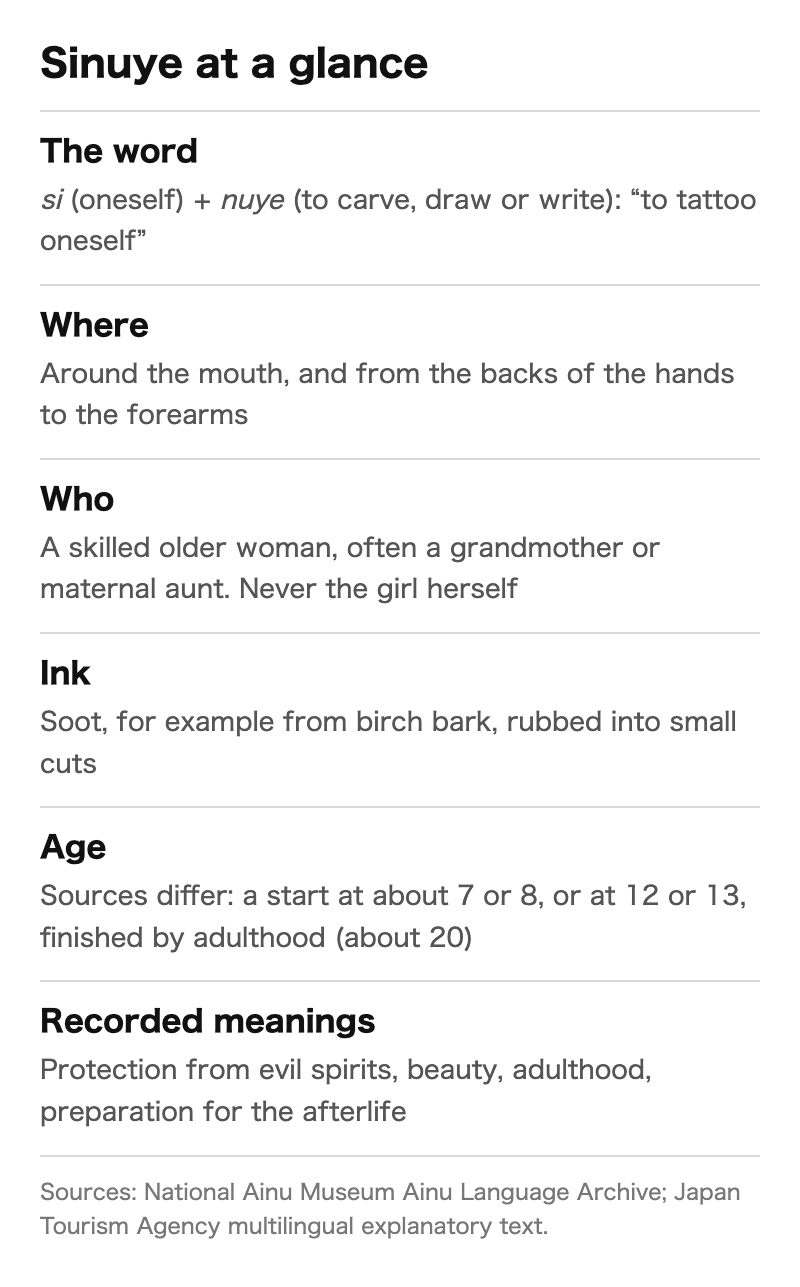 Figure: Sinuye at a glance (made by tattooers.jp from the sources below)
The meanings recorded are protection from evil spirits, beauty in the eyes of the community, a sign of adulthood and preparation for the afterlife [2]. We could not find a single meaning that applies to every region and every period, so treat these as the ones written down, not as a complete list.
Hajichi: The Hand Tattoos of Okinawa and Amami
Until modern times, women in Amami and Okinawa tattooed the backs of their hands as a rite of passage, according to a reading list published by the Okinawa Prefectural Library [5]. Amami is a group of islands between Kyushu and Okinawa. Okinawa was the Ryukyu Kingdom until Japan annexed it in 1879 [6].
Hajichi is the Okinawa Island name. The library lists other local names: hajichi or pajichi on Okinawa Island, haduchi on Kikai, hazuki on Amami Oshima, hanzuki on Tokunoshima, banjiki on Okinoerabu and Yoron, pizutsuku on Miyako and paritsuki on Ishigaki [5]. Written in Japanese, the word is 針突, "needle and poke."
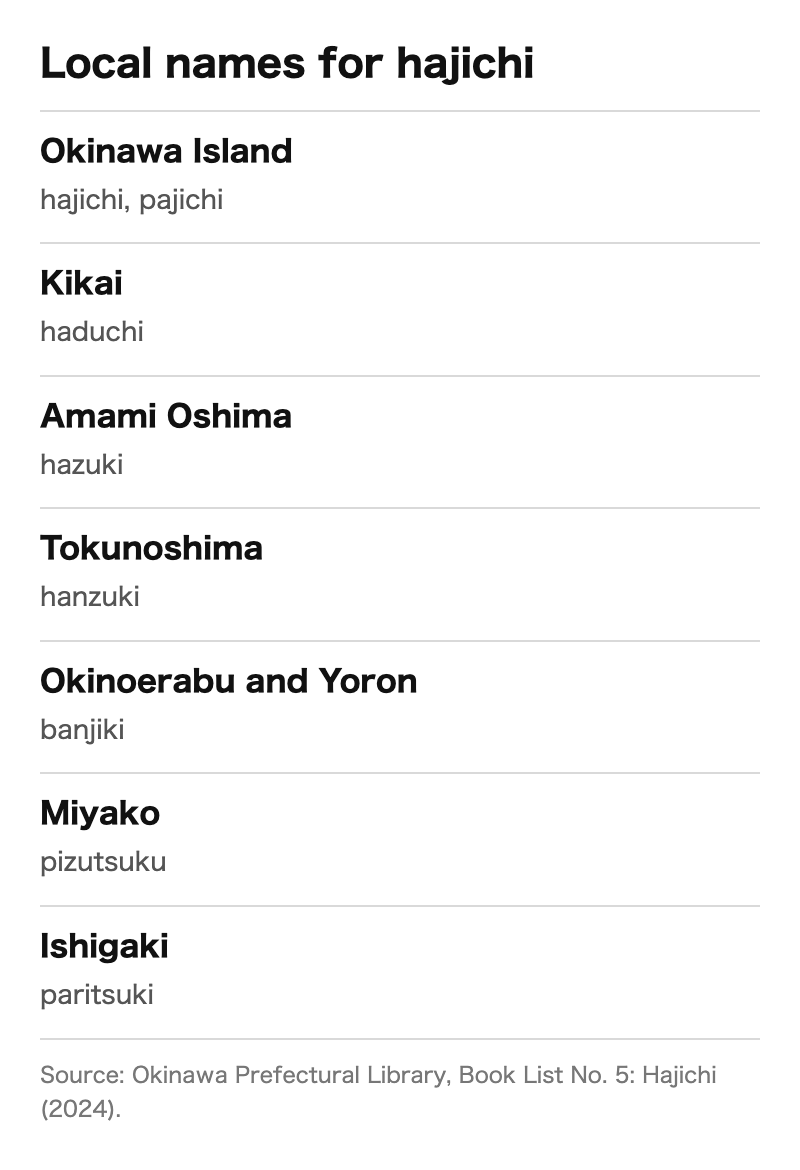 Figure: Local names for hajichi (made by tattooers.jp)
National Geographic, reporting on the revival in 2025, describes hajichi as marks of life milestones such as marriage, mastering weaving or turning 60. Girls could receive their first marks, two small circles between the knuckles called tontonmi, as young as six. A doctoral researcher quoted in the article calls a star-shaped mark "a passport to the afterlife," a way for ancestors to recognize the wearer [6].
The Meiji Bans: 1871 and 1899
The Ainu ban came as part of a policy to assimilate the Ainu, and the Okinawan ban as part of Meiji rule over the former Ryukyu Kingdom [2][3][6]. The Meiji period ran from 1868 to 1912.
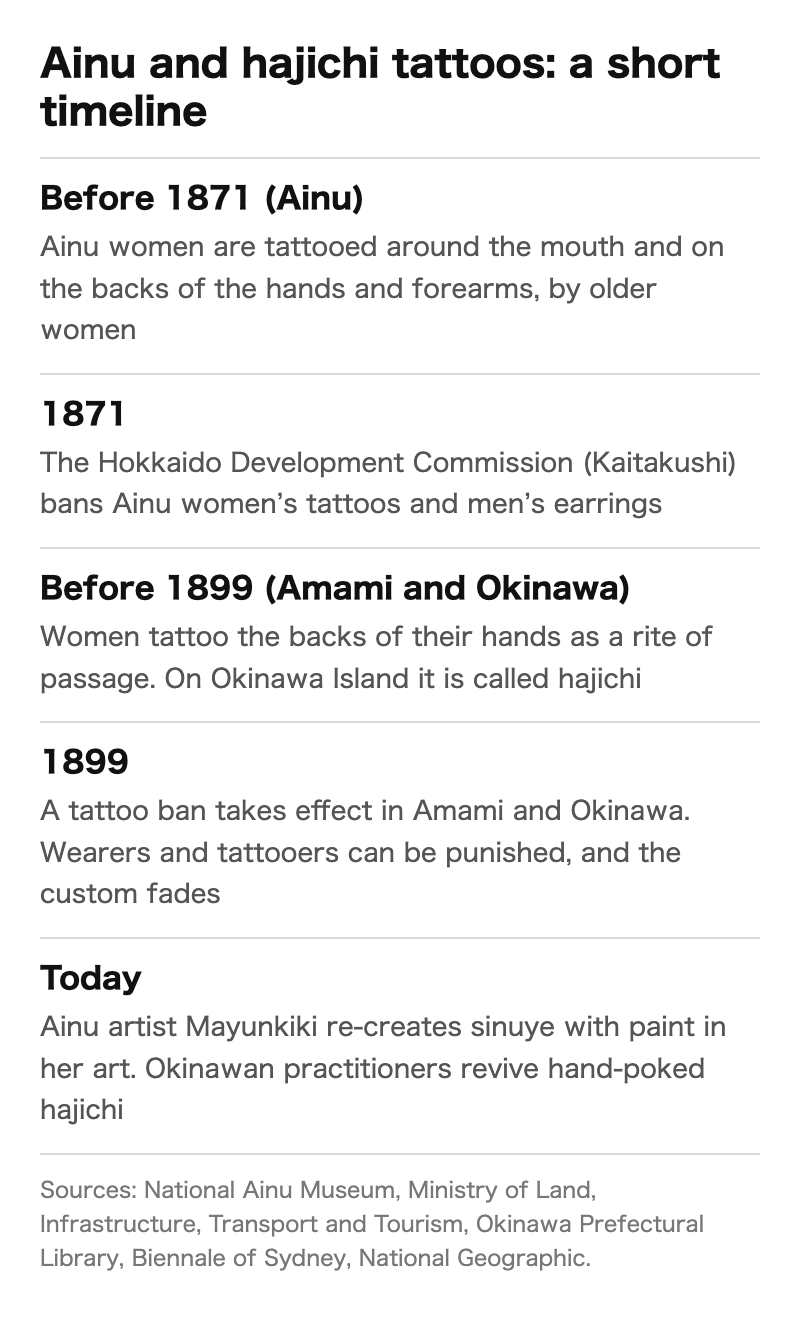 Figure: Ainu and hajichi tattoos, a short timeline (made by tattooers.jp)
1871, Hokkaido. In the same year as Japan's new family registration law, the Kaitakushi, the government office that ran Hokkaido, banned the burning of a dead person's house, women's tattoos and men's earrings, and pushed the Ainu to learn Japanese. A booklet from the Hokkaido Regional Development Bureau sets this out [3]. The Japan Center for Asian Historical Records adds that in 1871 the Ainu were forced to take Japanese-style names, and that customs such as earrings and tattoos were banned [4]. Many women kept tattooing anyway, because they believed they could not marry or reach the afterlife without it [2]. (Another source dates the push to change Ainu names to around 1876 [3].)
1899, Amami and Okinawa. When a tattoo ban took effect in 1899, both the women with hajichi and the people who tattooed them could be punished, and the custom faded away [5]. According to stories passed down in the community, some girls still tattooed each other in secret [6].
Decorative tattooing was also banned elsewhere in Japan in the early Meiji years. For how tattoos and the law changed from the Edo period to today, see the difference between irezumi and tattoo.
The Revival: Ainu and Okinawan Women Today
Both revivals we found are led by women from these communities. Here is what we could confirm from museums, galleries and reporting.
Ainu. The Ainu artist and musician Mayunkiki, a member of the vocal group Marewrew, made SINUYE: Tattoos for Ainu Women for the 22nd Biennale of Sydney (2020). She interviews older Ainu people who remember seeing sinuye and asks them to draw it on her face as they recall it, re-performing it with paint rather than tattoo ink [7]. Her 2022 solo show Siknure – Let me live at Ikon Gallery in Birmingham was the first solo exhibition by an Ainu artist in the UK [8]. A researcher at the National Ainu Museum has written a paper on her work since 2020 [9].
To learn about Ainu culture in person, the National Ainu Museum is part of Upopoy (the National Ainu Museum and Park) in Shiraoi, Hokkaido. Its permanent exhibition presents six themes from the perspective of the Ainu [10].
Hajichi. National Geographic's 2025 report follows hajichaa (hajichi tattooers) who hand-poke the marks again. Moeko Heshiki, who founded the Hajichi Project, works in Naha, Okinawa's capital. Practitioners in the Okinawan diaspora, such as in São Paulo, are part of it too [6]. The article's writer, a descendant of a woman who wore hajichi, describes receiving her own hajichi from Heshiki. The stigma has not gone: Heshiki says that becoming a public servant, such as a teacher, is nearly impossible with visible tattoos, so some people place hajichi where they can cover it [6].
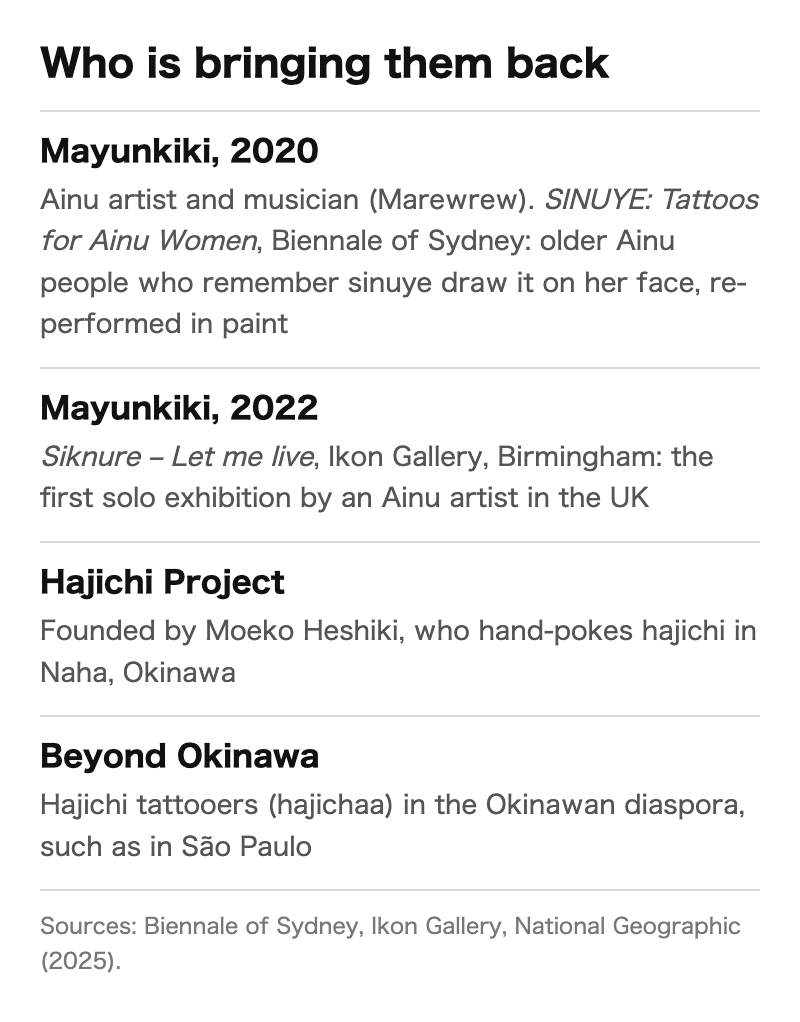 Figure: Who is bringing them back (made by tattooers.jp)
We did not find a statement from an Ainu or Okinawan organization that sets out who may receive these marks. The revivals we found are led by Ainu and Okinawan women and their communities.
Why We Don't Show Ainu or Hajichi Designs
Sinuye and hajichi are not a tattoo style; they belong to particular peoples and to their families' histories. Both were banned by law, and the communities are reclaiming them now. For that reason, this guide does not show the patterns, and we don't suggest asking an artist to copy them.
A comparison from New Zealand helps. Te Ara, the encyclopedia of New Zealand, explains that Māori moko represented a person's mana, or status [11]. Christchurch City Libraries describes kirituhi as a Māori-style tattoo made by a non-Māori tattooer or for a non-Māori wearer, telling the wearer's own story in the visual language of Māori art [12]. That is how kirituhi is described in New Zealand [12]. We could not find an equivalent framework from Ainu or Okinawan communities.
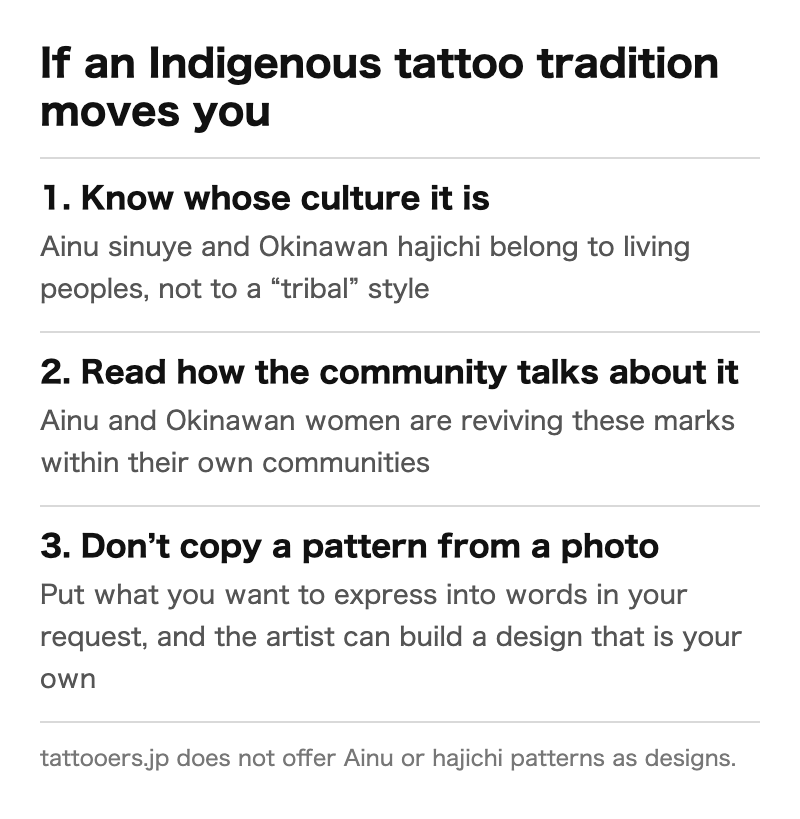 Figure: If an Indigenous tattoo tradition moves you (made by tattooers.jp)
If you want a tattoo that carries a meaning, put the meaning into words in your request, and the artist can build a design that is your own.
What "Tribal Tattoo" Usually Means Today
In today's tattoo shops, "tribal" often means a black-ink style that draws on patterns from the Pacific and Southeast Asia, plus later styles built from bold black curves. It is a broad label, not one culture. Artists in Japan who list the style tend to work in one of three directions:
| Direction | What it looks like |
|---|---|
| Inspired by traditional patterns | Bands, triangles and waves inspired by Samoan or Bornean work, often wrapped around a limb |
| Old-school tribal | Bold black curves with sharp points, often laid out symmetrically or along the body |
| Neo-tribal | Thin, sharp, angular lines with plenty of empty skin |
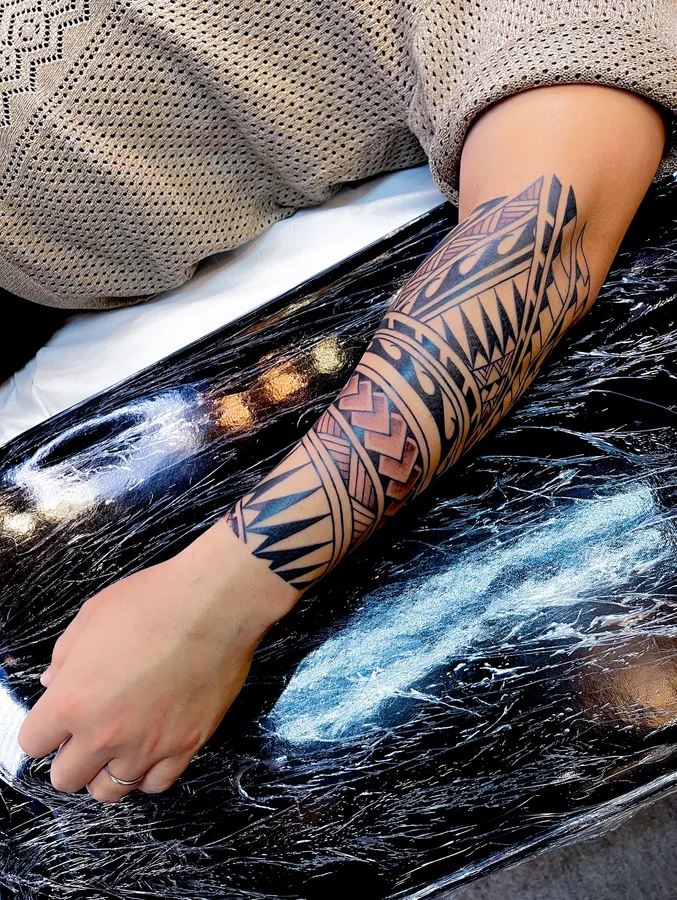 Samoan-inspired bands | RYUBUN TATTOOER
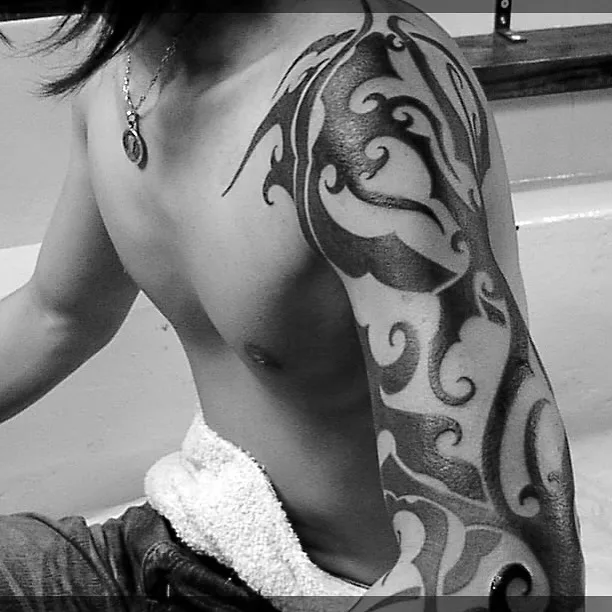 Borneo-inspired curves | RYUBUN TATTOOER
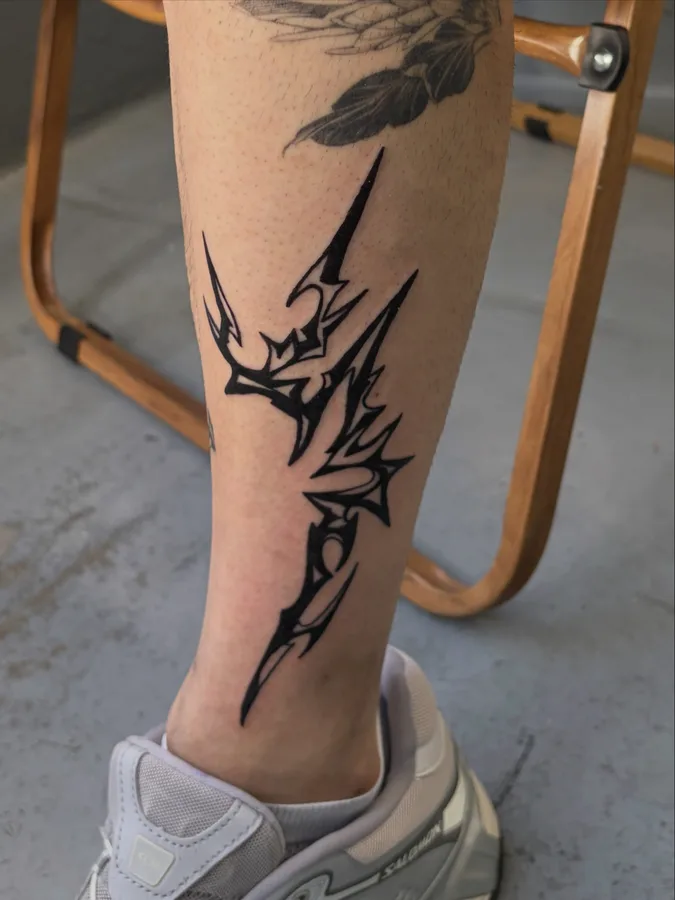 Neo-tribal | 唯ゐ Yuii
Images are quoted from works by artists listed on tattooers.jp (as of November 16, 2026). Tap an image to open the work.
Artist pages: RYUBUN TATTOOER / Yuii. The artist titles the first two works "SAMOA" and "Borneo." A design inspired by a tradition is not the same as a tattoo made within it. Samoan tatau and Bornean tattooing are living traditions too; the same questions apply if you are drawn to them.
Japanese Tribal Tattoo: Lions, Dragons and Bold Black Curves
In Japan, "Japanese tribal tattoo" in practice often means Japanese subjects drawn in tribal lines. On tattooers.jp, some artists have drawn the karajishi lion and peony, a classic pairing in Japanese tattooing, and the dragon, in the bold black curves of old-school tribal.
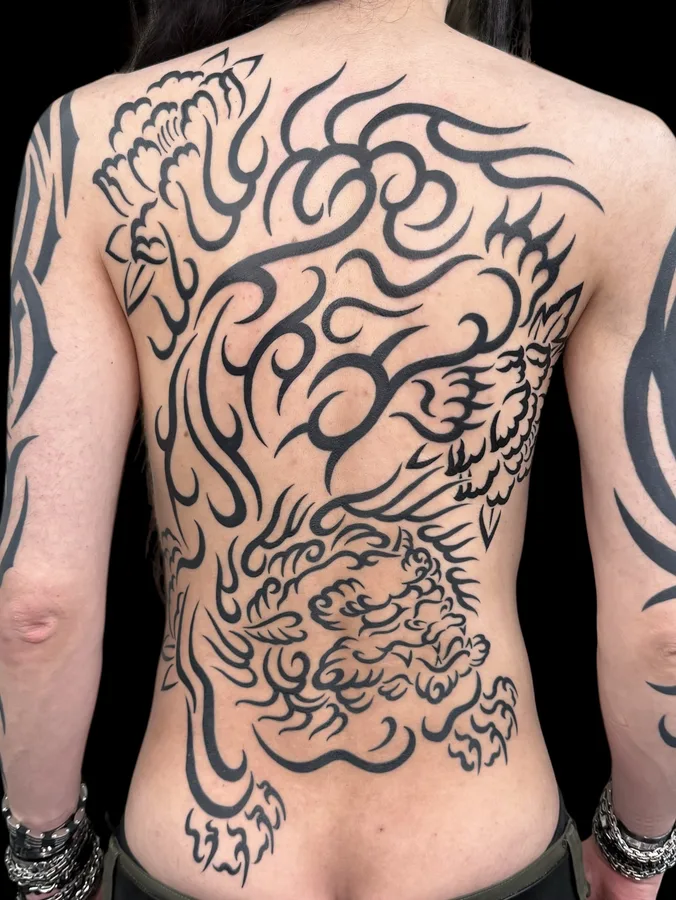 Lion and peony in tribal lines | 彫也 HORINARI
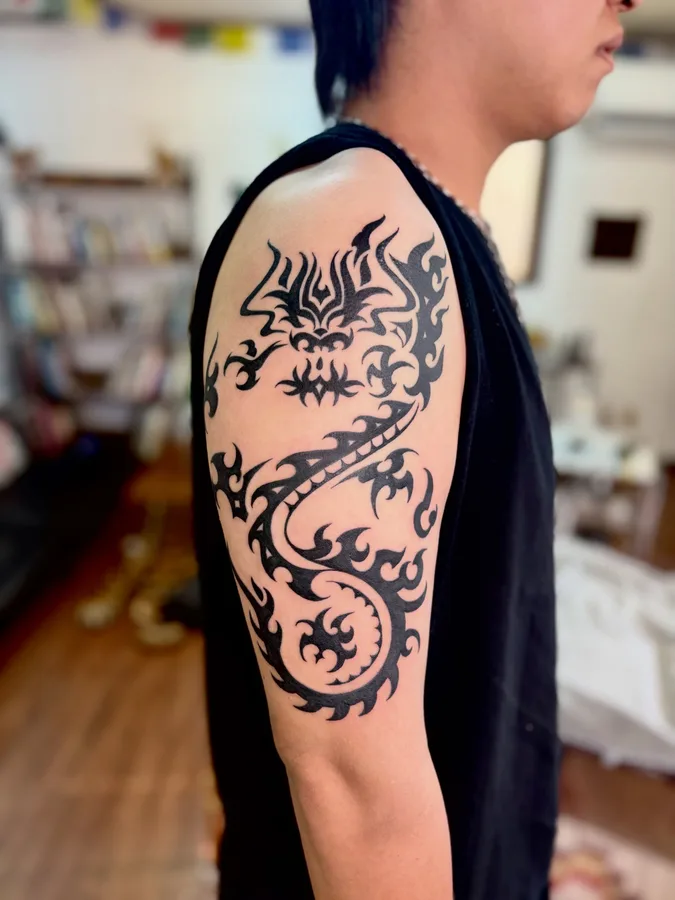 Old-school tribal dragon | Taiga Pisara
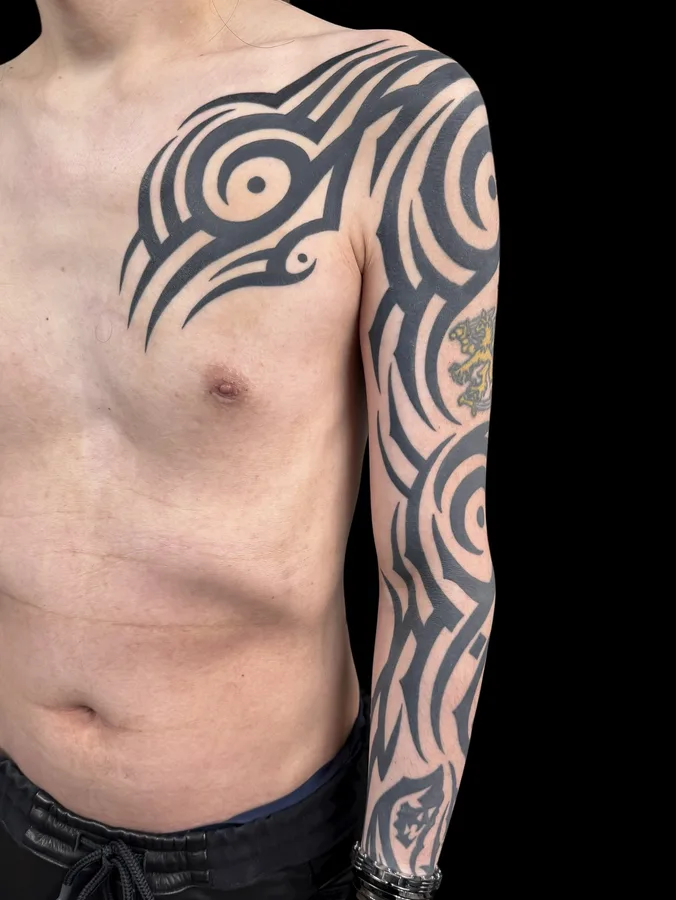 Old tribal, chest added later | 彫也 HORINARI
Images are quoted from works by artists listed on tattooers.jp (as of November 16, 2026). Tap an image to open the work.
Artist pages: HORINARI / Taiga Pisara.
Taiga Pisara, who works in Okinawa, writes that the old-school tribal dragon has long been a common request in Japan, and that requests for the old look have been picking up again lately. HORINARI describes the third piece as a tribal he tattooed previously, with the chest added on a later visit. For what the dragon and the lion stand for in Japanese tattooing, see Japanese tattoo meanings, and for the dragon in depth, see our dragon tattoo guide.
Frequently Asked Questions
Q. What is an Ainu tattoo called?
In the Ainu language, the word is sinuye, meaning "to tattoo oneself" [1]. It refers to the tattoos Ainu women wore around the mouth and on the hands and forearms.
Q. What is hajichi?
Hajichi is the Okinawa Island name for the hand tattoos women in Amami and Okinawa wore as a rite of passage. Other islands had their own names for it. It was banned in 1899 [5].
Q. Why were Ainu and Okinawan tattoos banned?
The Ainu ban was part of a policy to assimilate the Ainu, and the Okinawan ban came as part of Meiji rule over the former Ryukyu Kingdom [2][3][6]. The Hokkaido Development Commission banned Ainu women's tattoos in 1871, and a tattoo ban took effect in Amami and Okinawa in 1899 [3][5].
Q. Can I get an Ainu or hajichi tattoo?
These are the traditions of living Ainu and Okinawan communities, and today's revival is led from within them. If you are not from these communities, we suggest you don't get these patterns or ask an artist to copy them. If you have Ainu or Okinawan roots, the community-led projects above are the place to start. To learn more, visit Upopoy in Hokkaido [10].
Q. Is tribal tattooing popular in Japan?
It is a style you can find. Old-school tribal and neo-tribal both appear among works on tattooers.jp, and some artists combine tribal lines with Japanese subjects such as the dragon. Browse tribal tattoos to see the range.
Summary
- Two of Japan's best-known traditional tattoos are Ainu women's sinuye, around the mouth and on the hands, and hajichi, the hand tattoos of Amami and Okinawa
- Both marked stages of a woman's life. Recorded meanings include adulthood, marriage, protection and the afterlife
- The Meiji government banned them: 1871 in Hokkaido, 1899 in Okinawa
- Both are coming back today: hajichi as hand-poked tattoos, and sinuye in the work of Ainu artists
- They belong to those communities, so we don't show them as designs
- The modern "Japanese tribal tattoo" is something else: Japanese subjects such as dragons and lions drawn in tribal lines
To see how artists in Japan work in the modern tribal style, browse tribal tattoos. If you are planning a trip and want to be matched with a tattoo artist in Japan, you can send us your dates and idea; we message you on Instagram within 48 hours.
Read in Japanese: our guide to tribal tattoos.
References
Ages, placements and meanings differ by region and by source. Where sources disagree, we say so in the text.
- National Ainu Museum. Ainu Language Archive, dictionary search: "sinuye" (Japanese; entries from Tamura Suzuko's Saru dialect dictionary, Kayano Shigeru's Ainu dictionary and Chiri Mashiho's dictionaries). Accessed November 16, 2026.
- Japan Tourism Agency. Multilingual Explanatory Text Database: "Tattoos" (FY2024, Asahikawa, Hokkaido). Accessed November 16, 2026.
- Obihiro Development and Construction Department, Hokkaido Regional Development Bureau, Ministry of Land, Infrastructure, Transport and Tourism. Tokachi River Journey, Chapter 3-5: "The denial of Ainu culture" (PDF, Japanese). Accessed November 16, 2026.
- Japan Center for Asian Historical Records, National Archives of Japan. Life and culture in the Meiji, Taisho and early Showa periods: "Modern history of Indigenous peoples" (Japanese). Accessed November 16, 2026.
- Okinawa Prefectural Library. Book List No. 5: Hajichi (PDF, Japanese, March 2024). Accessed November 16, 2026.
- Haley Harrison, National Geographic (August 22, 2025). The revival of Okinawan hand tattoos. Accessed November 16, 2026.
- Biennale of Sydney, on Google Arts & Culture. SINUYE: Tattoos for Ainu Women, Mayunkiki, with photography by Hiroshi Ikeda (2020). Accessed November 16, 2026.
- Ikon Gallery. Mayunkiki: Siknure – Let me live (September 9 to November 13, 2022). Accessed November 16, 2026.
- Yachita Mio (2025). Contemporary Artistic Expression of Mayunkiki Post-2020. National Ainu Museum Journal, 2024(3), 34-78. Accessed November 16, 2026.
- Upopoy (National Ainu Museum and Park). National Ainu Museum. Accessed November 16, 2026.
- Rawinia Higgins, Te Ara – the Encyclopedia of New Zealand (2016). Tā moko – Māori tattooing, Page 4: Moko and status. Accessed November 16, 2026.
- Christchurch City Libraries. Toi Māori – Traditional Māori art. Accessed November 16, 2026.
- IWGIA (International Work Group for Indigenous Affairs). The Indigenous World 2023: Japan. Accessed November 16, 2026.
- House of Representatives, Japan. Act on Promoting Measures to Realize a Society in Which the Pride of the Ainu People Is Respected (Act No. 16 of 2019), Article 1 (Japanese). Accessed November 16, 2026.
