A Japanese snake tattoo is often chosen for rebirth and change, because snakes shed their skin, and in Japan also for protection and good fortune, but no single meaning is fixed. In Japanese, the snake is called hebi, and in Japanese belief it has long been seen as a guardian and as the messenger of Benzaiten, the goddess of fortune, rather than as the tempter of Western stories. In irezumi (traditional Japanese tattooing), this is the snake most often depicted.
This guide separates what dictionaries record from what is commonly said in the tattoo world, compares Japanese and Western snake tattoo meanings, and draws on our own count of 282 snake works listed on tattooers.jp: their styles, placements and the motifs drawn with them. To browse the works first, see snake tattoos.
What Does a Snake Tattoo Mean?
Because a snake sheds its skin again and again and seems to grow young, it has long been a symbol of rebirth and immortality [1]. The "new start" and "change" that people attach to snake tattoos grew out of that image.
| Motif or source | What dictionaries and official sources record | What is often said in the tattoo world |
|---|---|---|
| Shedding skin | Shedding repeatedly and growing young, the snake became a symbol of rebirth and immortality [1] | Rebirth, change |
| The staff of Asclepius | The Greek god of healing carried a staff with a snake coiled around it. The World Health Assembly chose it for the WHO emblem in 1948 [1][2] | Healing, protection |
| Water deity | In East Asia, snakes were seen as water gods or their messengers. In Japanese myth, the god of Mt. Miwa in Nara takes the form of a snake [1][3] | Guardian |
| The white snake and Benzaiten | Ugajin, a god of fortune, is often identified with Benzaiten. Because a white snake sits in the crown of that deity, white snakes are worshipped as gods [4] | Luck, fortune |
| Ouroboros | A snake biting its own tail to form a circle. With no beginning and no end, it stood for completeness, eternity and immortality [5] | Eternity, connection |
| The serpent of Eden | In Christianity, the serpent that tempted Eve in Eden is identified with Satan [1] | Temptation, knowledge |
Read the right column as interpretation. The left column is what we could confirm in dictionaries and official sources; the right column is how the tattoo world usually explains it.
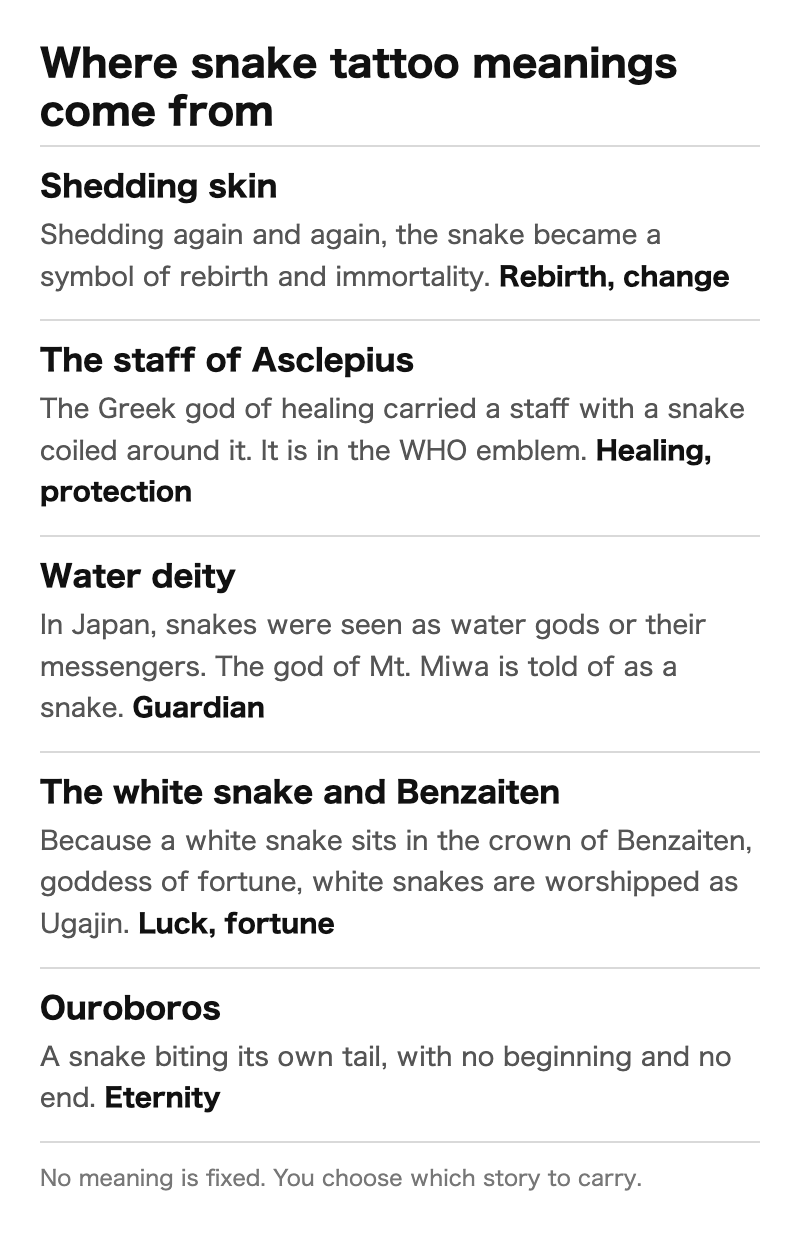 Figure: tattooers.jp editorial team
The same snake is worshipped as a guardian in one story and cast as the villain in another. Which story you want changes how it is drawn: a snake with its mouth open and fangs bared reads as strength or a warning, while a snake drawn softly with flowers leans toward rebirth and beauty.
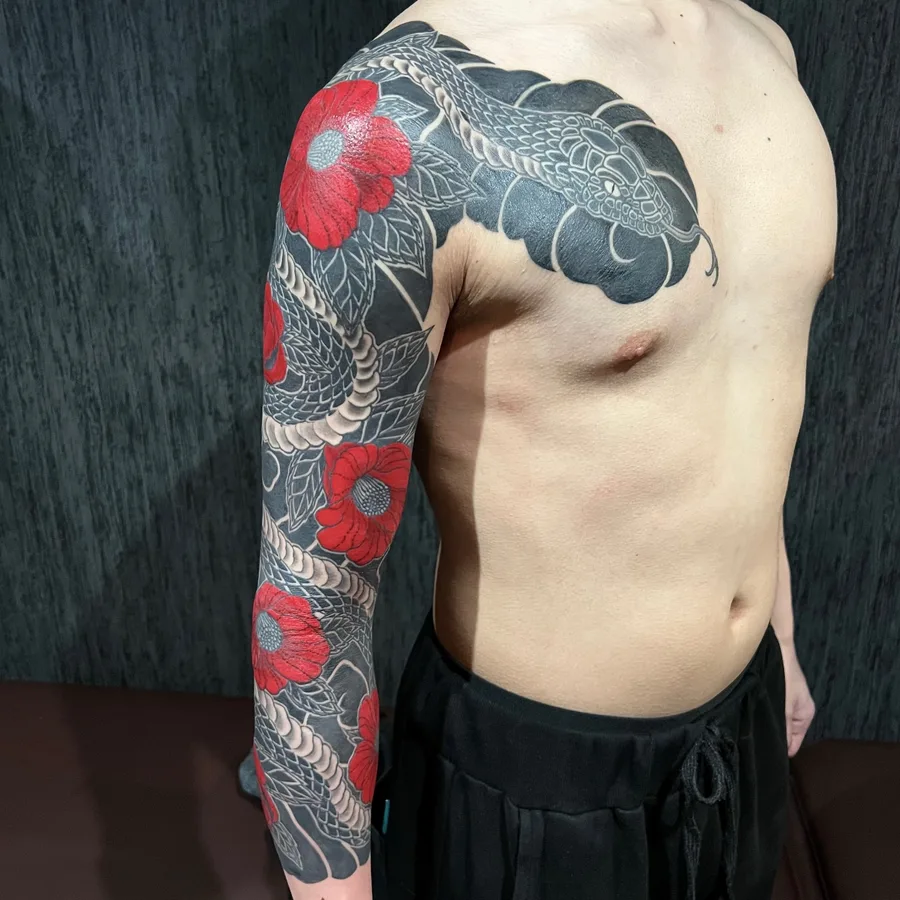 Black snake and camellias | 和 kazz
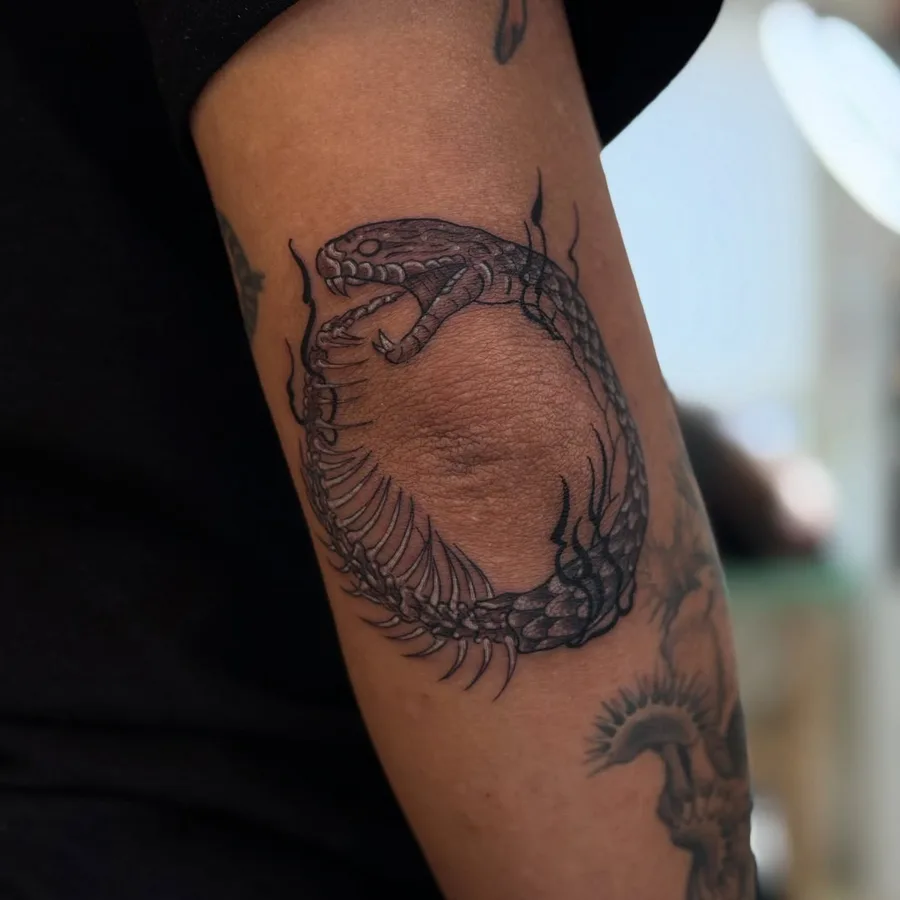 Ouroboros | はち Hachi
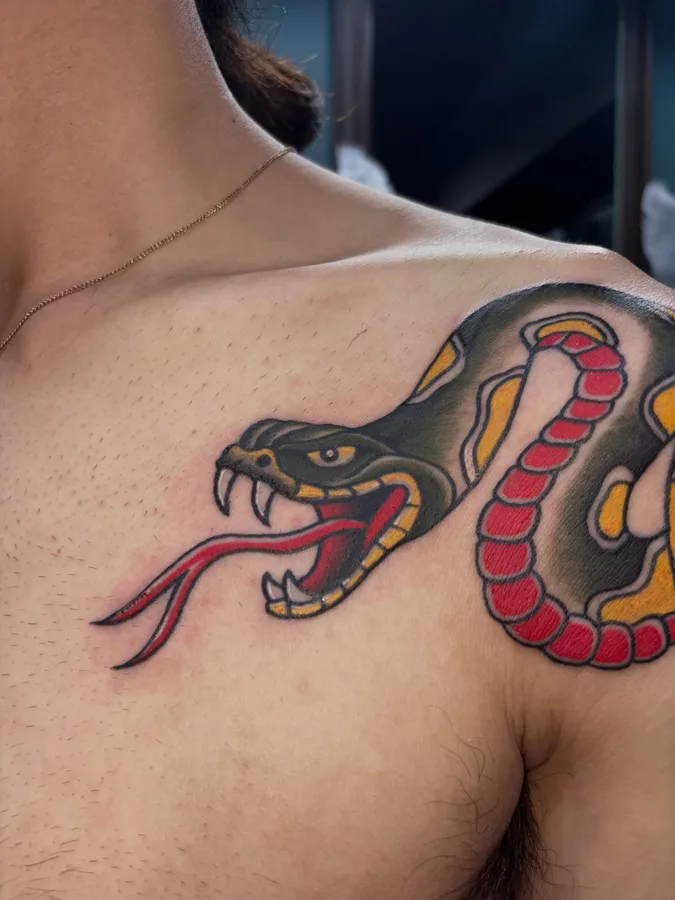 Old school, fangs bared | tera
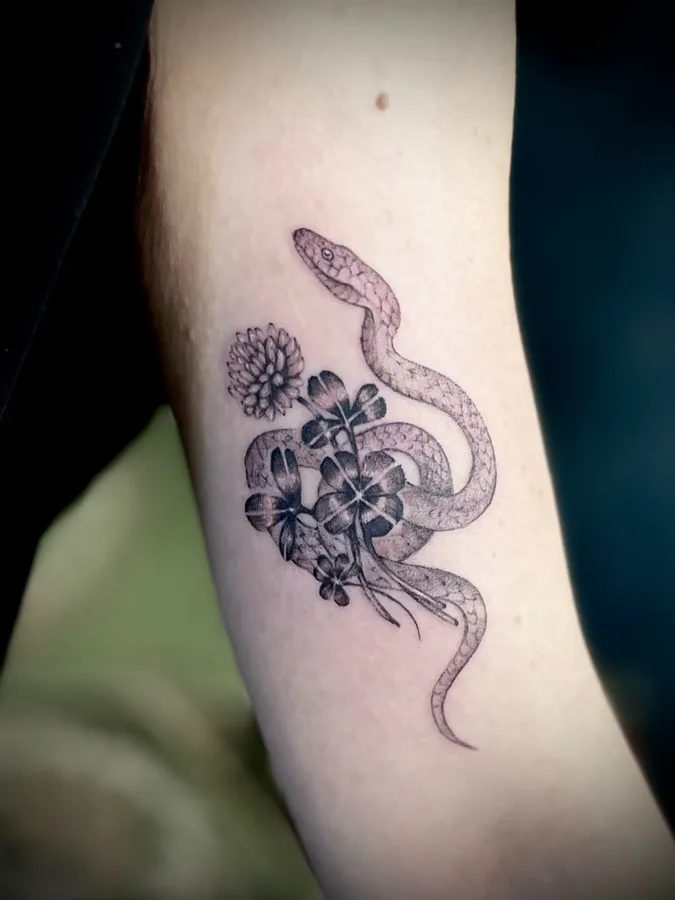 Snake and clover | NaO
Images are quoted from works by artists listed on tattooers.jp (as of November 16, 2026). Tap an image to open the work.
Cover photo: Amine İspir / Pexels
Artist pages: kazz / Hachi / tera / NaO
Some people build their own meaning in. kazz designed the black snake and camellias above around the client's own story: the fact that he had kept snakes, when he started getting tattooed, and the meaning of the flower. Beyond the old symbolism, your own connection to snakes, or the moment in life you get it, can be part of the picture.
Japanese Snake Tattoo Meaning: The Hebi in Irezumi
In Japan, the snake was often a figure of worship: a god of mountains and water, a guardian of the household, and the messenger of Benzaiten. That is why a hebi in irezumi tends to read as protective and lucky rather than sinister.
- A god of water and mountains: snakes were thought of as water gods or their messengers, and people prayed to them for rain. Old Japanese chronicles tell of Omononushi, the god of Mt. Miwa, whose true form was a snake [1][3]
- A guardian of the storehouse: in Japanese homes, snakes were often treated as guardians of the storehouse, and white snakes were thought especially good [1]
- The white snake of Benzaiten: Benzaiten (Benten) is the goddess of music, eloquence, wisdom and wealth, and one of the Seven Gods of Fortune [9]. White snakes are said to be her messengers, and at Engaku-ji temple in Kamakura there is a statue of Benzaiten seated on a coiled white snake [1]. Ugajin, the god identified with her, is pictured with a white snake in the crown [4]
- The jealous serpent: Japanese legend also has a darker snake. In the tale of Anchin and Kiyohime from Dojo-ji temple, a woman turns into a serpent out of obsessive love [1]. The Noh mask used for that serpent-woman is the hannya [6], one reason the hannya and the snake sit so naturally together
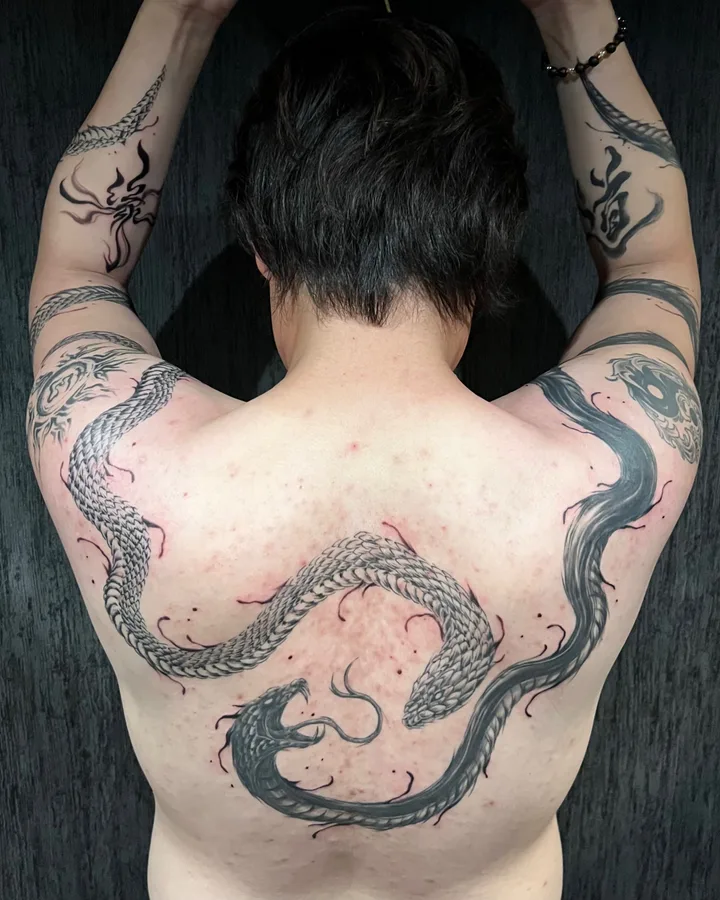 Black and white snakes | 和 kazz
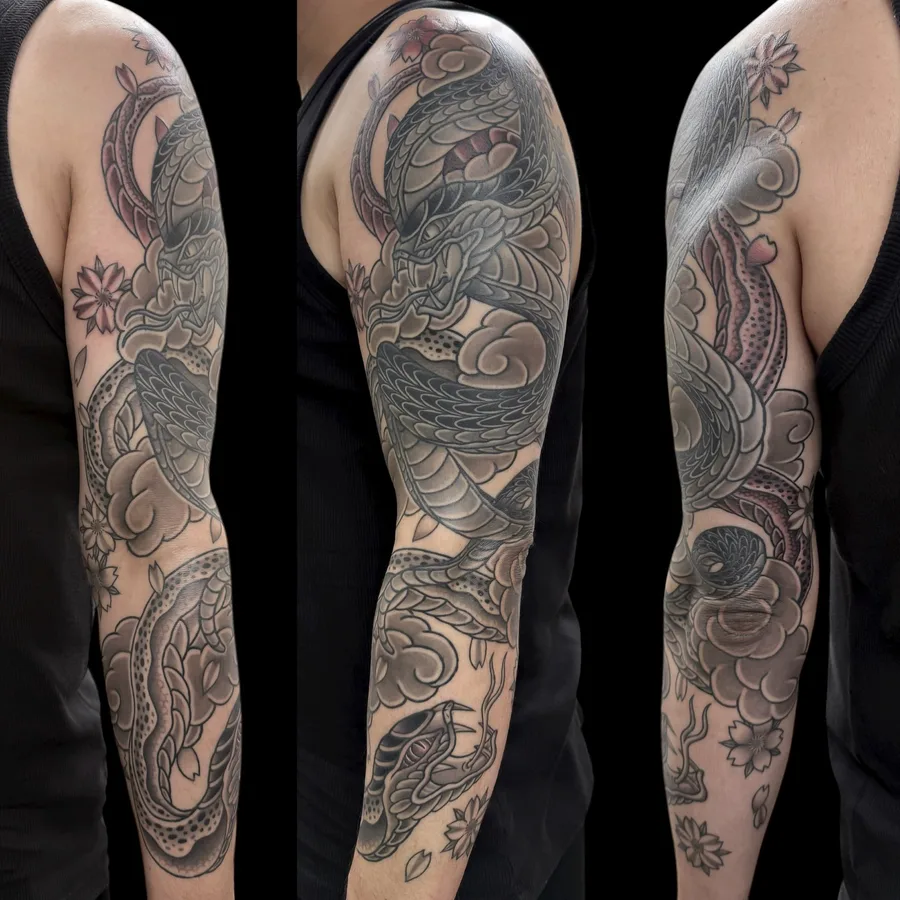 Two snakes, full sleeve | 彫也 HORINARI
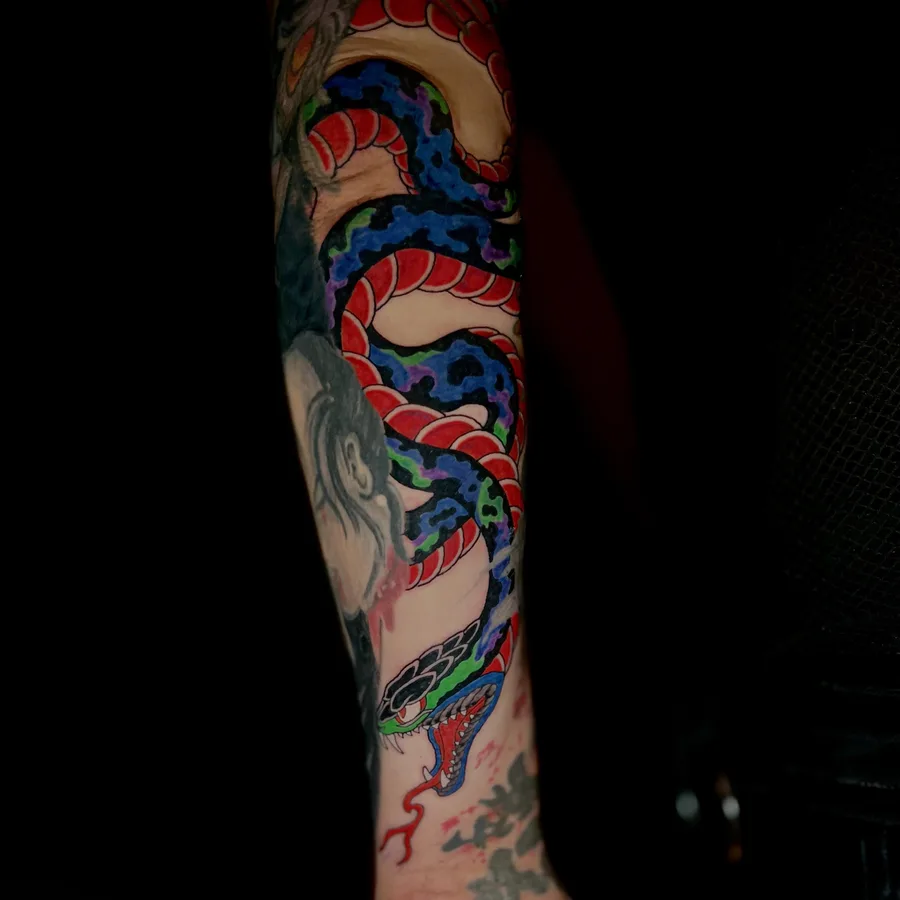 Color snake, freehand | 彫心堂 KOSHO
Images are quoted from works by artists listed on tattooers.jp (as of November 16, 2026). Tap an image to open the work.
Artist pages: kazz / HORINARI / KOSHO
kazz's black and white snakes run across the back, shoulders and both arms. The design was drawn to the client's actual body lines, combining a transferred stencil with freehand drawing. Shoshindo KOSHO describes the color snake as a "venomous snake, freehand", finished in one session. Some Japanese artists draw the design straight onto the skin with a pen, which makes it easy to follow the curve of the body.
For other Japanese motifs and what they are said to mean, see Japanese tattoo meanings. The dragon, a serpent-like creature itself, has its own guide: Japanese dragon tattoo meaning.
Snake Tattoo Meaning: Japanese vs Western
Western snake tattoos lean on Greek and Biblical stories (healing, eternity, temptation); Japanese snakes lean on worship (rebirth, protection, fortune). Both share the idea of rebirth through shedding skin.
| Japanese (irezumi) | Western | |
|---|---|---|
| Main stories | Water god and household guardian, Benzaiten's white snake, the serpent of Dojo-ji | Staff of Asclepius, ouroboros, the serpent of Eden, Medusa |
| Common readings | Rebirth, protection, luck and fortune | Rebirth, healing, eternity, temptation, danger |
| Often drawn with | Waves, clouds, flowers such as cherry blossoms and peonies, hannya masks | Roses, and figures such as Medusa. Daggers, apples and eagles also appear |
| Typical look | Part of a large composition that fills an arm or back | A single image, often old school with bold lines and fangs bared |
The "Often drawn with" row comes partly from our count below and partly from the works shown in this guide. On tattooers.jp, only 36% of the 282 snake works are Japanese traditional or neo-Japanese; more than 60% are in other styles (editorial count, November 11, 2026). Counted the same way, a little over 80% of dragon works were Japanese traditional (November 11, 2026). The snake is at home in both Japanese and Western tattooing.
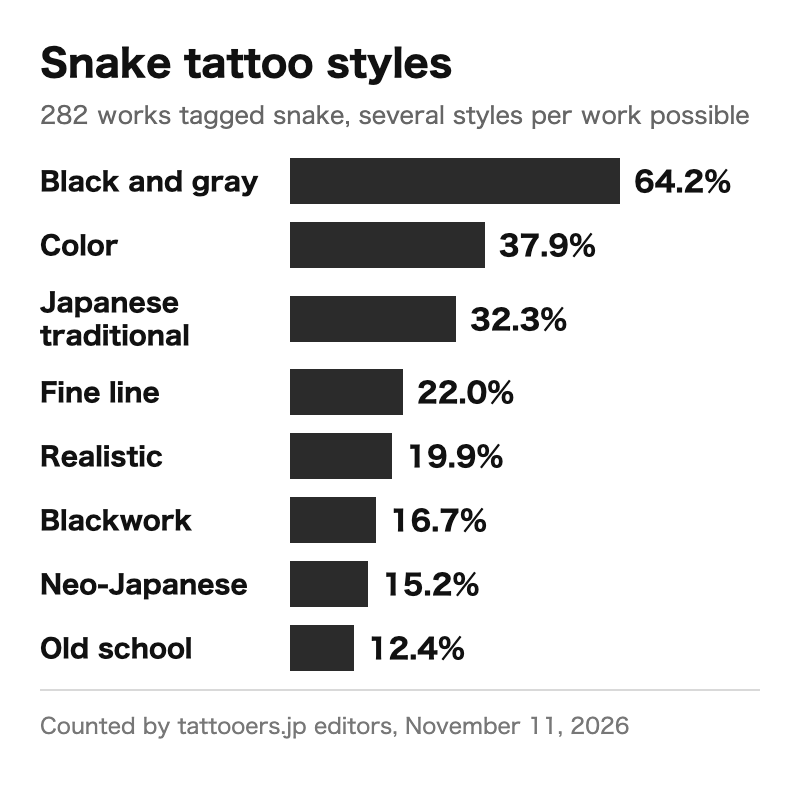 Figure: counted by tattooers.jp editors (November 11, 2026)
| Style | How the snake is usually drawn |
|---|---|
| Japanese traditional | With clouds, waves or cherry blossoms, as part of a large arm or back piece. Often paired with a hannya mask |
| Old school | Bold lines and clear colors. Mouth open, fangs bared, with a dagger or skull |
| Black and gray, realistic | Detailed scale texture and overlapping coils |
| Fine line, smoke | Thin lines or smoky shading that shows only the curve of the body |
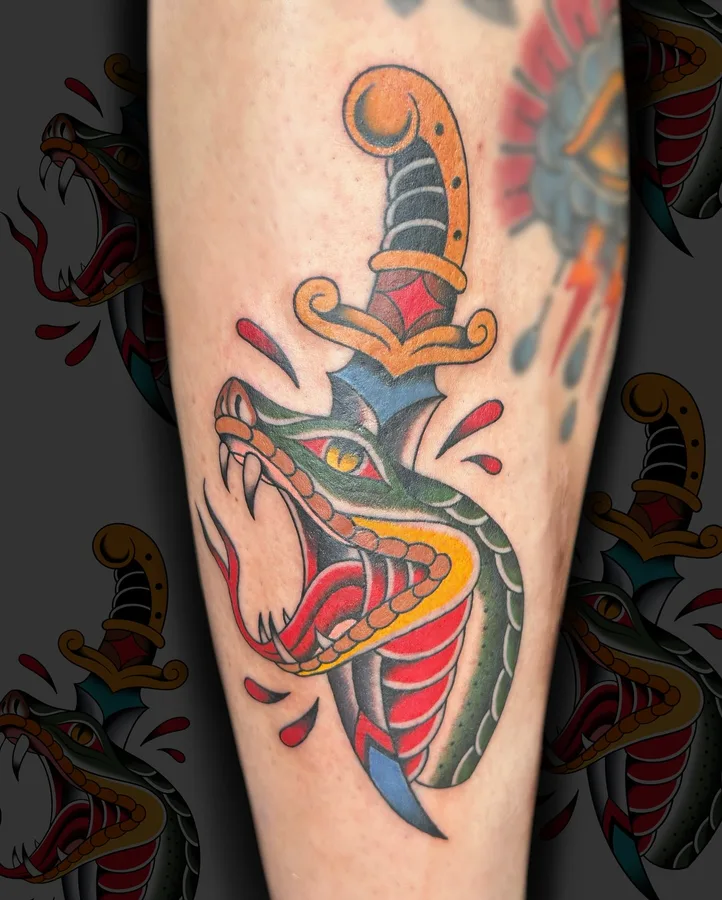
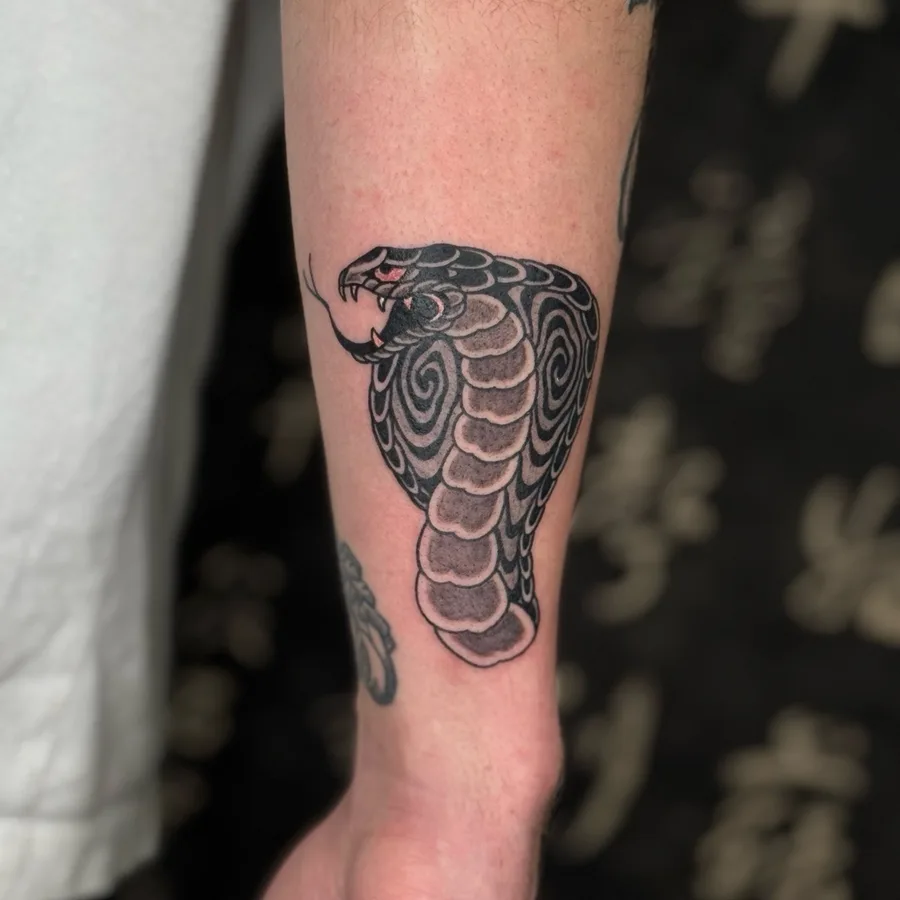
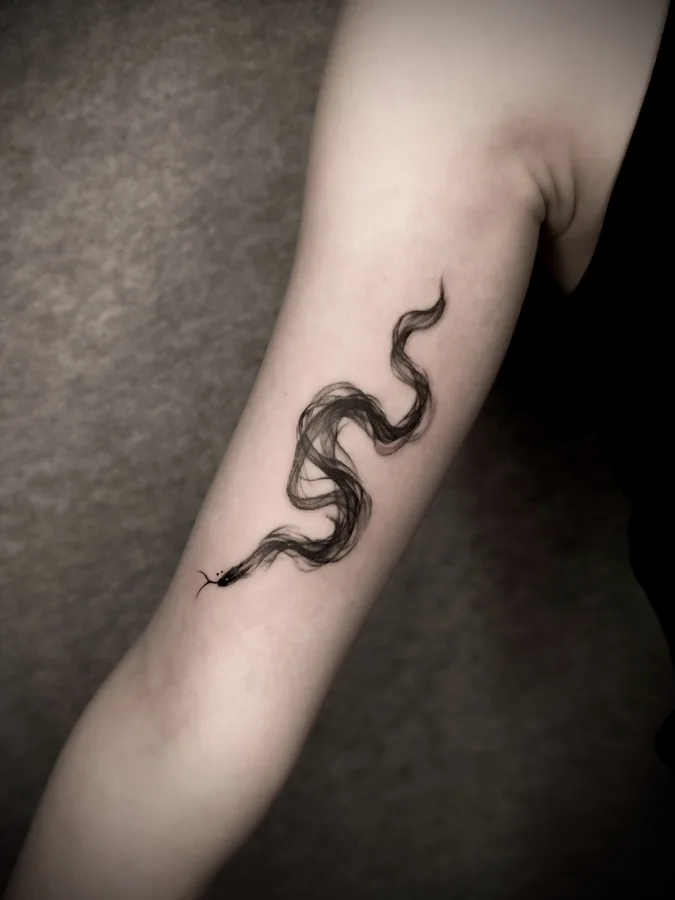
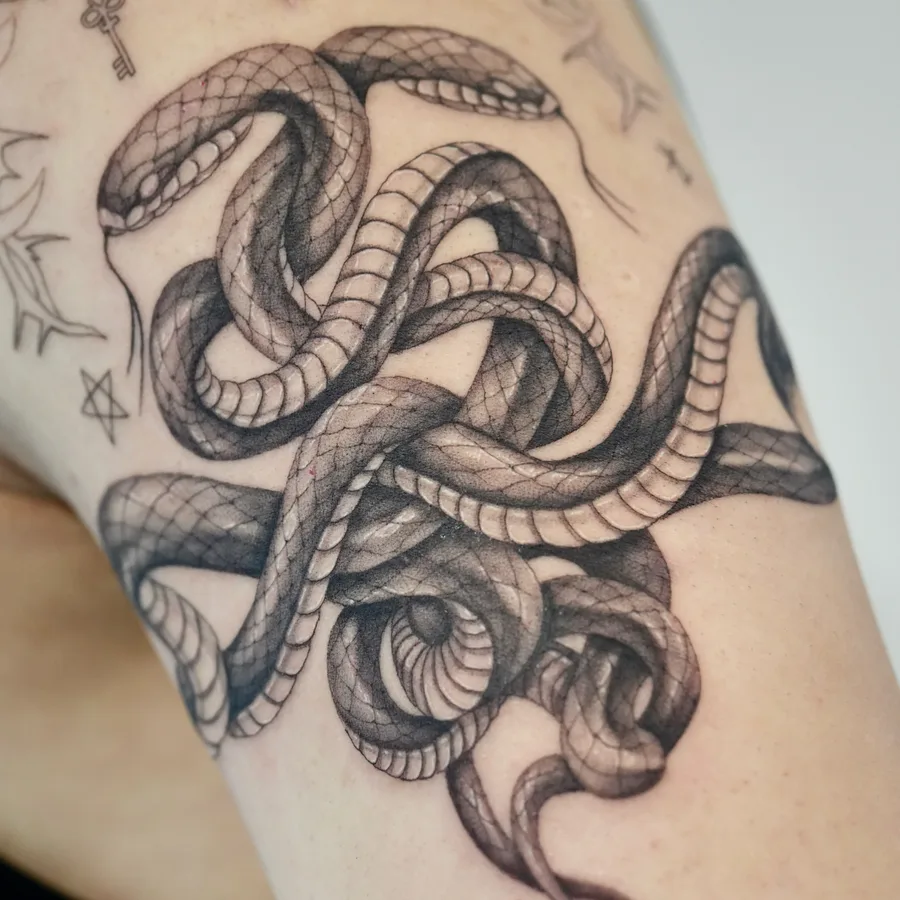
Images are quoted from works by artists listed on tattooers.jp (as of November 16, 2026). Tap an image to open the work.
Artist pages: ALO / Føø / HAZE / Kyo
Compare styles in Japanese style tattoos, neo-Japanese, old school, black and gray and realistic.
Snake and Hannya, Waves and Flowers: What Goes with the Snake
Flowers and plants appear in 45% of the snake works, the most common pairing overall (counted from tags, more than one per work). But the companions split clearly by style.
 Figure: counted by tattooers.jp editors (November 11, 2026)
- Japanese traditional: waves or clouds appear in a third of the works, and oni (demons) or hannya masks in nearly a quarter. Cherry blossoms, peonies and other flowers fill the arm or back around the snake
- Other styles: roses in about one in eight, skulls in about one in ten, and figures such as Medusa in one in five. None paired the snake with a hannya mask
So a snake with a hannya mask, waves and peonies is a distinctly Japanese combination, while a snake with a rose points to Western traditional. Skulls appear at about the same rate in both. For the hannya mask and other Japanese motifs, see Japanese tattoo meanings; for peonies, cherry blossoms and other flowers, see Japanese flower tattoos.
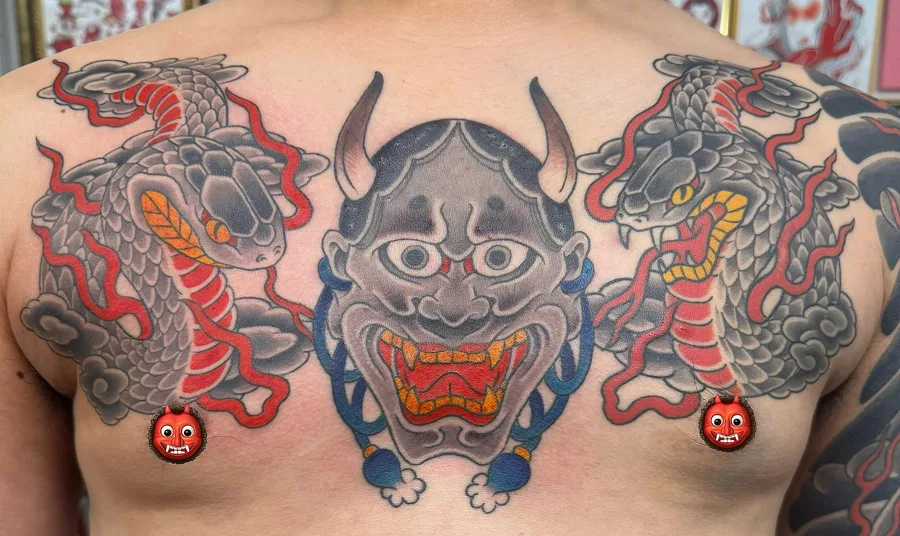 Hannya and two snakes | 西村弘司 Koji Nishimura
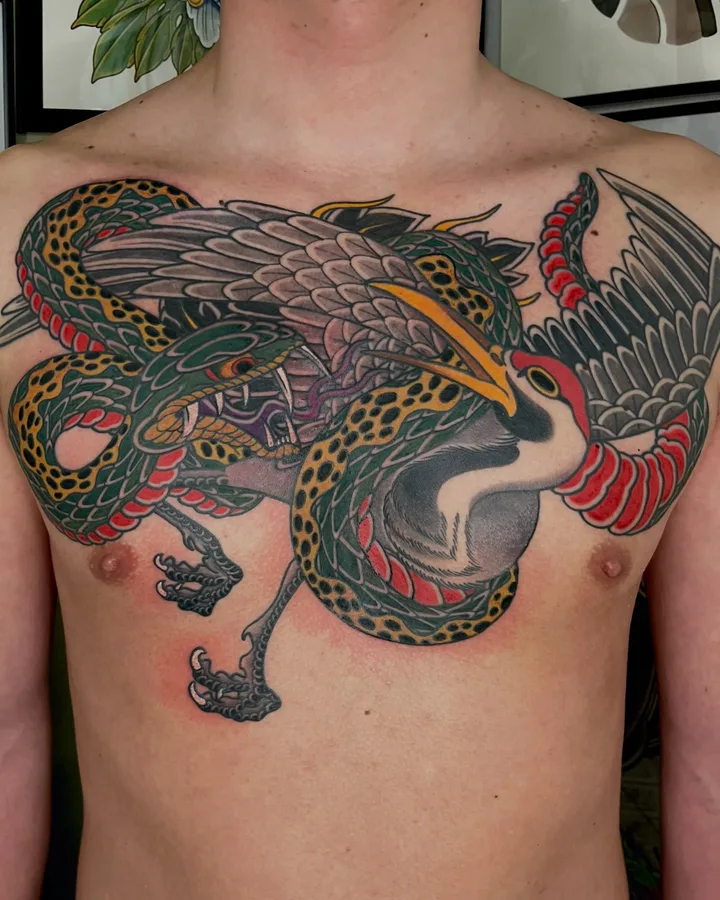 Crane and snake | RYOSHIN
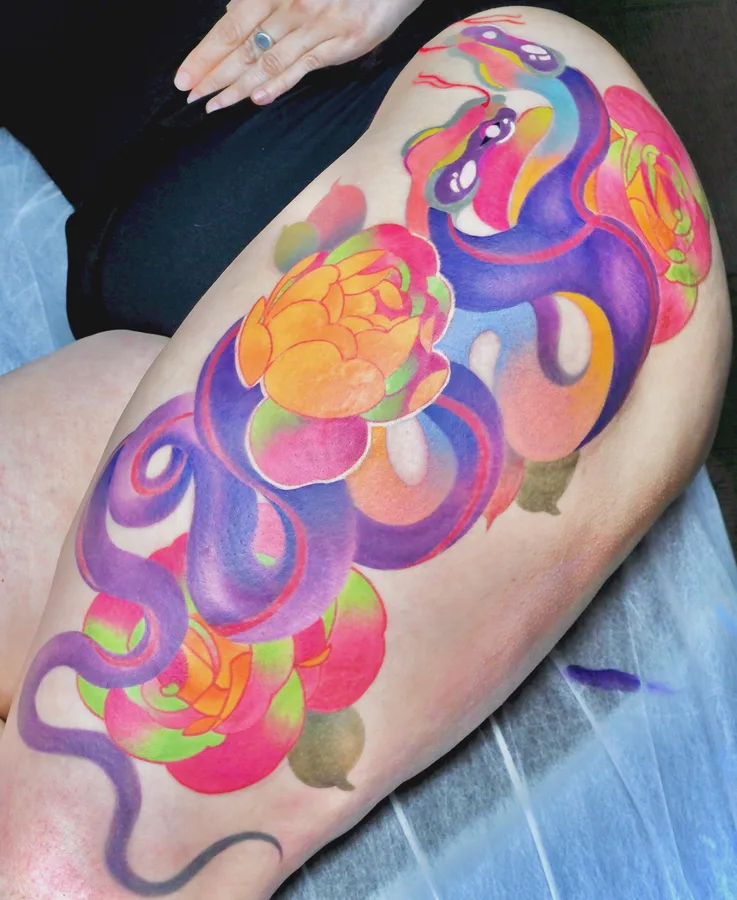 Snakes and flowers | ff.yang
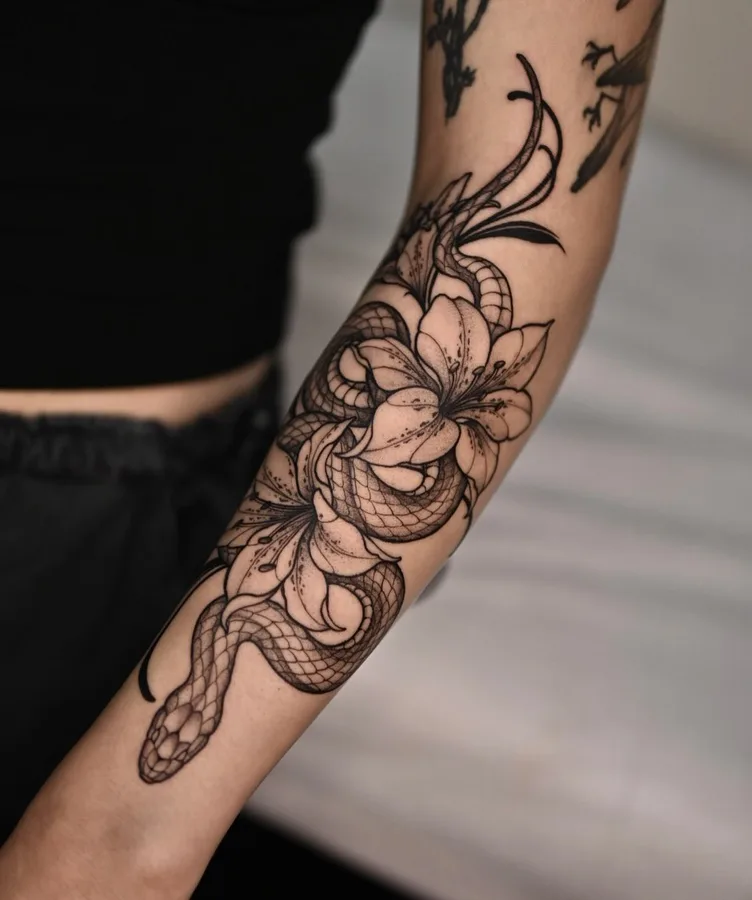 Snake and lily | Kana
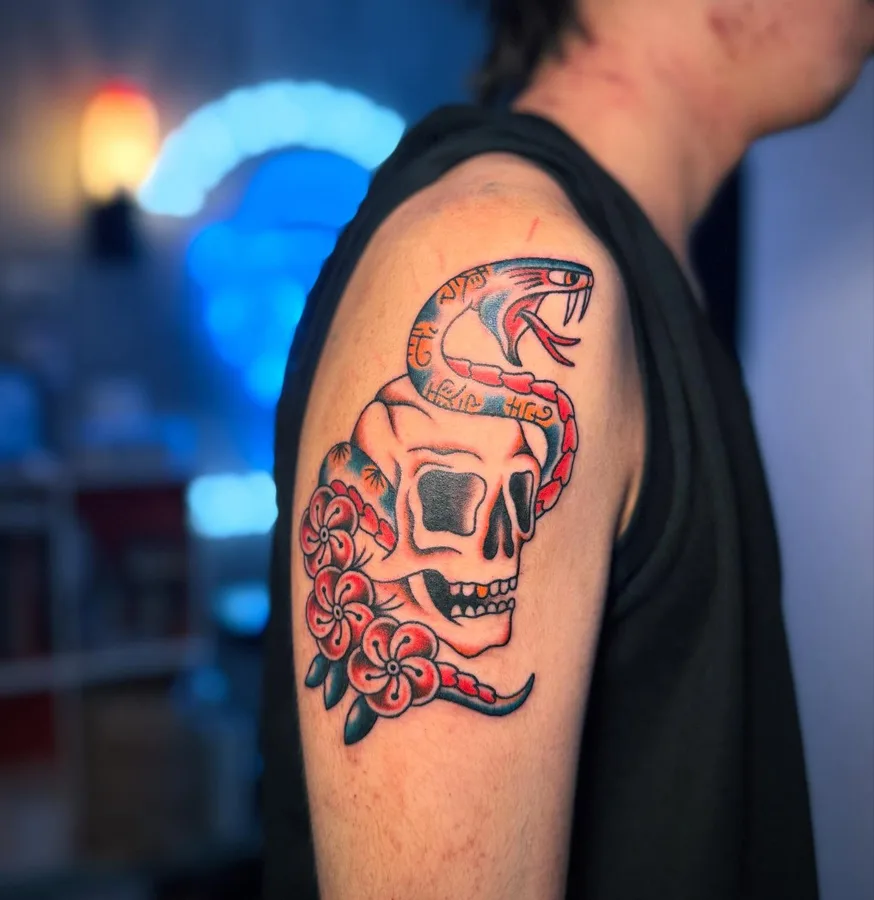 Snake and skull | savvy
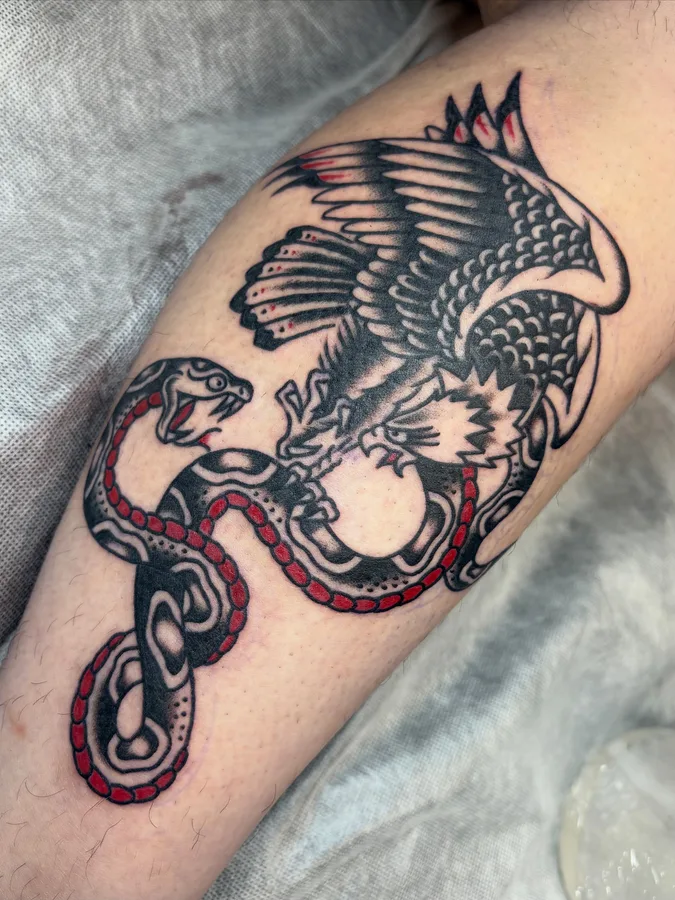 Eagle and snake | NATSUKO
Images are quoted from works by artists listed on tattooers.jp (as of November 16, 2026). Tap an image to open the work.
Artist pages: Koji Nishimura / RYOSHIN / ff.yang / Kana / savvy / NATSUKO
With flowers, let the flowers follow the snake's movement and the picture holds together. NaO wrote of the snake and clover that the flowers and leaves were arranged along the snake's movement so the motifs connect naturally. RYOSHIN's crane and snake across the chest was finished in three sessions.
Browse flowers, roses, skulls, hannya masks and waves on tattooers.jp.
Snakes in Myth: Medusa, Nue and Genbu
The snake also appears as part of mythical creatures and gods. Instead of a snake alone, you can choose a figure that wears one.
- Medusa: one of the Gorgons of Greek myth, with snakes for hair and a gaze that turned people to stone. The Gorgon's face seems to have started out as a protective charm [7]
- Nue: a creature from Japanese folklore. Midori describes it as having the face of a monkey, the body of a tiger and the tail of a snake
- Genbu (the Black Tortoise): one of the Four Guardians, with the Azure Dragon of the east, the White Tiger of the west and the Vermilion Bird of the south. It guards the north and is shown as a snake coiled around a tortoise [8]
- Snake and apple: a combination that recalls the serpent of Eden, seen in Western-style work
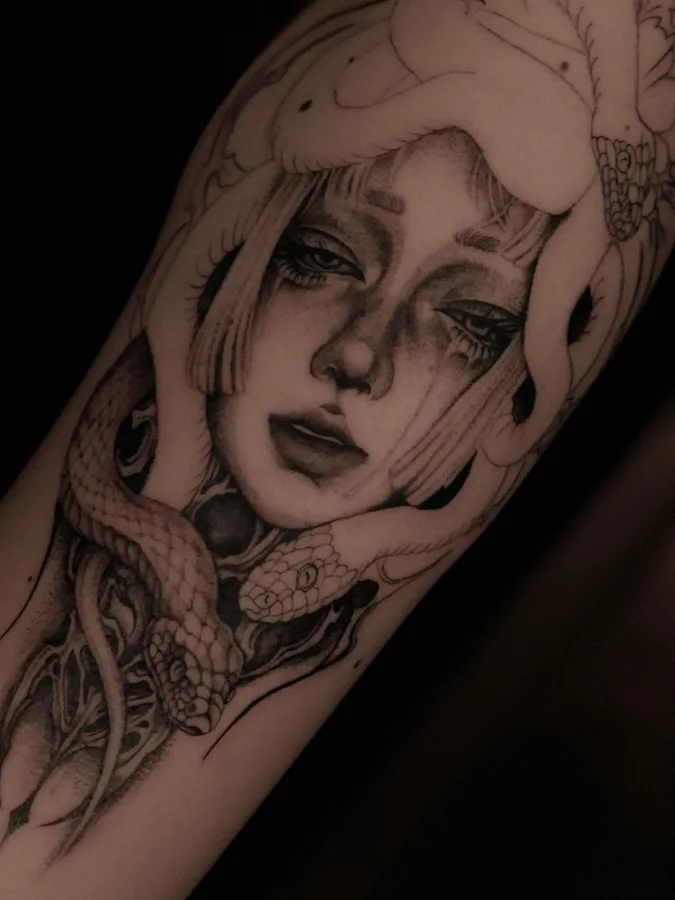
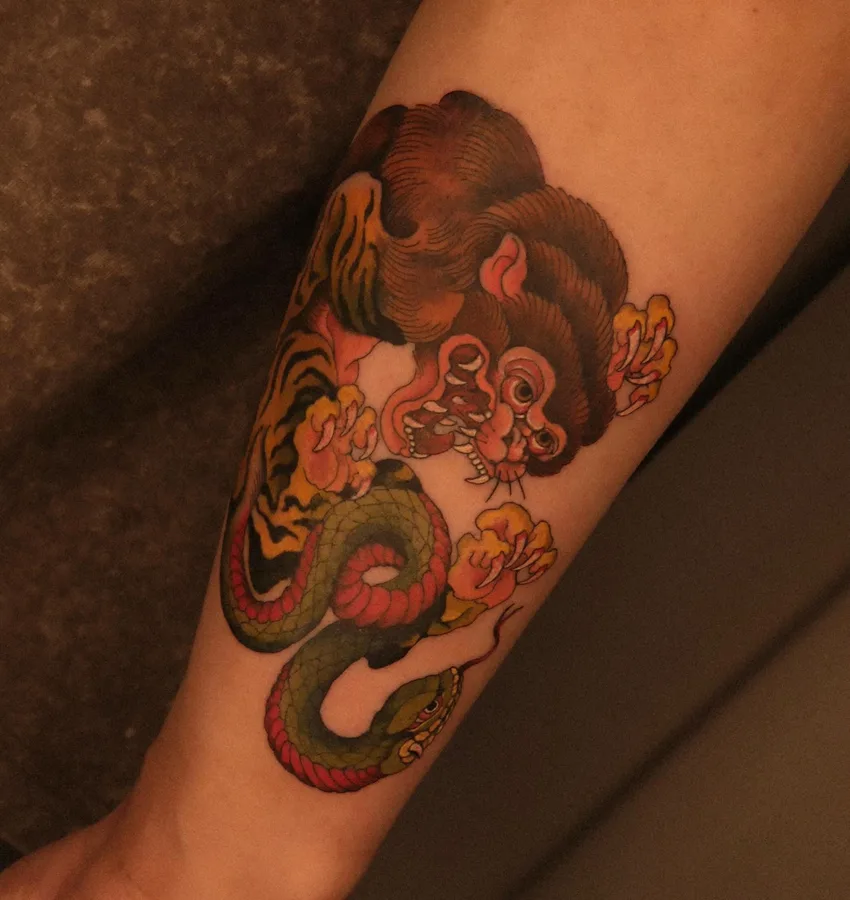
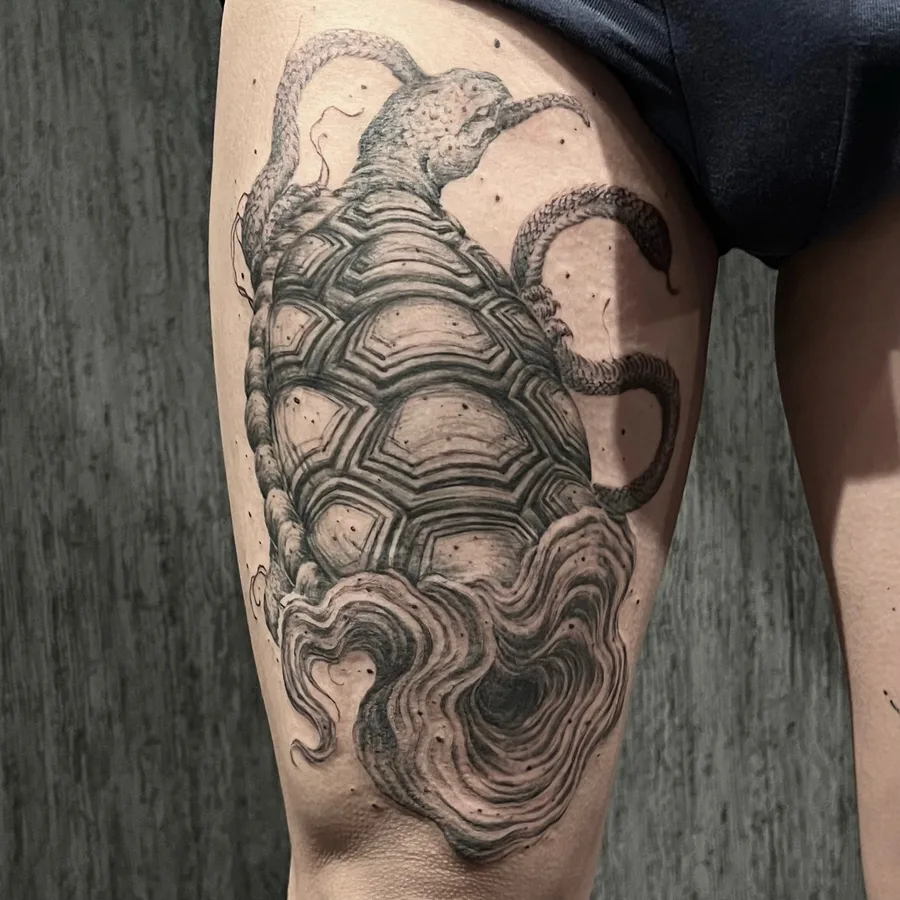
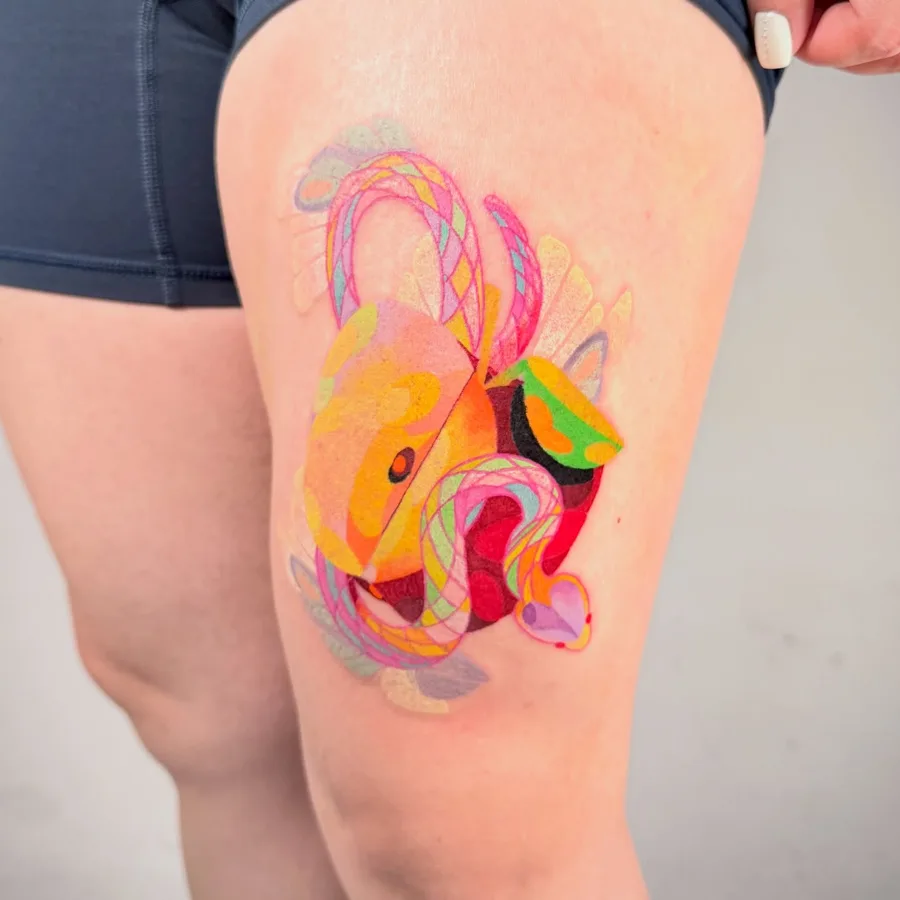
Images are quoted from works by artists listed on tattooers.jp (as of November 16, 2026). Tap an image to open the work.
Artist pages: Midori / kazz / ff.yang
kazz's Genbu completed a set of the Four Guardians on one client, after the Azure Dragon, Vermilion Bird and White Tiger. Some people build a single set one piece at a time. ff.yang's snake and apple took seven hours.
Where People Put Snake Tattoos: 282 Works on tattooers.jp
As of November 11, 2026, 282 works on tattooers.jp were tagged "snake" (our editorial count; the number keeps growing as artists add work). The arm is the most common placement at 53%, followed by the back (11%), leg (10%), chest (8%) and shoulder (8%). Japanese-style or not, more than half are on the arm.
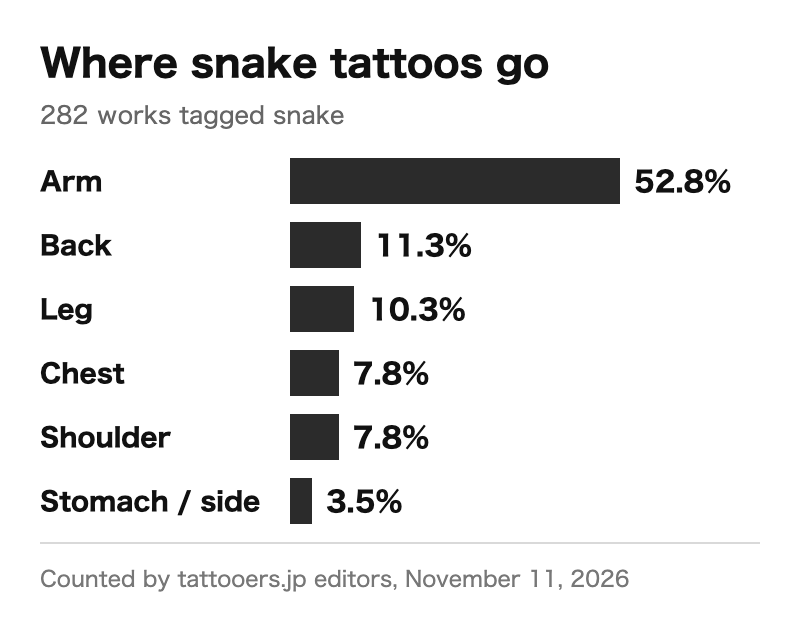 Figure: counted by tattooers.jp editors (November 11, 2026)
A snake's body is long and thin, so it can wrap around, follow a line or fill a gap. That makes it easy to fit on an arm: wrapped from shoulder to elbow, one snake down the forearm, a ring around the wrist, or winding from the back over the shoulder and down the arm.
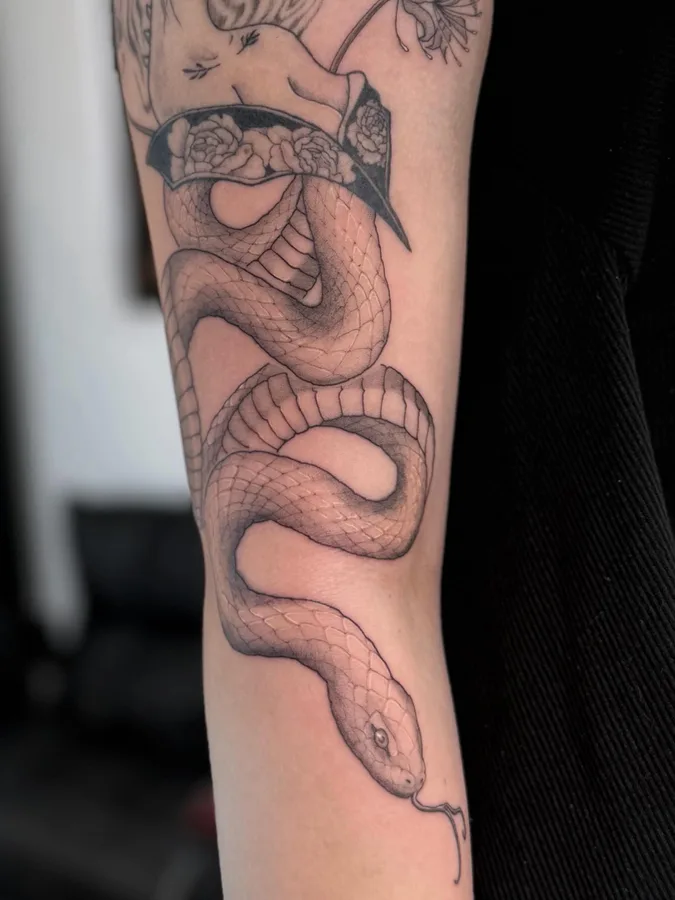 Down the arm | ALIEN TATTOO KOBE / Ki
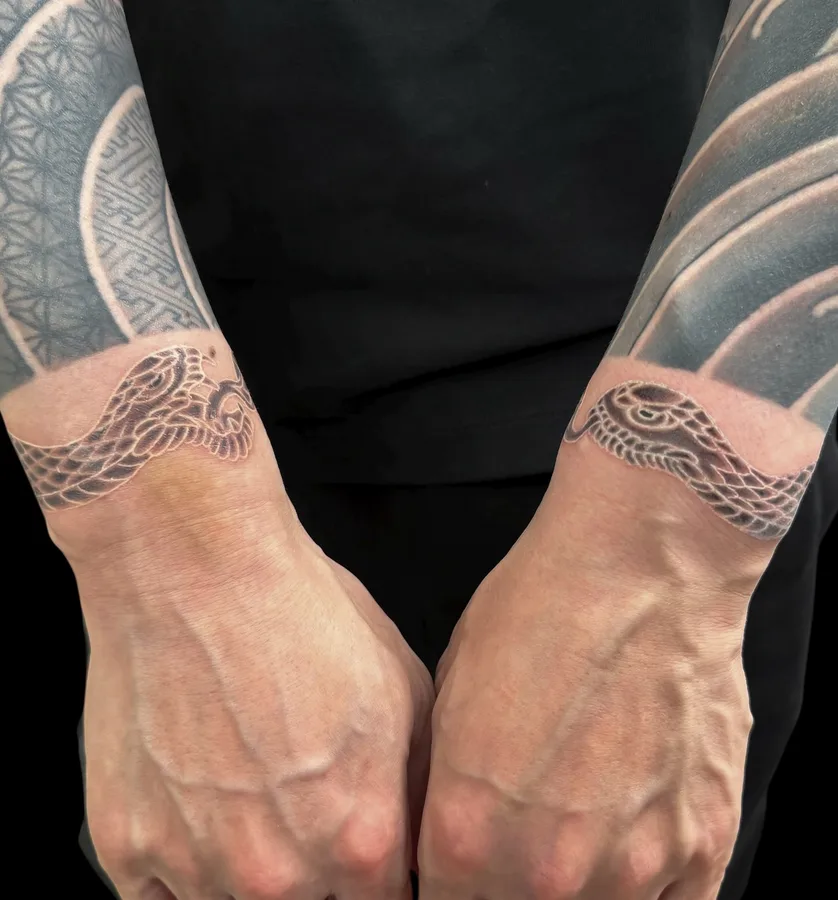 Around the wrists | 彫也 HORINARI
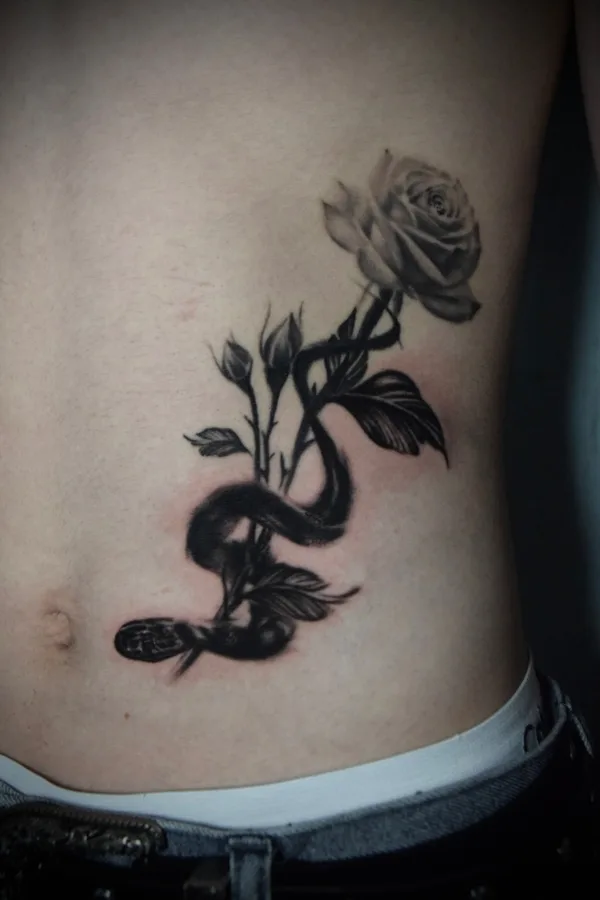 Along the side | KATSU
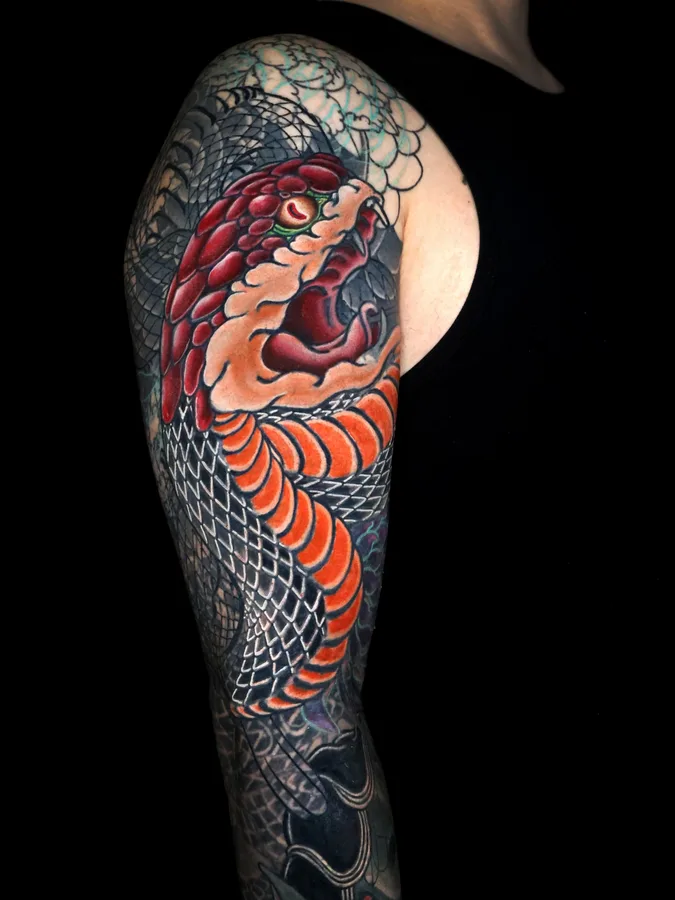 Full-arm cover-up | Shingun
Images are quoted from works by artists listed on tattooers.jp (as of November 16, 2026). Tap an image to open the work.
Artist pages: ALIEN TATTOO KOBE / Ki / HORINARI / KATSU / Shingun
Artists' notes show how much the snake is drawn to fit the body. ALIEN TATTOO KOBE / Ki added the snake to a spider lily piece at short notice, matched to the shape and slimness of the arm. KATSU designed a client's first tattoo, a rose and snake, with a slightly abstract touch to follow the body's lines.
A snake is also easy to add later. HORINARI added a second snake next to one tattooed earlier, and calls the white-outline wrist snakes a style often ordered 15 to 20 years ago. Some people choose a snake to fill the gaps between other tattoos.
Size and the number of sessions drive the cost; see the tattoo price guide for ranges and tattoo pain by body part for how each spot feels. Browse works by arm, back, leg and chest.
Planning a snake tattoo in Japan? Tell us your dates, the placement and the kind of snake you want, and we match you with an artist. We message you on Instagram within 48 hours, and the ¥15,000 deposit is fully refunded if we can't match you.
Small and Fine-Line Snake Tattoos
A snake in thin lines is easy to make small. About one in five snake works on tattooers.jp are tagged fine line, minimal or one-point, on the arm, shoulder, back or collarbone.
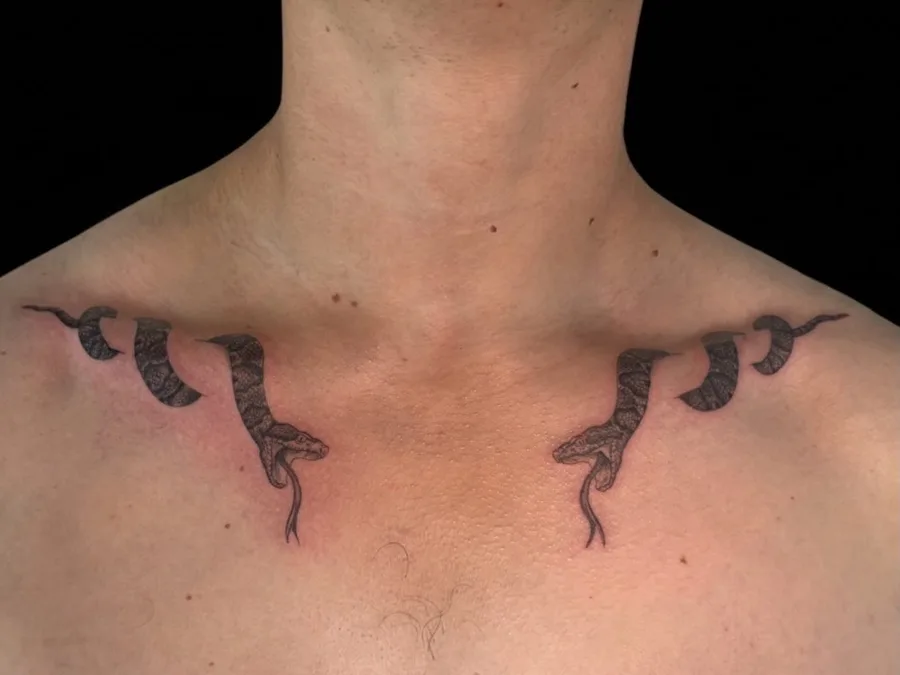
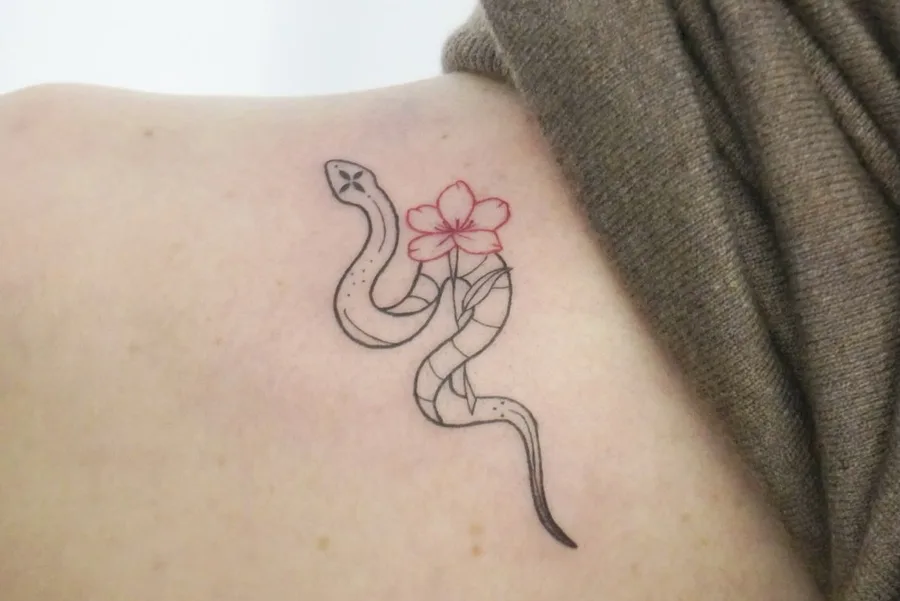
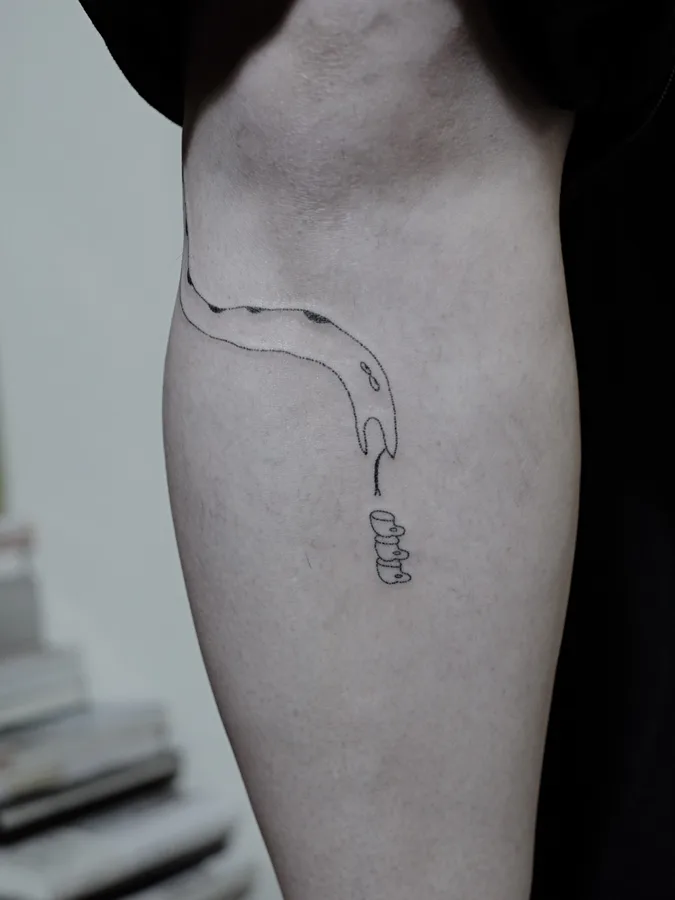
Images are quoted from works by artists listed on tattooers.jp (as of November 16, 2026). Tap an image to open the work.
Artist pages: Kai / SOU / Furatto
A snake has a lot of detail in its scales and face, though. The smaller it gets, the more has to be left out, so give the size you have in mind when you send your idea. More small work is in fine line tattoos.
Planning a Japanese Snake Tattoo in Japan
Decide five things before you send your idea: placement and how it wraps, head position and expression, style, what goes with it, and color and sessions.
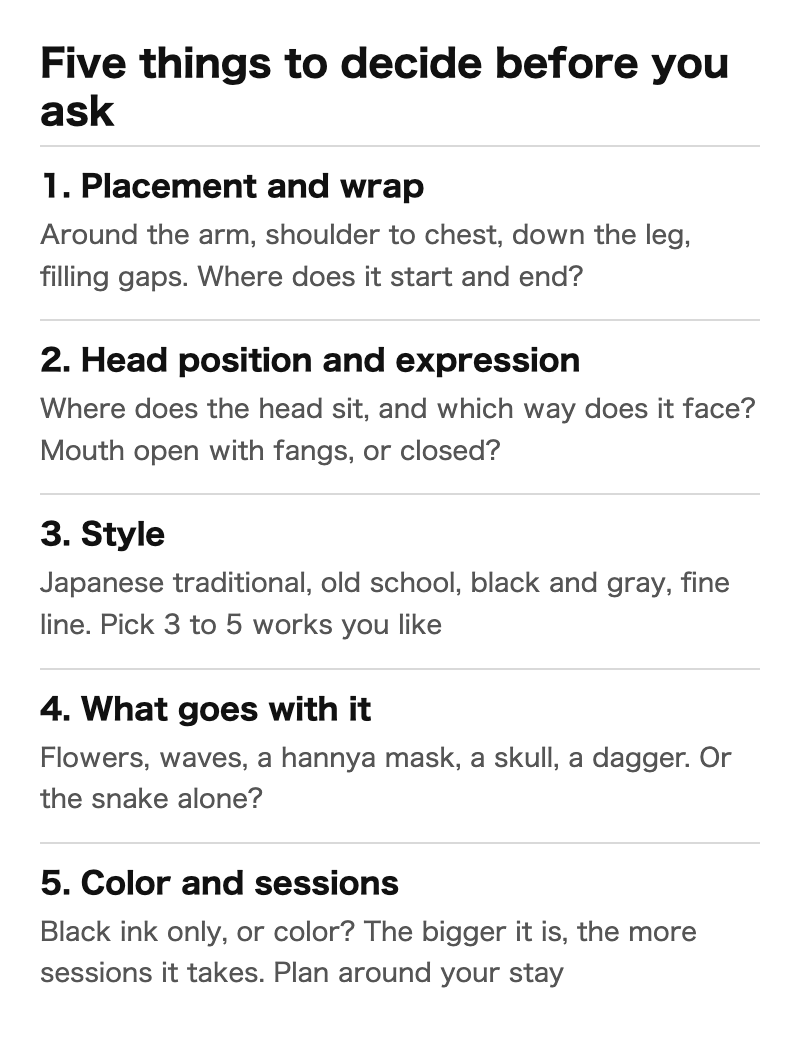 Figure: tattooers.jp editorial team
Color is a common source of regret. GEN, vocalist of the Japanese band HIKAGE, wanted the snake on his elbow in black, but when it was done abroad it came out in color; he talks about it in his interview. If you want black ink only, say so clearly.
Some people want a large snake to hide an old tattoo. Because a snake can be made thicker or longer and the space around it filled with flowers or waves, it can be shaped to the area you need to cover. Shingun's full-arm piece above is a snake cover-up in progress. Whether a cover-up works depends on how dark and large the old tattoo is; mention it in your request. You can also see artists who do cover-ups.
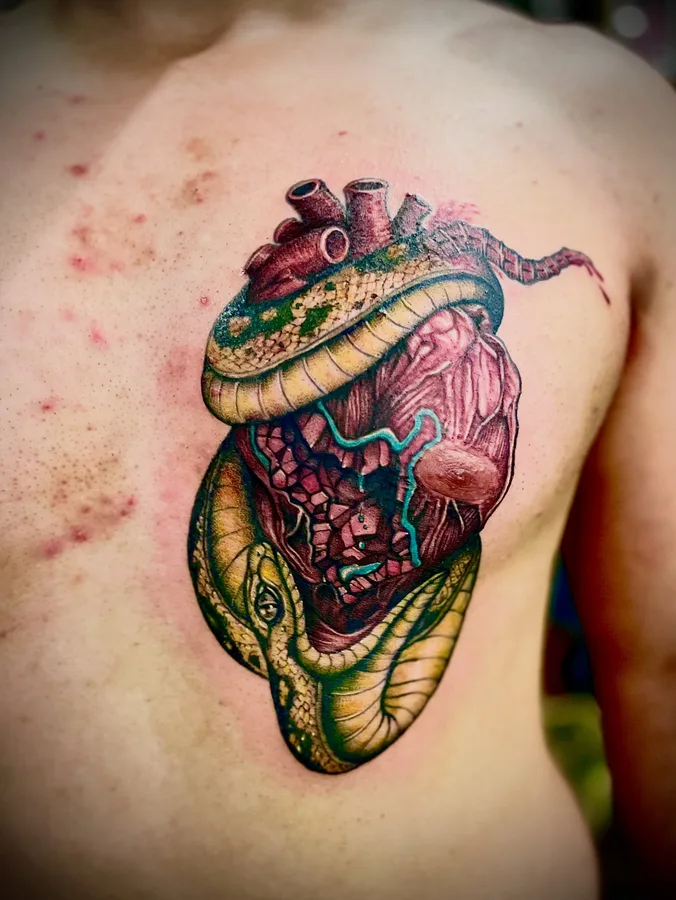
Images are quoted from works by artists listed on tattooers.jp (as of November 16, 2026). Tap an image to open the work.
Artist pages: NaO
NaO's snake and heart combines the heart as a symbol of life with the snake's strength, and NaO notes it was the client's first tattoo. Some people choose a large snake for their first piece. First-timers can also look through artists who welcome beginners.
On tattooers.jp you do not contact artists yourself. Put your dates, placement, size and reference pictures in the inbound request form, and we match you with an artist who fits. To get a feel for the range first, save three to five snakes you like from snake tattoos and attach them: the scales, the face and the way the body winds differ a lot from artist to artist. Many of the snake works on the site come from artists in Tokyo, Osaka, Hyogo, Kanagawa and Aichi; see Tokyo, Osaka, Hyogo, Kanagawa, Aichi and tattoo artists in Japan. Tattooing is for people 18 and over.
Frequently Asked Questions
Q. Is a snake tattoo bad luck in Japan?
No rule says so. In Japan, snakes were worshipped as water gods and their messengers, and the white snake is linked to Benzaiten, the goddess of fortune [1][4]. In Christianity, the serpent that tempted Eve is identified with Satan [1]. How you read it is up to you; if you worry, pair it with flowers or ask for a softer expression in your request.
Q. What does a white snake tattoo mean in Japan?
The white snake is said to be the messenger of Benzaiten, and white snakes are worshipped as Ugajin, a god of fortune identified with her [1][4]. In tattooing it is usually read as luck and fortune.
Q. Why are the snake and the hannya mask tattooed together?
On tattooers.jp, nearly a quarter of Japanese-style snake works include an oni or hannya mask, and none of the other styles do. The hannya is the Noh mask of a woman turned demon by jealousy, and it is worn for the serpent-woman of the play Dojoji [6]. The pairing has that story behind it, but the meaning of a finished piece is yours to decide.
Q. Should I get a snake in Japanese or Western style?
Either works. On tattooers.jp, 36% of snake works are Japanese traditional or neo-Japanese and more than 60% are other styles. Japanese snakes often come with waves and hannya masks, Western ones with roses. Choose by the style of the works you like.
Q. Can women get a snake tattoo?
Yes. No motif is tied to gender. The works on tattooers.jp include fine line snakes with flowers and small snakes on both collarbones. Line weight, color and size change the impression a lot, so choose by style.
Summary
- A Japanese snake tattoo is often chosen for rebirth through shedding skin, and in Japan for protection and fortune. No meaning is fixed
- In Japanese belief the hebi is often a figure of worship: a water god, a guardian of the storehouse and the white snake of Benzaiten. Western snakes draw on the staff of Asclepius, the ouroboros and the serpent of Eden
- Only 36% of the 282 snake works on tattooers.jp are Japanese traditional or neo-Japanese. The snake fits both traditions
- 53% are on the arm. A snake can wrap, follow the body and be added to later
- Japanese snakes come with waves, hannya masks and flowers; Western ones with roses
- Before you ask, decide placement and wrap, head and expression, style, what goes with it, and color and sessions
Want a snake tattooed in Japan? Get matched with an artist in Japan: tell us your dates and idea, and we message you on Instagram within 48 hours. The ¥15,000 deposit is fully refunded if we can't match you. You can also browse snake tattoos and Japanese style tattoos on tattooers.jp.
References
Many sources are Japanese dictionaries; titles are our translations. Links open external sites.
- Kotobank (Heibonsha World Encyclopedia, revised edition; Shogakukan Nipponica). "Snake" (Japanese). Accessed November 16, 2026.
- World Health Organization. The WHO Logo and Emblem. Accessed November 16, 2026.
- Kotobank (Heibonsha World Encyclopedia, old edition, and others). "Omononushi" (Japanese). Accessed November 16, 2026.
- Kotobank (Shogakukan Digital Daijisen; Nihon Kokugo Daijiten, concise edition). "Ugajin" (Japanese). Accessed November 16, 2026.
- Kotobank (Shogakukan Nipponica; Heibonsha World Encyclopedia, revised edition). "Ouroboros" (Japanese). Accessed November 16, 2026.
- Victoria and Albert Museum. Hannya (Noh mask, 1650–1750). Accessed November 16, 2026.
- Kotobank (Shogakukan Digital Daijisen; Nipponica). "Medusa" (Japanese). Accessed November 16, 2026.
- Kotobank (Shogakukan Digital Daijisen; Nipponica). "Genbu" (Japanese). Accessed November 16, 2026.
- Kotobank (Shogakukan Digital Daijisen). "Benzaiten" (Japanese). Accessed November 16, 2026.
The counts, placements and tag shares are tattooers.jp editorial counts based on the 282 works publicly tagged "snake" on tattooers.jp as of November 11, 2026. Tags include works where the snake plays a supporting role, so read the shares as tendencies. The dragon share comes from a count made the same way on November 11, 2026. Artists' words are paraphrased from their work descriptions. Meanings combine readings recorded in dictionaries and museums with interpretations heard in the tattoo world; they are not fixed meanings.
