If you get tattooed during a trip to Japan, keep it clean, wash it gently, put on only a thin layer of moisturizer, shower instead of bathing, and stay out of onsen, sento, pools and the sea until it has completely healed. The dermatology sources we checked don't give a fixed number of days. Consumer health guides often quote at least 2 to 4 weeks, and large pieces take longer [1][2][6][7].
That usually means planning your onsen days before the session, not after. This guide walks through the first weeks in the order a trip happens: the wrap or film, washing in a hotel room, hot springs and beaches, the flight home, Japan's summer sun and what to buy at a drugstore.
This is general information, not medical advice. Your tattoo artist's instructions come first, because they know the ink, the dressing and your skin. If something looks wrong, see a doctor.
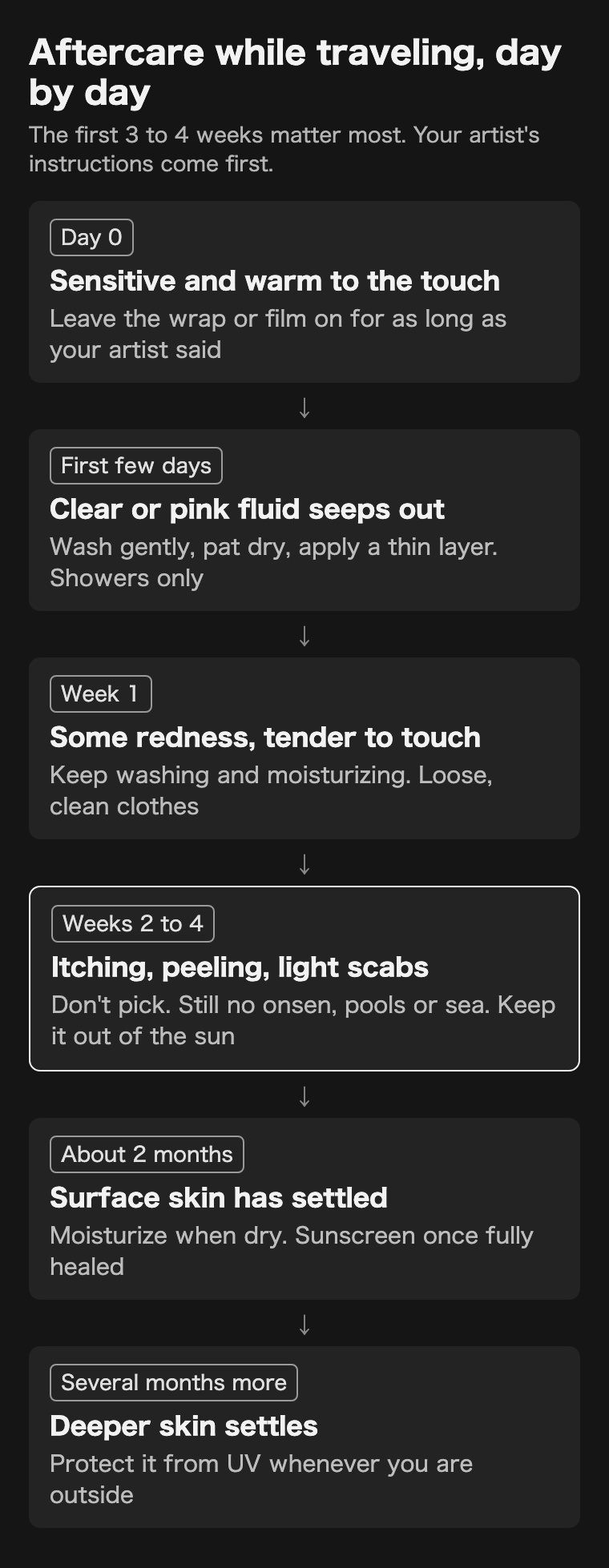
Your Aftercare Timeline, Day by Day
The first 3 to 4 weeks matter most. Crusting and peeling tend to settle from around the third week. The surface skin usually settles in about two months, and the deeper layers can take several months more [2]. Small tattoos tend to heal faster than large ones [2].
| When | What is common | What to do on the road |
|---|---|---|
| Day 0 (the session) | Sensitive and warm to the touch [1] | Keep the wrap or film on for as long as your artist said |
| First few days | Clear or pink fluid seeps out; mild redness and swelling fade day by day [1] | Wash gently and apply a thin layer of what your artist recommends [1][2]. Showers only |
| Week 1 | Some redness, tender to touch [5] | Keep washing and moisturizing. Wear loose, clean clothes [2] |
| Weeks 2 to 4 | Itching, peeling and light scabs [2] | Do not pick or scratch. Still no onsen, pools or sea. Keep it out of direct sun [1][2] |
| About 2 months | The surface skin has settled [2] | Moisturize when dry. Start sunscreen once it is fully healed [1][4] |
| Several months more | The deeper skin settles [2] | Protect it from UV whenever you are outside [4] |
 Cover photo: Nataliya Melnychuk / Unsplash
The only day counts in the table are the ones our sources state. If your trip is short, the whole healing period may happen after you fly home, so most of this guide is also what you will do at home.
Day 0 to Day 3: The Wrap, the Film and the First Wash
Leave the dressing on for exactly as long as your artist tells you. Artists use different dressings: ointment under plastic wrap or gauze, or an adhesive clear film (often called "second skin") [1][5]. One US dermatology article says you may need to keep a bandage on for at least three hours or more, depending on the size [2].
If you have a clear film:
- Some clear or pink fluid under the film is normal in the first days [1]. The European Academy of Dermatology and Venereology (EADV) leaflet says film can stay on for 24 hours or even several days as long as it feels comfortable and nothing leaks [1]
- If fluid leaks out or the film lifts, the leaflet says it must be changed [1]. Take it off, wash, and ask your artist whether to apply new film or switch to ointment
- Do not cover a healed tattoo with film again [1]
If you have wrap or gauze, wash your hands first, soak the dressing with warm, not hot, water and peel it off slowly [2].
Before you leave the studio, ask your artist two travel questions: how to reach them if something looks off (photos by message are easiest), and whether you will need spare film or ointment for the rest of your trip. If you booked through tattooers.jp (/inbound), you can also message our team on Instagram at @tattootourtokyo.
Washing and Moisturizing in a Hotel Room
Wash with clean hands, warm (not hot) water and a little mild soap, without rubbing, then pat dry. Showering is fine [1]. Hand washing is the single most important way to prevent infection [5].
- Wash your hands with soap before you touch the tattoo, and avoid touching it otherwise [1][5]
- Use warm, not hot, water and a gentle soap without fragrance or dye [2]
- Do not scrub. Pat dry with a clean towel or paper towel, or let it air dry [1][2]
- One US clinic suggests washing and moisturizing twice a day for the first weeks [2]. Follow your artist if they say otherwise
A pack of paper towels, or one clean towel kept just for the tattoo, makes patting dry simple. If your room has a bathtub, shower standing up and do not fill the tub to soak.
 Photo: Kelsey Curtis / Unsplash
Whatever you apply, keep it thin [1]. Sources disagree on what to use:
| What | What the sources say |
|---|---|
| Gentle ointment or moisturizer | The EADV leaflet describes a light film of hypoallergenic ointment two or three times a day for the first 2 to 3 days, then a gentle moisturizer until the scabs are gone [1] |
| Petroleum jelly | Advice is split. A Cleveland Clinic dermatology article says to avoid it because it can block the pores [2], and the American Academy of Dermatology (AAD) says petroleum-based products can fade tattoo ink and suggests water-based lotions or creams for dry tattooed skin [4]. Some artists still recommend a thin layer. Follow your artist, and if you use it, keep it thin |
| Antibiotic or antiseptic creams | Not needed while healing. Use them only for an infection, after a doctor sees it [1][5] |
| Fragranced products | A study of 84 tattoo aftercare products found many contained fragrance, botanicals and other potential allergens [8]. Unscented is the safer choice [1] |
When Can You Go in an Onsen, Sento, Pool or the Sea?
Not until the tattoo has completely healed. Showers are fine; soaking is not. The EADV leaflet says to avoid bathing, swimming and sauna until the tattoo is completely healed [1], and a US dermatology article says not to immerse it in water until then [2]. The dermatology sources we checked don't give a fixed number of days.
Consumer health sites put a range on it. Healthline says healing before swimming can take at least 2 to 4 weeks [6]. WebMD says to avoid swimming and the sun for about 2 weeks [7]. Large tattoos can take months to fully heal [2]. So the honest answer is a range, often at least 2 to 4 weeks, longer for big or heavily shaded work, and only once there are no scabs or peeling left. Your artist's call comes first.
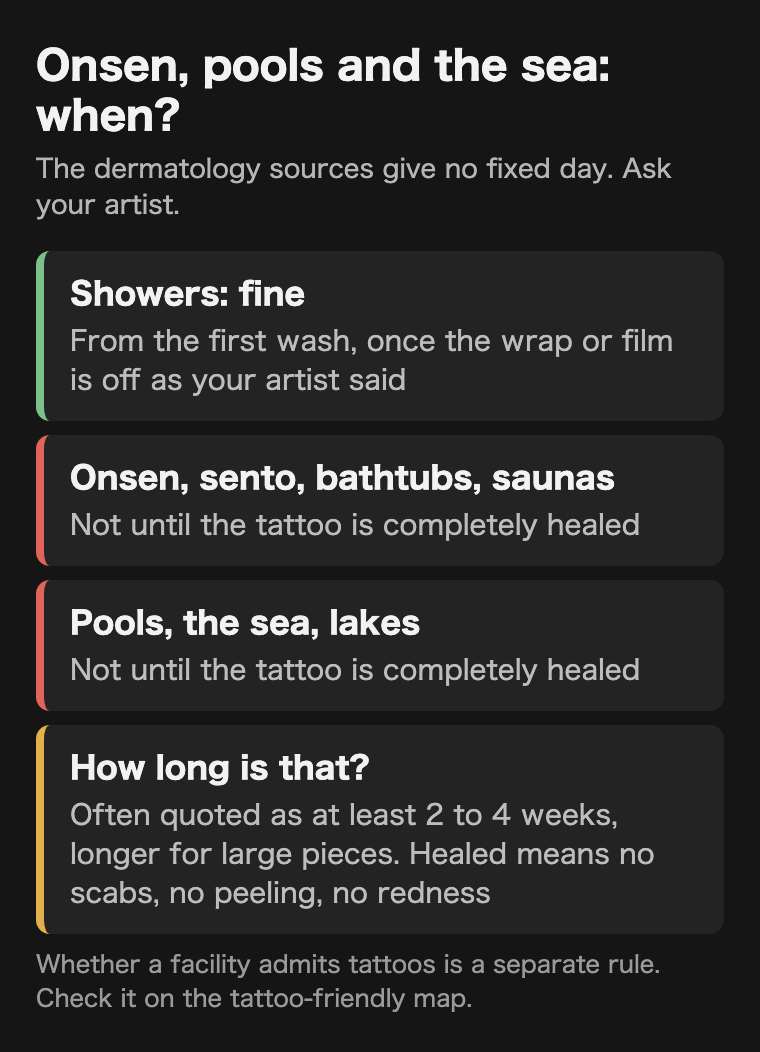
What this means for a trip:
- Book the onsen before the tattoo, not after. If both are on your itinerary, put the hot springs, the beach day and the pool at the start of the trip and the session near the end
- A private bath does not change the healing rule. An in-room bath or private onsen solves the facility's tattoo policy, not the open wound. Soaking is still the problem
- Hot water is harder on fresh skin. WebMD warns that very hot water hurts and can fade ink [7]. Onsen water is hot and shared, so we would not treat it more loosely than a pool
- Covering it does not help. Do not put cover stickers or tape on a tattoo that has not healed. See how to cover tattoos in Japan for later
Once it has healed, whether you may bathe is up to each facility. That part is not about your skin. Our tattoo-friendly onsen, sento and sauna map shows each facility's official wording, and our guide to tattoo-friendly onsen in Tokyo compares the rules there. You can also browse the Tokyo tattoo-friendly map.
What a Healed Tattoo Looks Like
A healed tattoo has no scabs and no peeling left, and the redness has gone. These works by artists on tattooers.jp were posted as healed photos, some months or more than a year after the session.
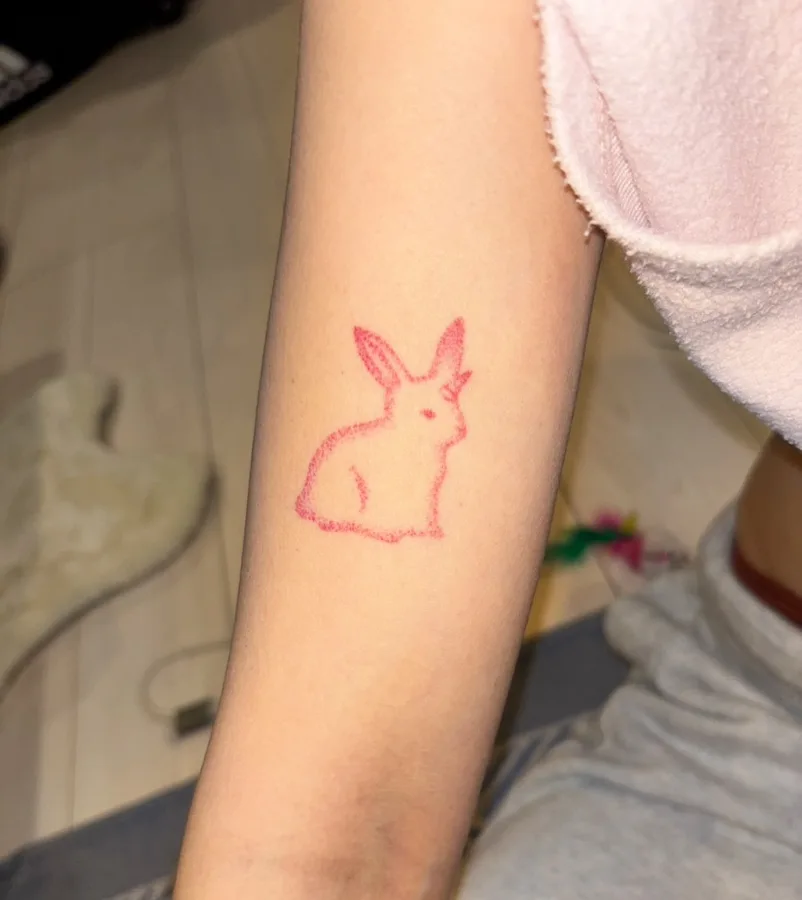 Rabbit, healed 2.5 months | miantatu
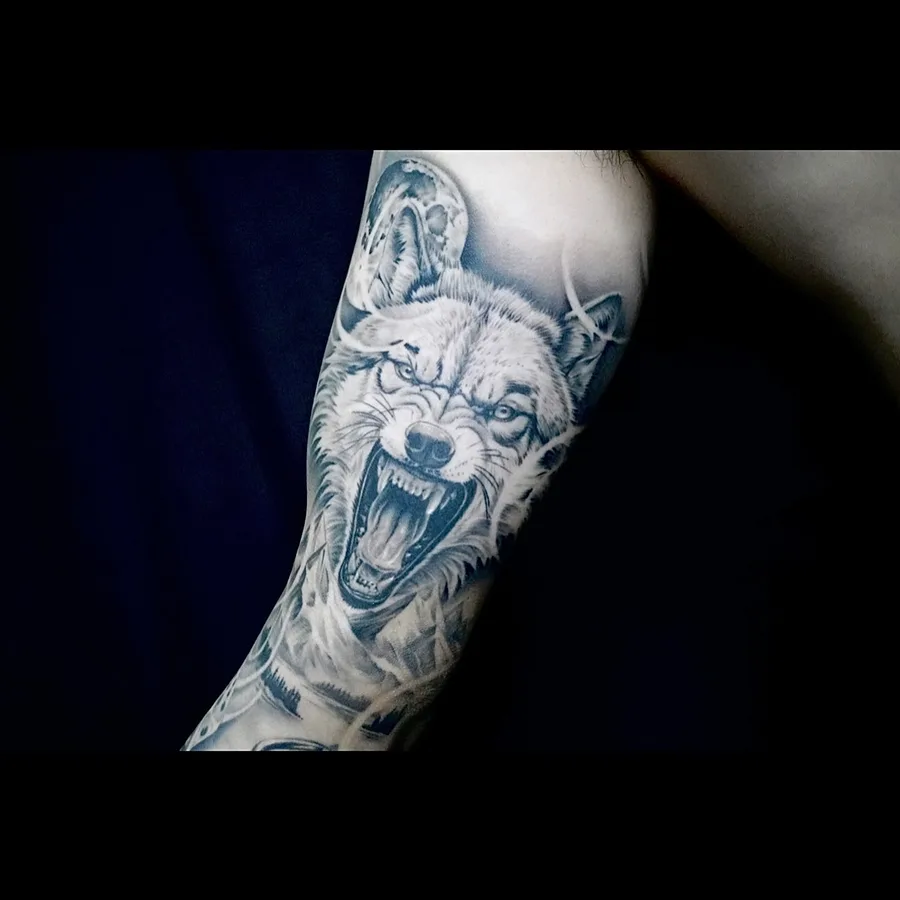 Wolf, healed | KZ
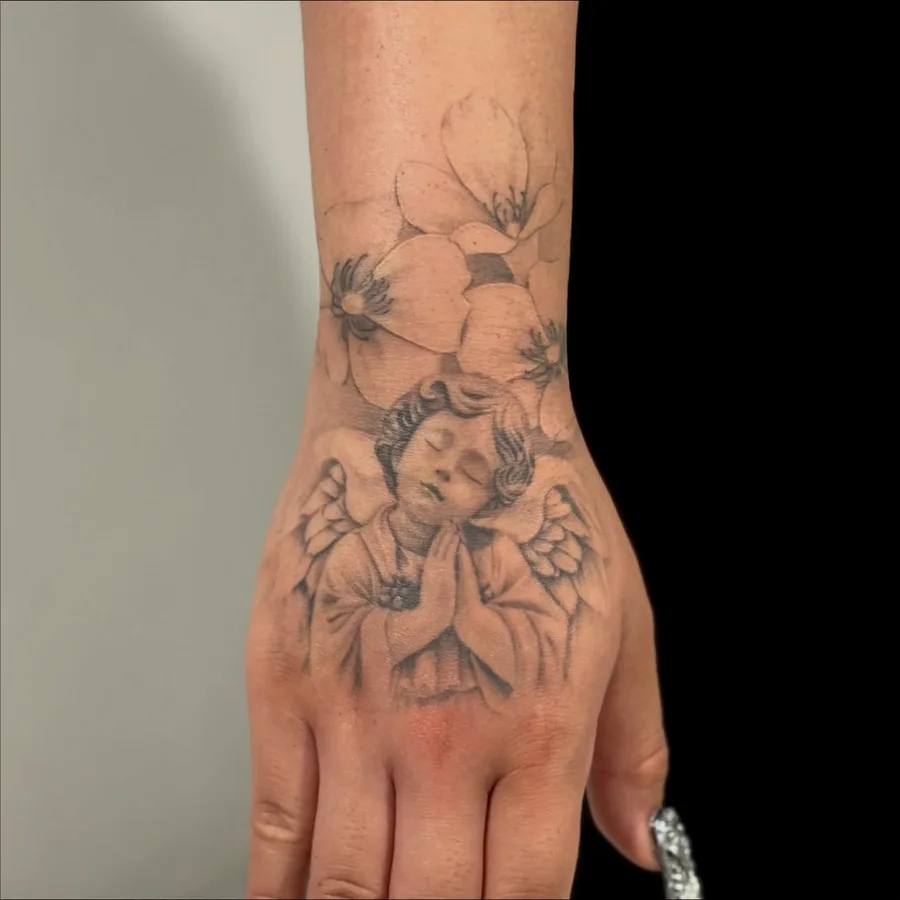 Angel and flowers, healed | 京 Kyo
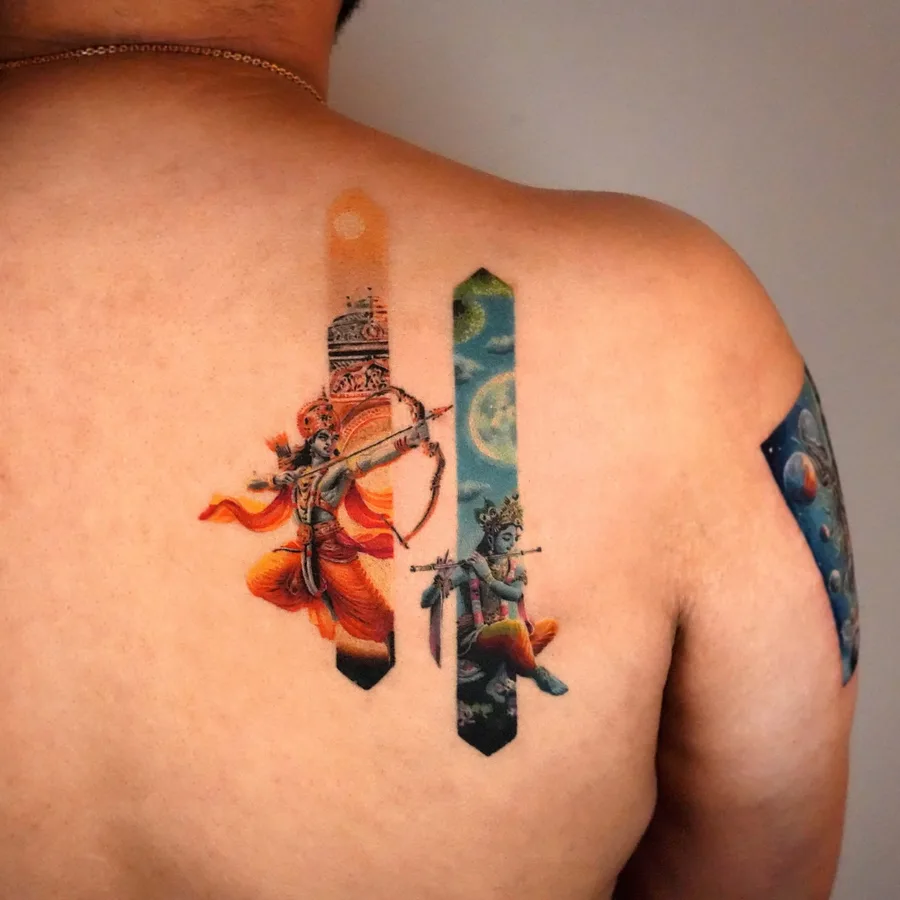 Rama and Krishna, healed 1 year 4 months | OPAL
Images are quoted from works by artists listed on tattooers.jp (as of November 16, 2026). Tap an image to open the work.
Artist pages: miantatu / KZ / Kyo / OPAL. More work: arm tattoos and fine line tattoos.
Itching is common along the way [2][3]. Do not scratch; keep washing and moisturizing, which usually eases it [2].
Flying Home With a Fresh Tattoo
A long flight right after a session is one of the things the EADV leaflet lists to avoid, especially with large tattoos, because heavy swelling can be uncomfortable [1]. Most visitors cannot change their flight, so plan around it.
- Ask your artist about the film. Film can stay on for a day or several days as long as nothing leaks [1], so some artists may time it to cover the flight. Ask whether to fly with it on and whether to pack a spare
- Ointment in your carry-on counts as a liquid. On international flights from Japan, creams and ointments go in containers of 100 ml or less, inside one clear zip-top bag of up to 1 liter per passenger [9]. A small tube is easiest; larger tubes go in checked baggage. The same list exempts prescription and over-the-counter medications in the amount you need on board, but you may be asked to show proof at screening [9]. Rules at your connecting airport may differ [9]
- Cabin air is dry. Humidity on board is typically 10 to 20 percent [10]. If your routine includes moisturizer, wash or sanitize your hands and apply a thin layer
- Avoid rubbing. Wear loose clothes over the tattoo, keep bag straps and seat belts off it if you can, and choose a seat that keeps the tattooed side away from the aisle cart and other passengers
- Long sitting. Getting up and moving now and then during a long flight is good general advice; immobility on flights is a known health concern [10]
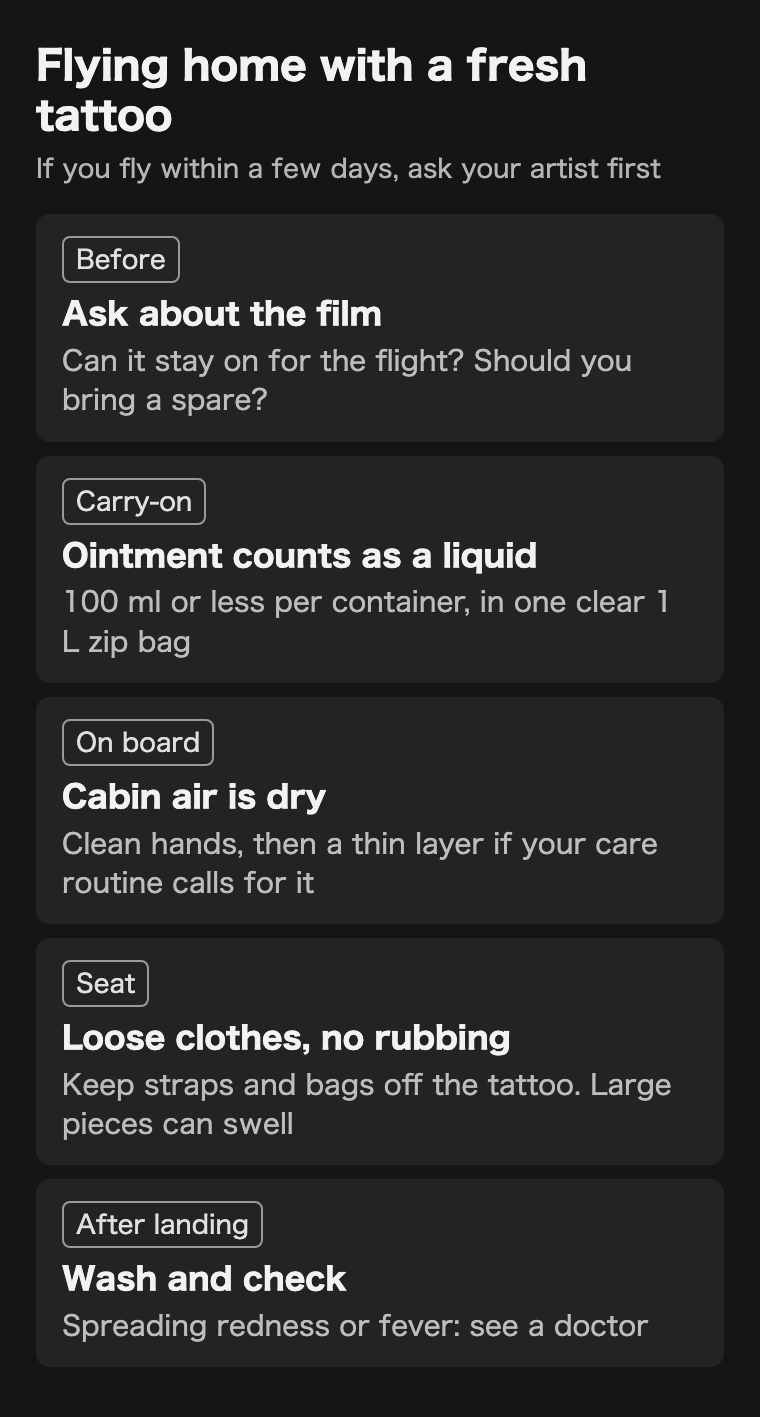
When you land, wash it, let it dry and look at it. If redness is spreading or you have a fever, see a doctor at home and mention that you were recently tattooed.
Sun, Heat and Humidity in Japan
Keep a healing tattoo covered with clothing, not sunscreen. The EADV leaflet says clothing is the best protection while healing and that sunscreen can be used after complete healing [1]. A US dermatology article also lists applying sunscreen among things to avoid until the tattoo is fully healed [2].
Japan's summer sun is strong. Ministry of the Environment data show that in July the UV index exceeds 8, the "very high" category, for several hours around noon in the regions it compares, except Sapporo [11]. Loose long sleeves, a hat and shade around midday do more for a fresh tattoo than anything you can put on it.
Once it has fully healed, the AAD recommends a broad-spectrum, water-resistant sunscreen with SPF 30 or higher, applied 15 minutes before going out and reapplied at least every two hours [4]. Sun exposure and tanning beds can fade ink [2][4].
Heat and humidity bring sweat. The EADV leaflet lists activities and clothing that cause friction and sweating among things to avoid while healing [1]. On hot days:
- Wear loose, breathable fabric over the tattoo and change out of sweaty clothes
- Rinse and pat dry after a sweaty day of sightseeing, then a thin layer of moisturizer
- Skip the gym session and long hikes in the first days if the tattoo sits where straps or clothes rub
What to Buy at a Japanese Drugstore
Japanese drugstores carry plain petroleum jelly, fragrance-free moisturizers and mild soaps, but use only what your artist approves. Bring the product your artist recommends if you can, and buy a backup here only after checking with them.
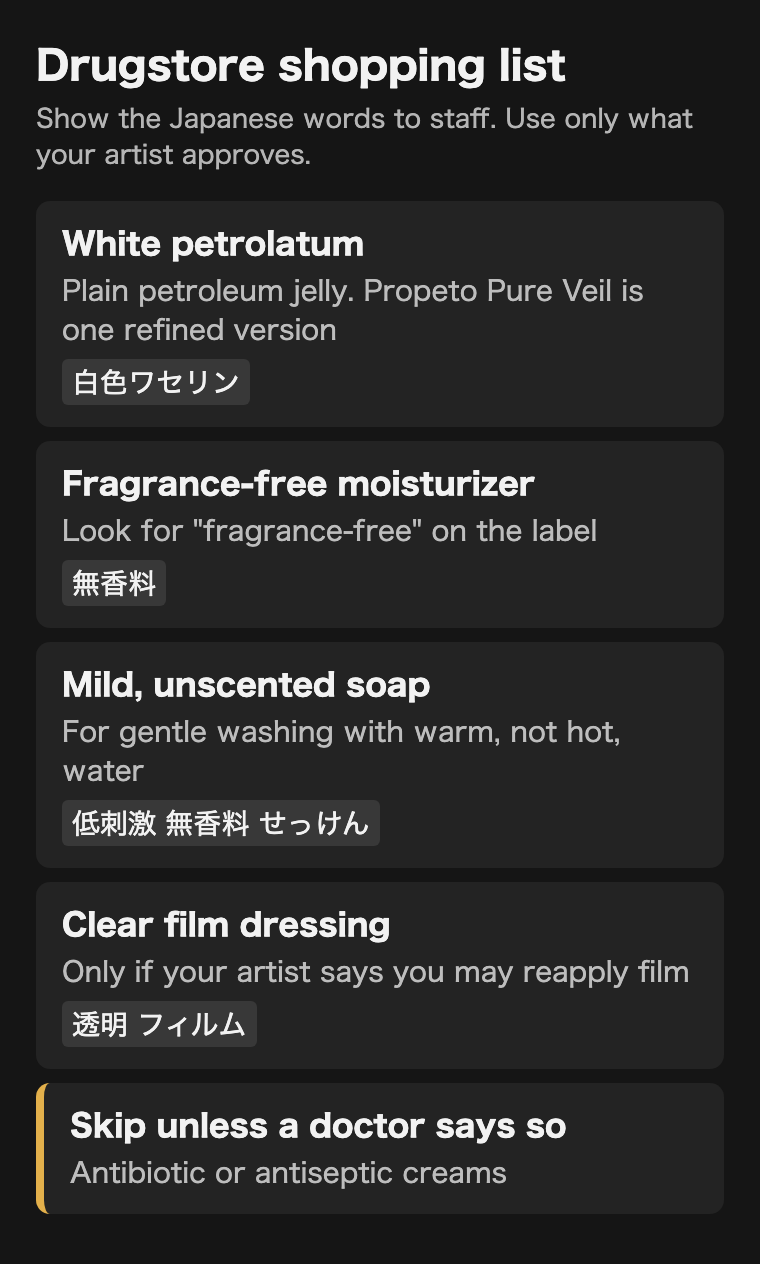
- White petrolatum (hakushoku waserin): plain petroleum jelly, sold as an over-the-counter skin protectant. One widely sold refined version is Propeto Pure Veil, sold by Daiichi Sankyo Healthcare, which lists white petrolatum as its only ingredient [12]. Some dermatology sources advise against petroleum jelly on a healing tattoo [2][4], so buy it only if your artist tells you to use it, and apply it thinly
- Fragrance-free moisturizer: look for "muko-ryo" (fragrance-free) on the label. Unscented is the safer choice [1][8]
- Mild soap: unscented and dye-free [2]
- Clear film dressings: some drugstores sell them, but do not put new film on without asking your artist first [1]
- Skip antibiotic and antiseptic creams unless a doctor prescribes them [1][5]
We did not test any of these products, and stock varies by store.
If Something Looks Wrong While You Are in Japan
Message your artist first for worries that are not urgent. See a doctor right away for spreading red streaks, high or lasting fever or feeling flu-like. Call 119 for trouble breathing.
| Common during healing | Signs to get checked | |
|---|---|---|
| Redness and swelling | Mild, and fading day by day [1] | Getting darker, spreading, or a painful red area growing [1][3] |
| Pain | Tender to touch for about a week [5] | Getting worse instead of better; throbbing or burning [1][5] |
| Fluid | Clear or pink fluid in the first days [1] | Increasing; yellow or green, thick fluid or pus; bad smell [1][5] |
| Warmth and fever | Large pieces can feel feverish for about the first 12 hours, settling by the next day [1] | Still feverish the next day; fever or chills [1][3] |
| Itching and peeling | Weeks 2 to 4 [2] | Small blisters or a weeping, very itchy rash, which may be a reaction to an aftercare product [1] |
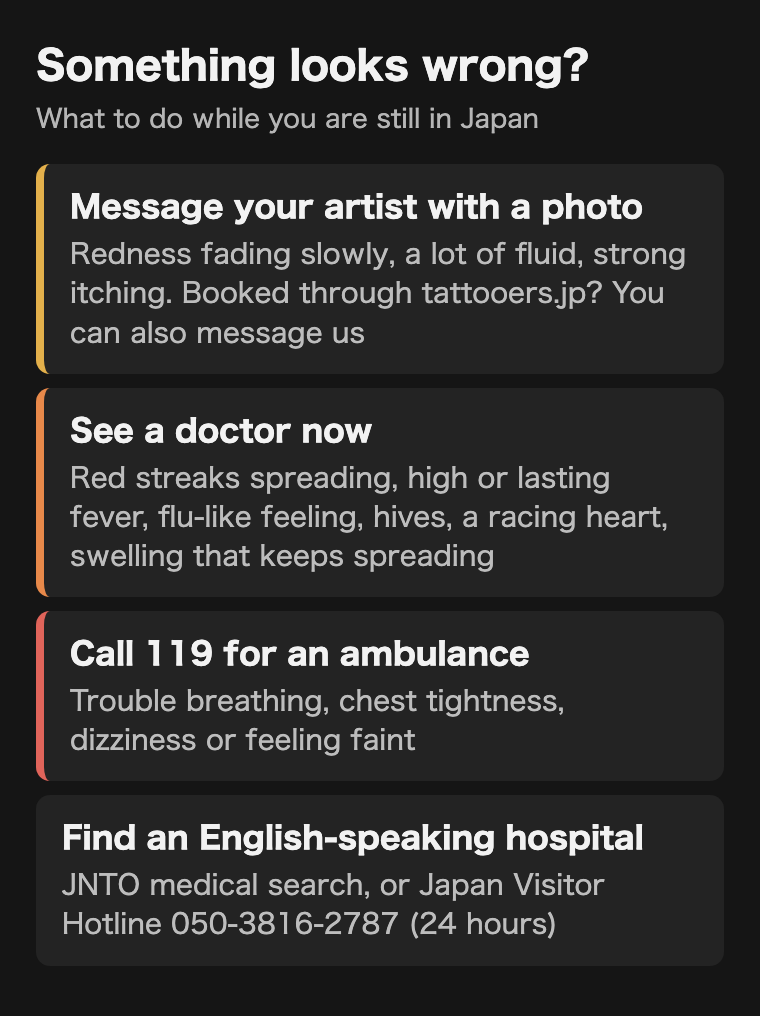
- Not urgent: send your artist a photo first. The AAD suggests telling your artist about a mild reaction limited to the tattoo [3]. If you booked through tattooers.jp (/inbound), you can also message our team on Instagram at @tattootourtokyo
- See a doctor now: red streaks running from the tattoo, a high or lasting fever, or a flu-like feeling can mean a serious infection [1]. Hives, a racing heart or swelling that keeps spreading also need prompt medical care [3]. Do not wait for your artist's reply; use the JNTO search or hotline below to find a hospital
- Emergency: for trouble breathing, chest tightness, dizziness or feeling faint, call 119 for an ambulance [3]
- Finding a clinic: the Japan National Tourism Organization (JNTO) runs a medical institution search you can filter by area, language and department, and the Japan Visitor Hotline (050-3816-2787) answers 24 hours a day, 365 days a year, in English, Chinese and Korean [13]. A dermatology clinic is the usual place for skin problems
- A rash in the first days: if a blistering or weeping rash appears, the EADV leaflet says to stop all aftercare products [1]
Before the trip, check that your travel insurance covers medical care in Japan. Tell your artist if you saw a doctor; knowing which materials were used can help find the cause [1].
Frequently Asked Questions
Q. How long after a tattoo can I go in an onsen?
Not until it has completely healed, with no scabs or peeling left. The dermatology sources we checked don't give a fixed number of days; consumer health guides often quote at least 2 to 4 weeks, longer for large pieces [1][2][6]. Ask your artist. After that, check whether the facility admits tattoos on our tattoo-friendly map.
Q. Can I swim in a pool or the sea after getting a tattoo?
Not while it is healing. The EADV leaflet says to avoid swimming until the tattoo is completely healed [1]. Healthline puts that at at least 2 to 4 weeks [6] and WebMD at about 2 weeks [7]. Plan beach days before the session.
Q. Can I fly the day after getting a tattoo?
Many visitors have to. The EADV leaflet lists a long-haul flight just after tattooing as something to avoid, especially for large tattoos, because swelling can be uncomfortable [1]. Ask your artist whether to fly with the film on, keep ointment in a container of 100 ml or less in your zip bag [9], and wear loose clothing.
Q. When can I put sunscreen on a new tattoo?
After it has fully healed. Until then, cover it with clothing [1][2]. Afterward, the AAD recommends SPF 30 or higher, broad-spectrum and water-resistant, reapplied at least every two hours [4].
Q. Can I buy tattoo aftercare products in Japan?
Drugstores sell white petrolatum, fragrance-free moisturizers and mild soaps. Use what your artist recommends and keep any layer thin [1].
Summary
- Keep the wrap or film on as long as your artist says. If film leaks, change it and ask your artist
- Wash with clean hands, warm (not hot) water and mild soap; pat dry; apply a thin layer
- Showers only. No onsen, sento, bath, pool or sea until it has completely healed, often at least 2 to 4 weeks
- On the flight home: ask about the film, keep ointment under 100 ml in your liquids bag, wear loose clothes
- Cover it from Japan's summer sun with clothing; sunscreen only after it heals
- Red streaks, fever or trouble breathing: see a doctor. JNTO's search and hotline help you find English-speaking care
Planning a tattoo on your trip? Book it with the healing time in mind. Get matched with an artist in Japan: tell us your dates, your idea and the rest of your itinerary, and we match you with an artist and message you on Instagram within 48 hours. For what tattoos cost in Japan, see our tattoo price guide. For how much each spot hurts, see tattoo pain by body part. You can also browse tattoo artists in Japan, or read up on Japanese tattoo meanings before you choose a design.
Read in Japanese: our full aftercare guide for readers in Japan.
References
Medical sources describe general practice and differ from each other. Product details are the seller's own description; we did not test them.
- European Academy of Dermatology and Venereology (EADV) Tattoos and Body Art Task Force (2021). Information Leaflet for Patients: Tattoo aftercare (PDF). Accessed November 16, 2026.
- Cleveland Clinic (2026). Tattoo Aftercare Tips From a Dermatologist. Accessed November 16, 2026.
- American Academy of Dermatology (AAD). Tattoos: 7 unexpected skin reactions and what to do about them. Accessed October 29, 2026.
- American Academy of Dermatology (AAD). Caring for tattooed skin. Accessed October 29, 2026.
- Chartered Institute of Environmental Health (CIEH), Public Health England North West / East Midlands, Tattoo and Piercing Industry Union (2013). Tattooing and body piercing guidance Toolkit, Part C: Tattoo aftercare (PDF). Accessed October 29, 2026.
- Healthline (2021, medically reviewed by Deborah Weatherspoon, PhD, RN). Swimming With a New Tattoo: Everything You Need to Know. Accessed November 16, 2026.
- WebMD (medically reviewed by Stephanie S. Gardner, MD, October 20, 2025). Tattoo Aftercare: How To Take Care of a New Tattoo. Accessed November 16, 2026.
- Liou YL, Liszewski W, Schlarbaum JP, Warshaw EM (2021). Characterization of Tattoo Aftercare Products: Allergenic Ingredients and Marketing Claims. Dermatitis, 32(5), 301-307. Accessed October 29, 2026.
- Civil Aviation Bureau, Ministry of Land, Infrastructure, Transport and Tourism (October 1, 2015). List and Description of LAGs Restriction (PDF). Accessed November 16, 2026. Check your airline for the latest rules.
- US Centers for Disease Control and Prevention. CDC Yellow Book: Air Travel. Accessed November 16, 2026.
- Ministry of the Environment, Japan. Solar ultraviolet radiation: basic information (PDF, Japanese). Accessed November 16, 2026.
- Pharmaceuticals and Medical Devices Agency (PMDA). Propeto Pure Veil, OTC drug information (Japanese). Accessed November 16, 2026.
- Japan National Tourism Organization (JNTO). Guide for when you are feeling ill. Accessed November 16, 2026.
