Japanese flower tattoos take their meanings from centuries of Japanese art and dictionaries: the cherry blossom (sakura) is regarded as Japan's national flower [1], the peony (botan) has long stood for wealth and honor [2], and the chrysanthemum (kiku) was believed in China to bring long life [3]. These are readings, not rules, and the same flower can mean something different to each person who wears it.
In a Japanese traditional piece (wabori, also called irezumi; see Irezumi vs Tattoo), flowers do two jobs. They can take the lead on their own, or they can surround a main subject such as a lion, koi or dragon, and some of those pairings, like the lion and peony, go back hundreds of years. Choosing one comes down to the flower, its meaning and the style you want it in. This guide covers the flowers you see most in Japanese tattoos, what each is said to mean, the classic pairings, and how seasons come into it. For the meanings of animals, masks and deities, see Japanese tattoo meanings.
Japanese Flower Tattoo Meanings at a Glance
"What art and dictionaries record" is what we could confirm in Japanese dictionaries and museum pages. "How it is often read in tattoos" is what you will hear in the tattoo world. Neither column is a rule.
| Flower | What art and dictionaries record | How it is often read in tattoos | Classic partners | Works |
|---|---|---|---|---|
| Cherry blossom (sakura) | Long a subject of Japanese poetry and painting; regarded as Japan's national flower [1] | Beauty that does not last, from the way it blooms and falls | Koi, dragons | Cherry blossom |
| Peony (botan) | Native to China, called the king of flowers, a symbol of wealth and honor [2][4] | Wealth and splendor | Karajishi lions, butterflies | Peony |
| Chrysanthemum (kiku) | Believed in China to bring long life; the imperial crest; also regarded as a national flower of Japan [3] | Long life and nobility | Flowing water, koi | Chrysanthemum |
| Lotus (hasu) | In Buddhist texts, a flower that grows from mud without being stained, standing for purity [9] | Purity and enlightenment | Buddhist figures, waves | Lotus |
| Camellia (tsubaki) | A native evergreen with red flowers in early spring, found in Japan's oldest poetry [11] | No set reading | — | No tag yet |
| Red spider lily (higanbana) | Blooms around the autumn equinox; also called "dead person's flower"; its other name, manjushage, is a heavenly flower in Buddhist texts [12][13] | Sometimes chosen for its link to the next world | — | No tag yet |
| Maple (momiji) | Autumn leaves; scattered on flowing water, they form the Tatsuta River pattern [14][15] | Autumn | Koi, flowing water | Maple |
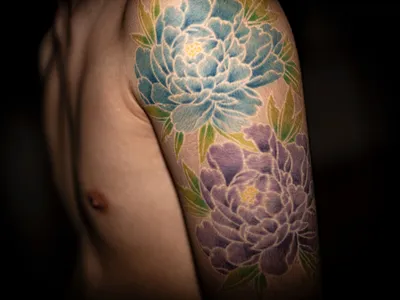 Peonies | 彫音 Horine
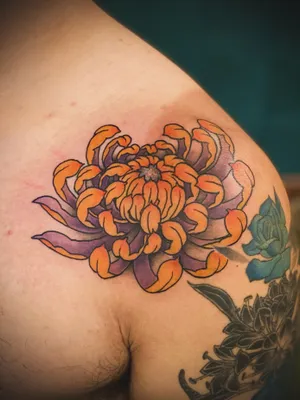 Chrysanthemum | ToM【DRAGON HEART TATTOO】
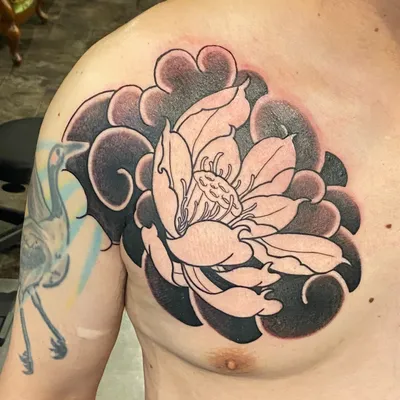 Lotus and waves (in progress) | ToM【DRAGON HEART TATTOO】
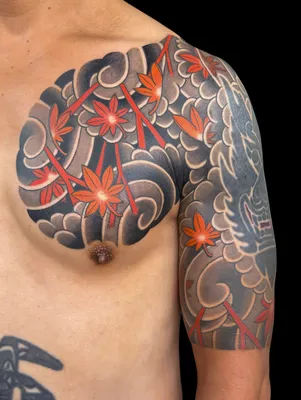 Maple leaves | 彫也 HORINARI
Images are quoted from works by artists listed on tattooers.jp (as of November 16, 2026). Tap an image to open the work.
Cover photo: Jonathan Borba / Pexels
Artist pages: Horine / ToM / HORINARI
Cherry Blossom Tattoo Meaning (Sakura)
The cherry blossom is Japan's best-known flower: a long-standing subject of poetry and painting, and regarded today as the national flower [1]. People in the Edo period (1603–1868) bred a great many garden varieties [1], and in tattoos the blossom is often read as beauty that does not last, because it blooms all at once and falls within days. That reading comes from the tattoo world and from how the flower behaves, not from a dictionary definition.
On tattooers.jp, cherry blossoms are the second most common named flower after the rose, and 73% of cherry blossom works are in the Japanese or neo-Japanese style. In wabori they most often fill the space around koi and dragons, as in the pairings below. Small color blossoms on an ankle or wrist are also common.
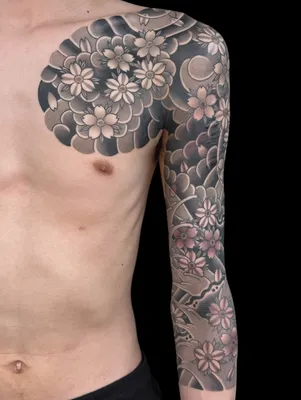
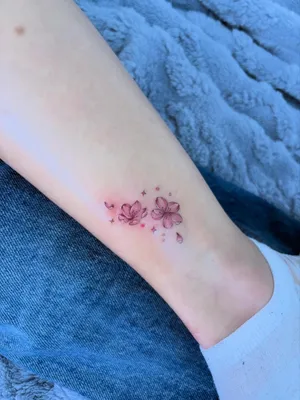
Images are quoted from works by artists listed on tattooers.jp (as of November 16, 2026). Tap an image to open the work.
Artist pages: HORINARI / Chii Shirokawa
Peony Tattoo in Japanese Art (Botan)
The peony came to Japan from China, where it was called the king of flowers and treated as a symbol of wealth and honor [2][4]. Japan Search, the national cultural heritage portal, notes that the peony carries meanings of wealth and happiness and was a favored pattern on furisode, the long-sleeved kimono [5]. In tattoos it is read the same way: splendor, and a flower big enough to hold the center of a piece.
Peonies on tattooers.jp are usually large and in color: 62% are Japanese or neo-Japanese style, and 62% use color. The peony is also the flower of the best-known pairing in Japanese tattooing, the karajishi lion and peony, covered in the pairings section below. Snakes wrapped around peonies are another combination you will see.
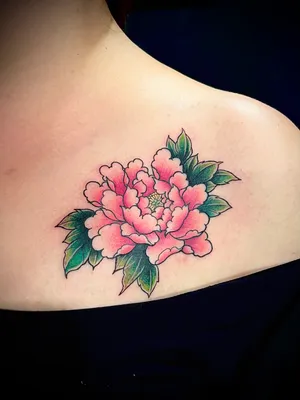
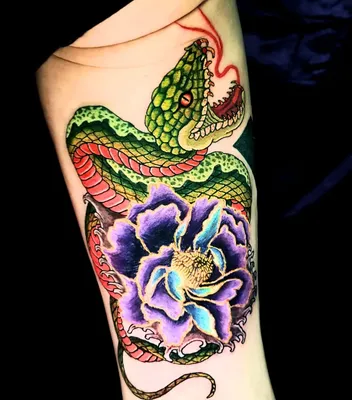
Images are quoted from works by artists listed on tattooers.jp (as of November 16, 2026). Tap an image to open the work.
Chrysanthemum Tattoo Meaning (Kiku)
In China the chrysanthemum was believed to bring long life; in Japan it became the imperial crest and is also regarded as a national flower [3]. It seems to have reached Japan in the Nara period (710–794), and Japanese growers later bred a great many varieties [3]. The long-life idea also lives on in a legend retold in Noh theater: Kikujido, a boy exiled to the mountains, drank the dew from chrysanthemum leaves and never grew old [7].
That legend is behind kikusui, "chrysanthemum water": a pattern of chrysanthemum flowers floating on flowing water, best known as the family crest of the Kusunoki, a medieval samurai family [8]. Chrysanthemums are the most Japanese-style flower on tattooers.jp, with 81% of works in the Japanese or neo-Japanese style. Many are large, single blooms drawn from the side; others sit beside a koi.
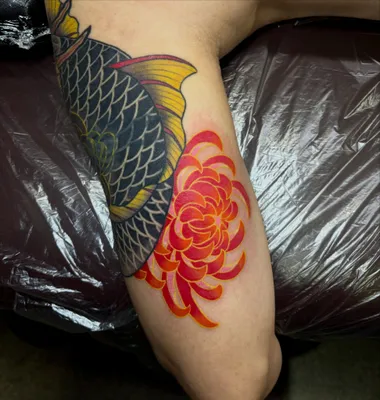
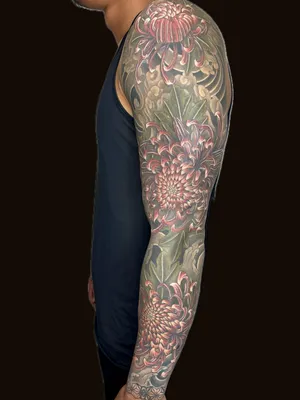
Images are quoted from works by artists listed on tattooers.jp (as of November 16, 2026). Tap an image to open the work.
Lotus Tattoo Meaning in Japan (Hasu)
The lotus is the flower of Buddhism: Buddhist texts compare its clean bloom, rising from mud without being stained, to the purity of the Buddha [9]. Buddhas and bodhisattvas are shown seated on lotus pedestals, and the Lotus Sutra takes its name from the white lotus [9]. The plant came to Japan from China long ago and blooms in summer [10].
In Japanese tattoos the lotus often appears with Buddhist figures such as Kannon, the bodhisattva of compassion, or on its own with waves around it. It is also a common base for a single bonji (Sanskrit) character. It is also one of the most flexible flowers in style: on tattooers.jp, lotus works split fairly evenly between Japanese, black and gray, fine line and botanical styles.
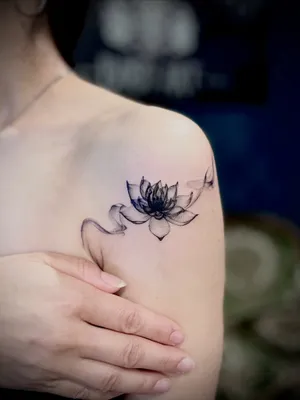
Images are quoted from works by artists listed on tattooers.jp (as of November 16, 2026). Tap an image to open the work.
Artist page: NaO
Camellia, Red Spider Lily and Maple
These three appear less often than the big four, but each has a clear place in Japanese art.
- Camellia (tsubaki): an evergreen native to Japan that opens red flowers in early spring, or even winter in some areas. It appears in the Man'yoshu, Japan's oldest poetry collection (8th century) [11]. We found no fixed tattoo meaning; it is usually chosen for its deep red and its season
- Red spider lily (higanbana): blooms around the autumn equinox (higan) on embankments, at the edges of rice fields and near graves. Its folk names include "dead person's flower" and "ghost flower" [12]. Its other name, manjushage, comes from Buddhist texts, where it is a heavenly flower said to free those who see it from bad karma [13]. Some people choose it for that double image of death and a heavenly flower
- Maple (momiji): the red and yellow leaves of late autumn [14]. Maple leaves scattered on flowing water form a pattern called Tatsuta River, named after a poem in the Kokinshu anthology (905–914) about the river's red leaves [15]. In tattoos, maple leaves are often scattered around koi and waves
Red spider lilies and camellias have no tag of their own on tattooers.jp yet. Counting works by their descriptions, both are mostly done in color (about 70% and 60%).
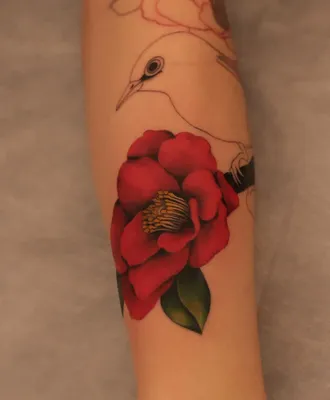
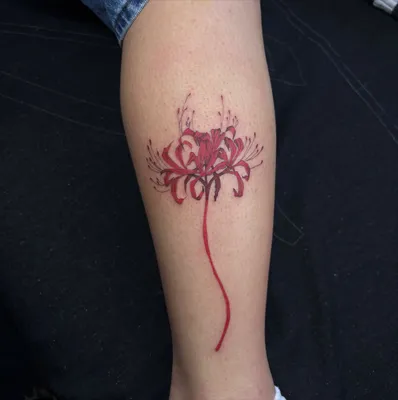
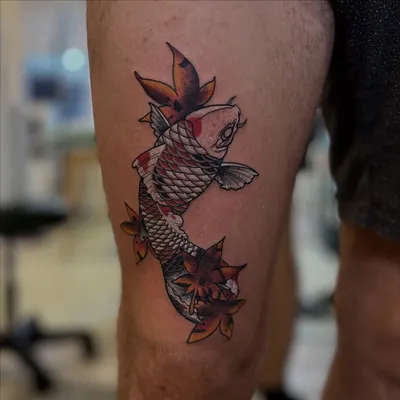
Images are quoted from works by artists listed on tattooers.jp (as of November 16, 2026). Tap an image to open the work.
Artist pages: Midori / Sora / Hachi
Classic Pairings: Lion and Peony, Koi and Cherry Blossom
One of the oldest flower pairings in Japanese tattooing is the karajishi lion with peonies. In the Noh play Shakkyo the lion, king of beasts, was matched with the peony, king of flowers, and lions and peonies fill the carvings of Nikko Toshogu, the shrine to the first Tokugawa shogun [6]. In the late Edo period, firefighters, laborers and other tough townsmen tattooed themselves with heroes of the Chinese novel Water Margin and with lion-and-peony designs [6], after Utagawa Kuniyoshi's prints of tattooed Water Margin heroes, first published in 1827, became a craze [18].
Other pairings are newer, or are simply what tattoo artists have settled on. The table separates the two.
| Pairing | Where it comes from | In tattoos |
|---|---|---|
| Peony and karajishi lion | Noh play Shakkyo; Nikko Toshogu carvings; late Edo tattoos [6]. Japan Search calls it a classic good match, and Hiroshige made a print of it [5] | The lion takes the lead, with peonies filling the space around it. In English the lion is often called a foo dog |
| Peony and butterfly | Painted by Hokusai, Hiroshige and Kuniyoshi [5]; the June card of hanafuda (Japanese flower cards) shows a peony with butterflies [4] | A lighter, often smaller design |
| Chrysanthemum and flowing water | The kikusui pattern of chrysanthemums floating on water, tied to the Kikujido legend of long life [7][8] | Chrysanthemums with water or waves, sometimes with a koi |
| Maple and flowing water | The Tatsuta River pattern, from a 10th-century poem [15] | Maple leaves on the water around a koi |
| Lotus and Buddhist figures | Buddhas and bodhisattvas sit on lotus pedestals [9] | Lotus under or around Kannon and other deities |
| Cherry blossom and koi | We found no older source for this pairing | Petals scattered on the water around a koi; one of the most common combinations on tattooers.jp |
| Cherry blossom and dragon | We found no older source for this pairing | Blossoms in the clouds around a dragon. See dragon tattoos |
On tattooers.jp, about 3 in 10 Japanese-style flower works also include a dragon, koi, lion, tiger, phoenix or snake. The other 7 in 10 have no main animal or figure, so flowers taking the lead on their own is just as normal.
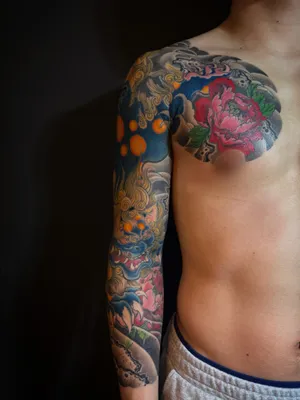
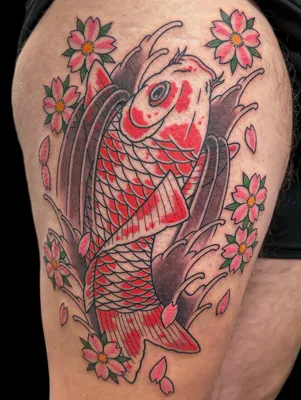
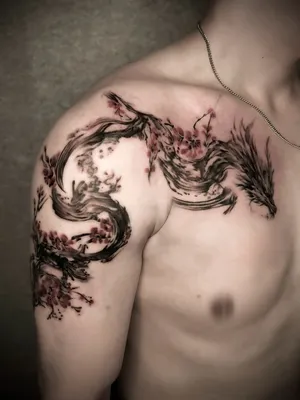
Images are quoted from works by artists listed on tattooers.jp (as of November 16, 2026). Tap an image to open the work.
Artist pages: Horiaki / HORINARI / HAZE
Want a Japanese flower piece while you are in Japan? Tell us your dates, the flower and the placement, and we match you with an artist. We message you on Instagram within 48 hours, and the ¥15,000 deposit is fully refunded if we can't match you.
Matching Flowers to the Season
Japanese art ties many flowers to a season, and some tattoo artists keep the flowers in one piece to a single season. Others mix seasons on purpose, for example to show a whole year on one back. Neither is a rule; if you have a preference, mention it in your request and we pass it on to the artist.
The clearest record of flowers by month is hanafuda, Japanese playing cards with one plant for each month: pine, plum, cherry blossom, wisteria, iris, peony, bush clover, pampas grass, chrysanthemum, maple, willow and paulownia, from January to December [16]. Some of the cards also carry a classic partner, such as maple with deer [16]. In the Edo period, flowers that stood for good fortune or for a season were favorite patterns on kimono and everyday objects [17].
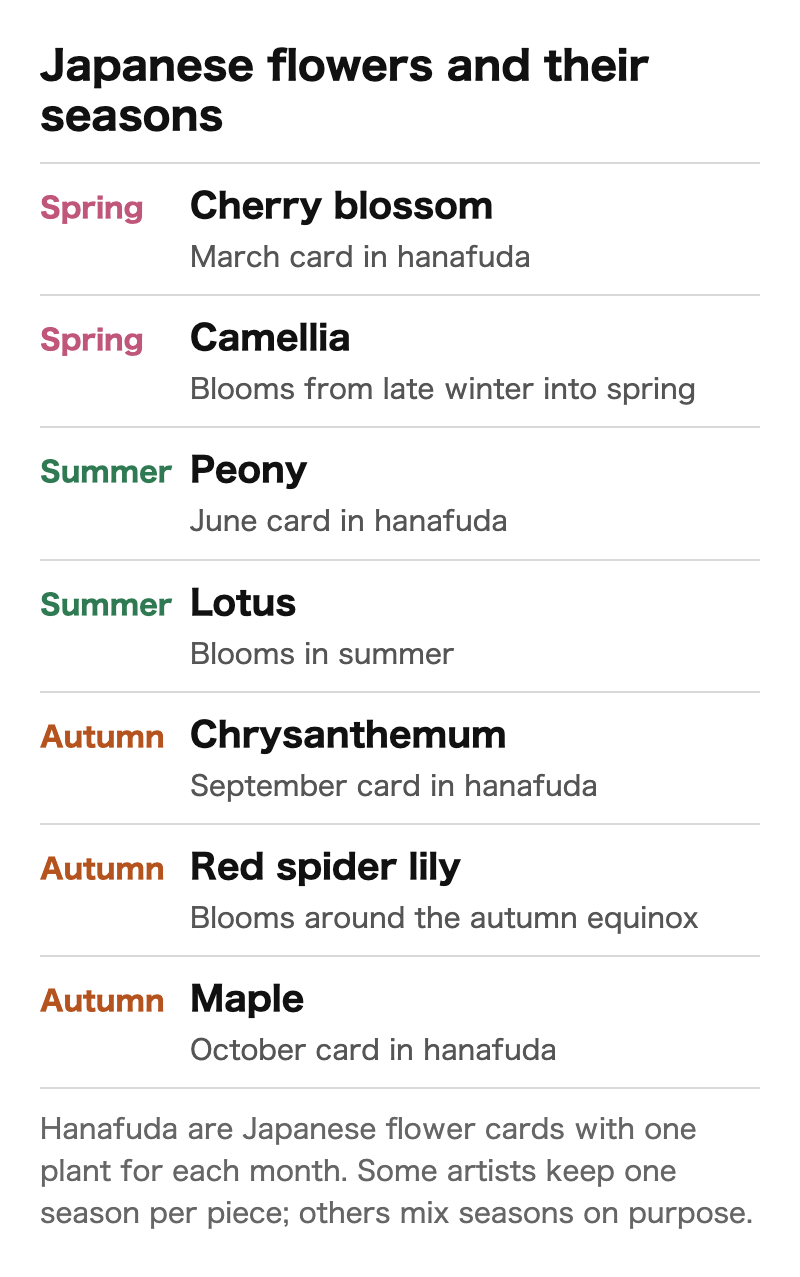 Figure: tattooers.jp editorial team (sources: references 1, 4, 10–12, 14 and 16)
Some combinations follow directly from this: cherry blossoms with spring, maple leaves with autumn. If you want a cherry blossom and a maple leaf in the same piece, write it in the form, so the artist can plan how to place them.
Which Styles Japanese Flowers Are Tattooed In
We counted 2,099 flower works published on tattooers.jp (as of November 14, 2026). The table shows, for each flower, the share of its works in each style. One work can have several styles, so rows do not add up to 100%.
| Flower | Japanese or neo-Japanese | Color or watercolor | Black and gray | Fine line | Botanical |
|---|---|---|---|---|---|
| All flower works | 31% | 44% | 51% | 31% | 33% |
| Cherry blossom | 73% | 57% | 47% | 23% | 25% |
| Peony | 62% | 62% | 42% | 29% | 42% |
| Chrysanthemum | 81% | 31% | 60% | 22% | 23% |
| Lotus | 39% | 40% | 55% | 41% | 51% |
| Rose (for comparison) | 5% | 40% | 60% | 35% | 34% |
Weighted so that each artist counts equally, then rounded. Flowers with few works are not shown.
- Cherry blossom, peony and chrysanthemum lean strongly Japanese, at roughly twice the average for flowers
- The lotus works in almost any style, from wabori to fine line
- The rose is the most common named flower overall, but only 5% of roses are Japanese style, so it rarely appears in wabori
Browse by style: Japanese, neo-Japanese, black and gray, fine line and botanical.
Flowers Outside the Japanese Style
Roses, lilies and sunflowers are popular in Japan too, but mostly outside wabori. On tattooers.jp, roses are usually black and gray or fine line, and 77% of lily works are botanical, drawn like a plant illustration. If you want a flower with Japanese meaning, cherry blossom, peony, chrysanthemum and lotus are the ones that fit a Japanese piece. If you simply love a rose, the style matters more than the meaning.
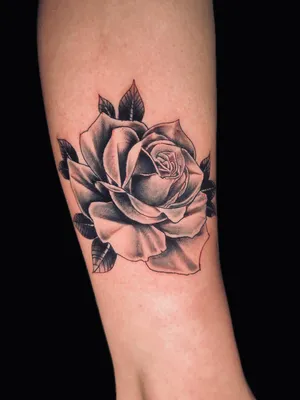
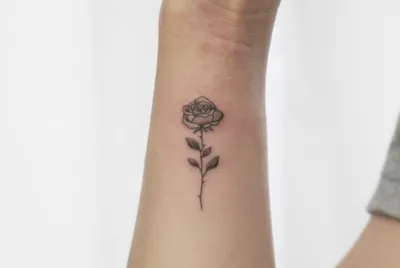
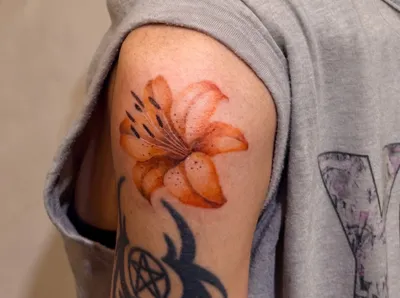
Images are quoted from works by artists listed on tattooers.jp (as of November 16, 2026). Tap an image to open the work.
Artist pages: Horitake / SOU / Aimi
Two Things to Know: Red Ink and Flower Language
Red ink. Cherry blossoms, peonies, camellias and red spider lilies often use red or pink. Allergic reactions to red ink are a known problem in dermatology and are still reported after the EU's REACH rules on tattoo inks, but how often they happen is unknown, because no large studies exist [19]. If you have sensitive skin or allergies, put it in your request so the artist knows. If itching or raised skin appears months or years later, see a dermatologist. For caring for a new tattoo during your trip, see tattoo aftercare while traveling in Japan.
Flower language. The Western "language of flowers" is not where Japanese tattoo meanings come from. Flower meanings differ by country and source, and one flower can have several [20]. In Japan, the Western idea of flower language arrived in the early Meiji era (from 1868) [21]. The meanings in this guide come instead from Japanese art, Buddhism and Chinese tradition.
Frequently Asked Questions
Q. What does a Japanese cherry blossom tattoo mean?
The cherry blossom is regarded as Japan's national flower and has been painted and written about for centuries [1]. In tattoos it is most often read as beauty that does not last, because it falls so soon after it blooms. That is an interpretation, not a fixed meaning.
Q. Why is the peony paired with a lion?
In Japanese art the lion, king of beasts, was matched with the peony, king of flowers, through the Noh play Shakkyo, and the pair was carved and painted for centuries. Late Edo firefighters and laborers made it a tattoo design [6].
Q. Can I mix flowers from different seasons?
Yes. Some artists keep one season per piece, and others mix seasons to show the whole year. Write your preference in the form and the artist will propose a layout.
Q. Is a chrysanthemum tattoo linked to the Japanese imperial family?
The imperial crest is a stylized 16-petal chrysanthemum [3], but the chrysanthemum is also a classic flower in Japanese art and tattooing in its own right. Tattoo chrysanthemums are usually painted as flowers, often from the side, not as crests.
Q. Is a red spider lily tattoo unlucky?
Its folk names link it to death [12], but its Buddhist name refers to a heavenly flower that frees people from bad karma [13]. How you read it is up to you.
Q. Can a Japanese flower tattoo be small?
Yes. A single cherry blossom, peony, chrysanthemum or lotus works at small sizes, and fine line versions are common. How small a design can go depends on its detail and the artist. For costs, see tattoo prices in Japan. See tattoo pain by body part when choosing a spot, and how to cover tattoos in Japan for onsen and gyms.
Summary
Japanese flower tattoos carry meanings from Japanese art and dictionaries, and they are read together with whatever they surround.
- Cherry blossom: regarded as Japan's national flower, often read as beauty that does not last. Peony: king of flowers, wealth and honor. Chrysanthemum: long life, and the imperial crest
- Lotus stands for Buddhist purity; the red spider lily is tied to both death and a Buddhist heavenly flower; maple and camellia mark autumn and early spring
- Classic pairings with real history: lion and peony, peony and butterfly, chrysanthemum and flowing water, maple and flowing water. Koi and dragons with cherry blossoms are a tattoo convention
- Some artists match flowers to one season; others mix them. Hanafuda cards are the easiest guide to which flower belongs to which month
Planning a Japanese flower piece in Japan? Get matched with an artist in Japan: tell us your dates, the flower and the placement. We message you on Instagram within 48 hours, and the ¥15,000 deposit is fully refunded if we can't match you. You can also browse Japanese style tattoos, all flower works and tattoo artists in Japan, including Tokyo and Osaka. For dragons, koi, lions and other motifs, see Japanese tattoo meanings.
References
Most sources are Japanese dictionaries and museum pages; titles are our translations. Links open external sites.
- Kotobank (Shogakukan Nihon Kokugo Daijiten). "Cherry blossom" (Japanese). Accessed November 16, 2026.
- Kyoto National Museum (2020). The Peony: Flower of Wealth and Honor (exhibition note, English). Accessed November 16, 2026.
- Kotobank (Shogakukan Digital Daijisen, Nihon Kokugo Daijiten). "Chrysanthemum" (Japanese). Accessed November 16, 2026.
- Kotobank (Shogakukan Digital Daijisen, Nihon Kokugo Daijiten). "Peony" (Japanese). Accessed November 16, 2026.
- Japan Search (National Diet Library). "Peony" (gallery, Japanese). Accessed November 16, 2026.
- Kotobank (Heibonsha World Encyclopedia, revised edition, karajishi entry by Takada Mamoru). "Lion (shishi)" (Japanese). Accessed November 16, 2026.
- Kotobank (Shogakukan Digital Daijisen, Nihon Kokugo Daijiten; Heibonsha World Encyclopedia). "Kikujido" (Japanese). Accessed November 16, 2026.
- Kotobank (Shogakukan Digital Daijisen, Nihon Kokugo Daijiten). "Kikusui (chrysanthemum water)" (Japanese). Accessed November 16, 2026.
- Kotobank (Shogakukan Nipponica, entry by Ishigami Zenno; Britannica Japan). "Renge (lotus flower)" (Japanese). Accessed November 16, 2026.
- Kotobank (Shogakukan Digital Daijisen, Nihon Kokugo Daijiten). "Lotus (hasu)" (Japanese). Accessed November 16, 2026.
- Kotobank (Shogakukan Digital Daijisen, Nihon Kokugo Daijiten). "Camellia (tsubaki)" (Japanese). Accessed November 16, 2026.
- Kotobank (Shogakukan Digital Daijisen, Nihon Kokugo Daijiten). "Higanbana (red spider lily)" (Japanese). Accessed November 16, 2026.
- Kotobank (Shogakukan Digital Daijisen, Nihon Kokugo Daijiten; Britannica Japan). "Manjushage" (Japanese). Accessed November 16, 2026.
- Kotobank (Shogakukan Digital Daijisen). "Autumn leaves (momiji)" (Japanese). Accessed November 16, 2026.
- Kotobank (Shogakukan Digital Daijisen, Nihon Kokugo Daijiten). "Tatsuta River" (Japanese). Accessed November 16, 2026.
- Kotobank (Shogakukan Digital Daijisen; Heibonsha World Encyclopedia, revised edition). "Hanafuda (flower cards)" (Japanese). Accessed November 16, 2026.
- Fukuoka City Museum (2026). Flowers in Full Bloom in the Edo Period (special exhibition No. 626, February 3 to April 19, 2026, Japanese). Accessed November 16, 2026.
- Tanigawa Atsushi (2023). Edo Baroque: Tattoo Ukiyo-e (preface to Japanese Iconography: Tattoo, PIE International, Japanese). Accessed November 16, 2026.
- van der Bent SAS (2025). Red tattoo allergies after REACH regulation: a continuing problem. Dermatology Reports 18(2):10462. Accessed November 16, 2026.
- Collaborative Reference Database, National Diet Library (case from Nagano Prefectural Library, 2022). When did flower language begin? (Japanese). Accessed November 16, 2026.
- Collaborative Reference Database, National Diet Library (case from Aichi Shukutoku University Library, 2018). The first flower language book published in Japan (Japanese). Accessed November 16, 2026.
Meanings here combine readings recorded in art and dictionaries with interpretations heard in the tattoo world. They are not fixed meanings. Work counts and shares are based on 2,099 flower works published on tattooers.jp, counted by the tattooers.jp editorial team as of November 14, 2026, with each artist weighted equally; read them as trends.
