A Japanese dragon tattoo is most often chosen for strength, protection and rising in life, but no single meaning is fixed. The dragon of East Asian art is a serpent-like creature said to live in water, rise into the sky and bring rain [1], and the meanings people attach to it in tattooing grew out of those old images and legends.
This guide separates what dictionaries and museums record from what is commonly said in the tattoo world. It covers rising and descending dragons, the number of claws (three, four or five), and how to read the clouds, waves, jewel and tiger that often appear with the dragon. It also draws on our own count of 407 dragon works listed on tattooers.jp: where people put them and what they pair them with. To browse the works first, see dragon tattoos.
What Does a Japanese Dragon Tattoo Mean?
In East Asian art, the dragon is an imaginary creature that lives in water and brings rain. In China it was honored with the qilin, phoenix and turtle as one of the four auspicious beasts, and it became a symbol of the emperor [1]. The idea of "rising in life" comes from the Chinese legend of the Dragon Gate: a carp that swims up the rapids of the Dragon Gate on the Yellow River turns into a dragon [2].
| What you look at | What dictionaries and museums record | What is often said in the tattoo world |
|---|---|---|
| The dragon itself | Lives in water and brings rain. One of China's four auspicious beasts and a symbol of the emperor [1] | Strength, protection |
| Link to the emperor | In 1315 a five-clawed, two-horned dragon was made exclusive to the emperor [3]. Under the Ming and Qing, yellow and the five-clawed dragon were reserved for imperial use [4] | Royal dignity, high rank |
| Link to the koi | The Dragon Gate legend: a carp that climbs it becomes a dragon [2] | Rising in life, effort rewarded |
| Rain and success | In China, dragons bring rain and also symbolize success [5] | Blessings, good fortune |
| Rising and descending | At Ueno Toshogu Shrine in Tokyo, the dragon facing down is called the rising one [6] | Rising: momentum and success. Descending: blessings and protection |
| Number of claws | Five claws were the emperor's design in China. Japanese dragons often have three, but the number was never fixed [7] | "A Japanese dragon has three claws" |
Read the right column as interpretation. The left column is what we could confirm in primary sources; the right column is how the tattoo world usually explains it.
A Japanese dragon is also not the same creature as the Western dragon. The East Asian dragon has a long serpent body, four legs, two horns and whiskers, and is tied to water and rain [1], while the European dragon is a fire-breathing beast. Which one you want changes both the shape and the story.
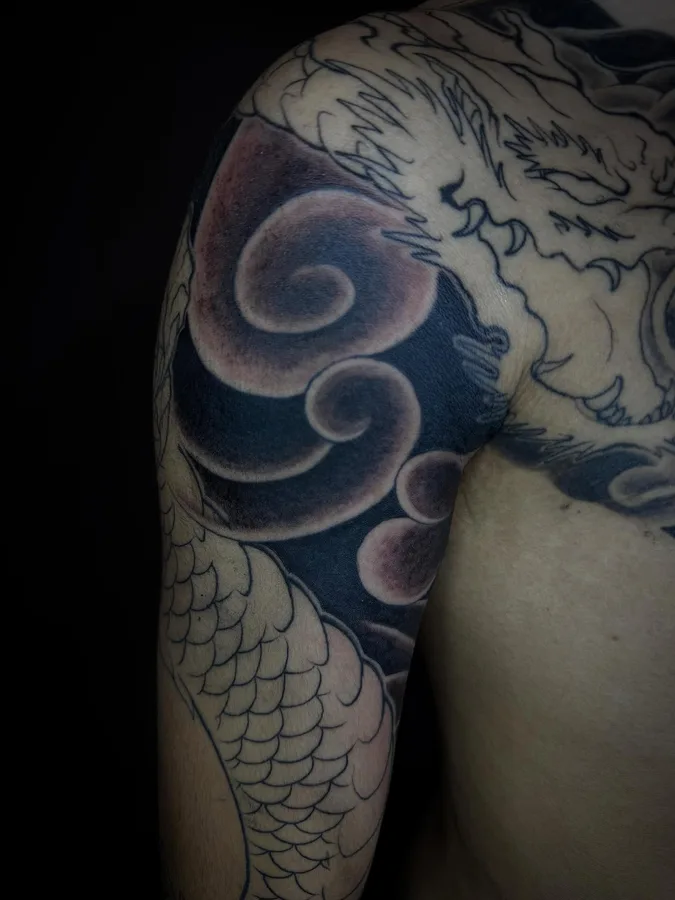 Clouds and scales | 彫旭 Horiaki
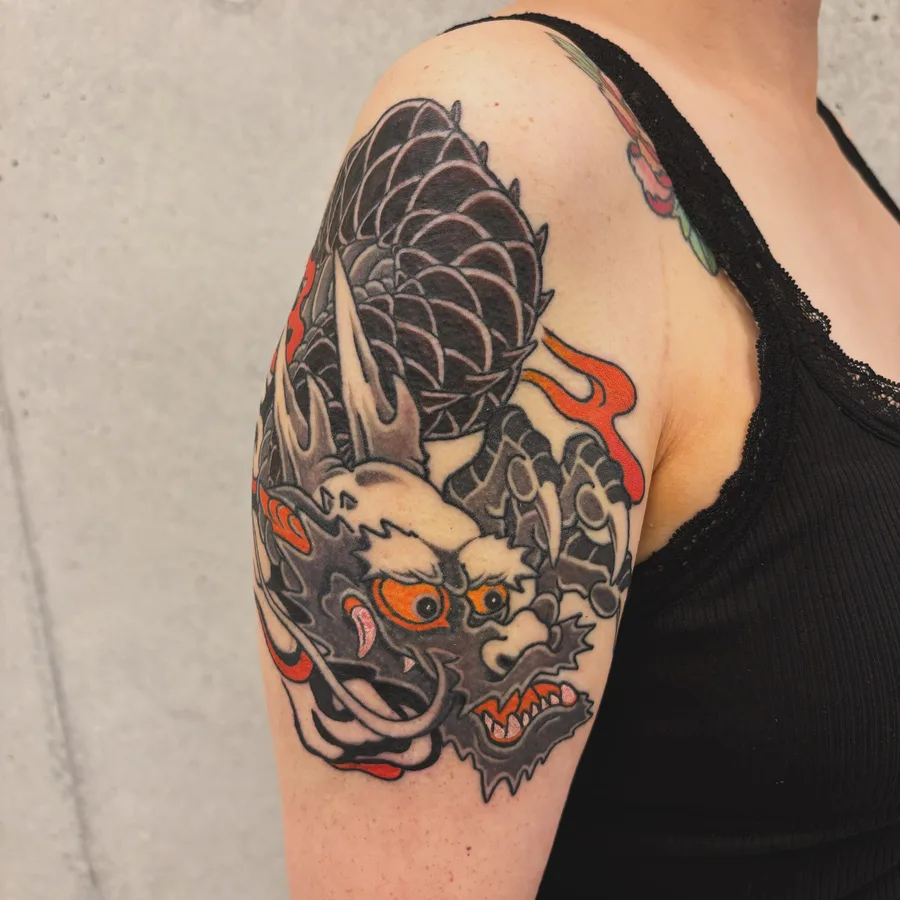 Horns and fangs | 彫まる Horimaru
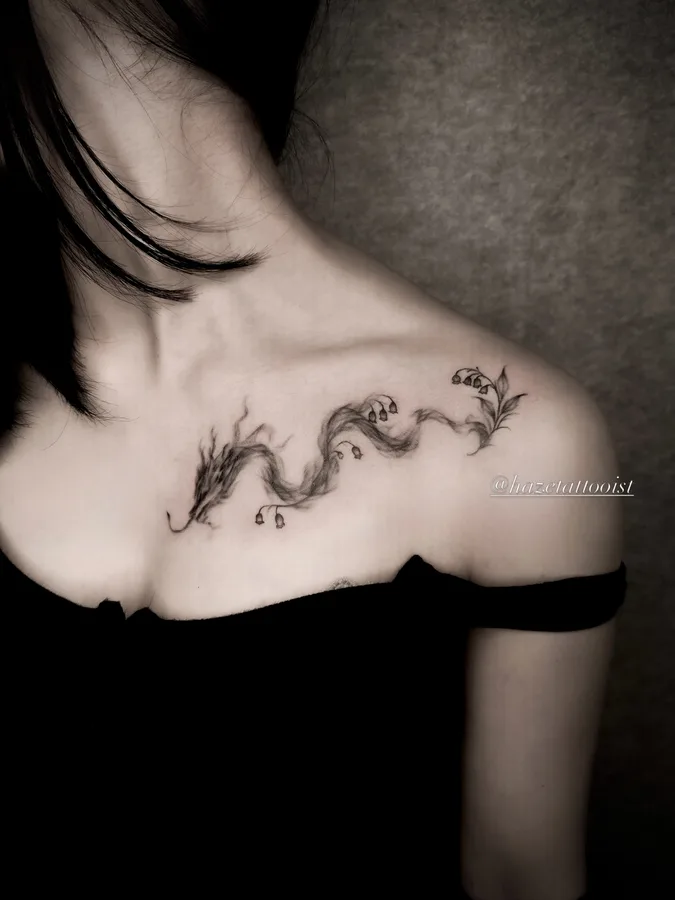 Fine line | HAZE
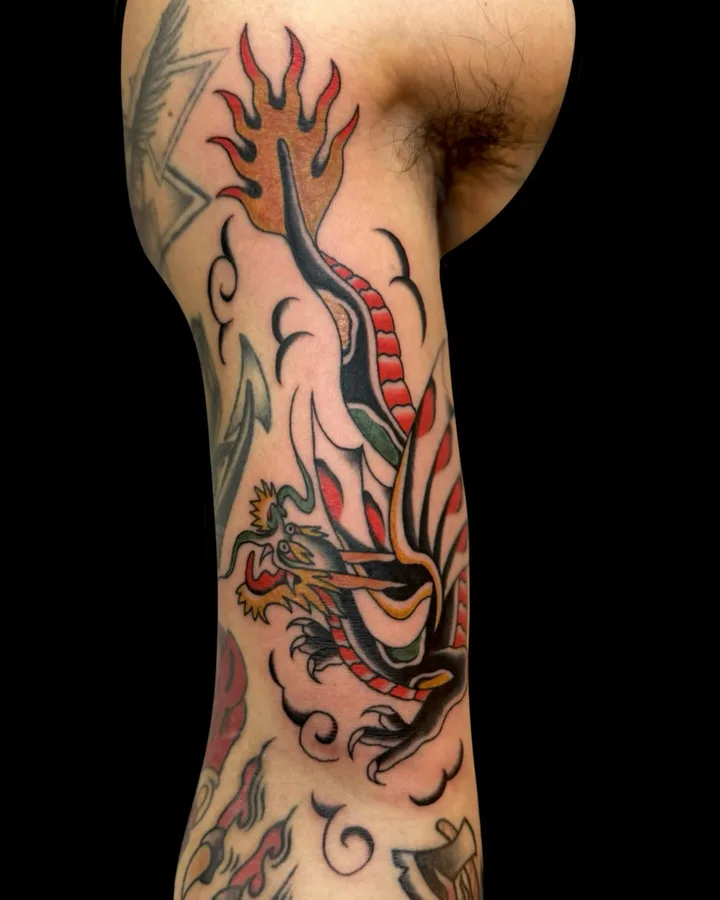 Dragon and flames | KOTARO
Images are quoted from works by artists listed on tattooers.jp (as of November 16, 2026). Tap an image to open the work.
Cover photo: Katia Miasoed / Pexels
Artist pages: Horiaki / Horimaru / HAZE / KOTARO
For the meanings of Japanese motifs in general, including the koi, phoenix and tiger that often share a piece with the dragon, see Japanese tattoo meanings. For what the word irezumi means and how it differs from "tattoo", see Irezumi vs Tattoo.
Rising Dragon Tattoo vs Descending Dragon
A dragon heading up toward the sky is usually called a rising dragon (nobori-ryu), and one heading down toward the earth is called a descending dragon (kudari-ryu). In tattooing, the rising dragon is linked with momentum and success, and the descending dragon with blessings and protection from bad luck. We could not find these readings in dictionaries or museum records, though, so treat them as tattoo-world explanations. Neither direction is recorded as luckier than the other.
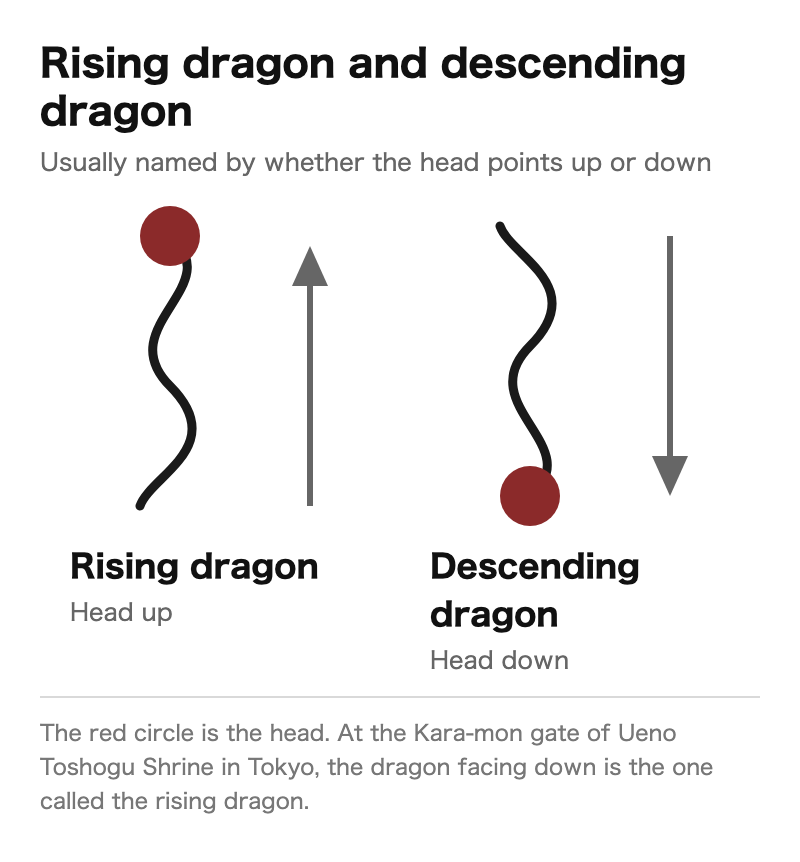 Figure: tattooers.jp editorial team
The names do not always match the picture. The Kara-mon gate of Ueno Toshogu Shrine in Tokyo, built in 1651, carries a pair of carved dragons called the rising dragon and the descending dragon. According to the Japan Tourism Agency's commentary, the dragon facing down is the one called "rising", a reminder from the ruling Tokugawa family that only the humble can achieve truly great things [6].
So "head up means rising" is not an absolute rule. What matters more for your tattoo is where on the body the head sits and which way the body flows. Some works on tattooers.jp are titled "rising dragon" by their artists.
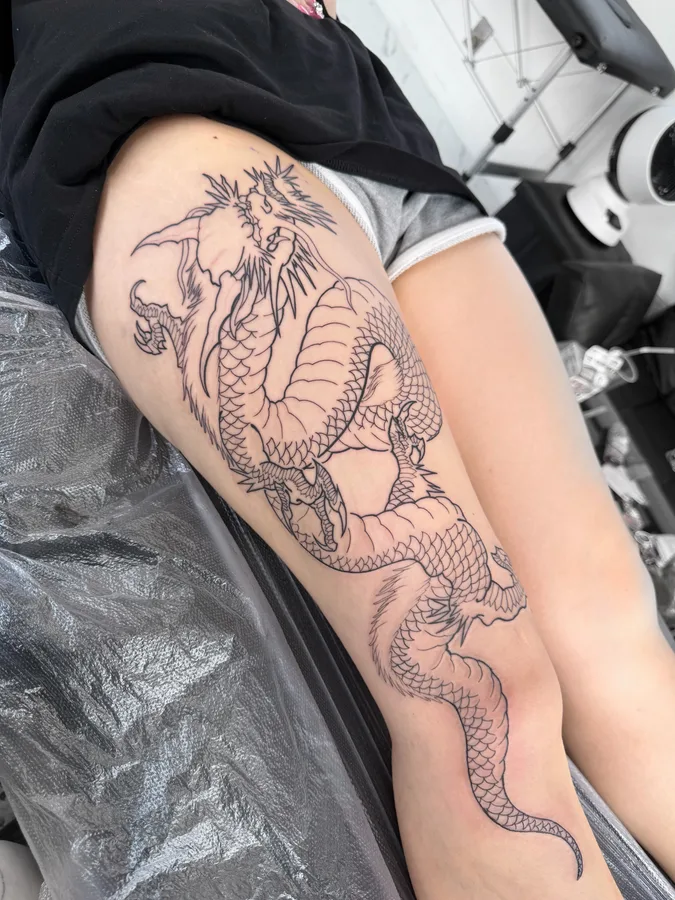 Rising dragon in progress | ALIEN TATTOO KOBE / Ki
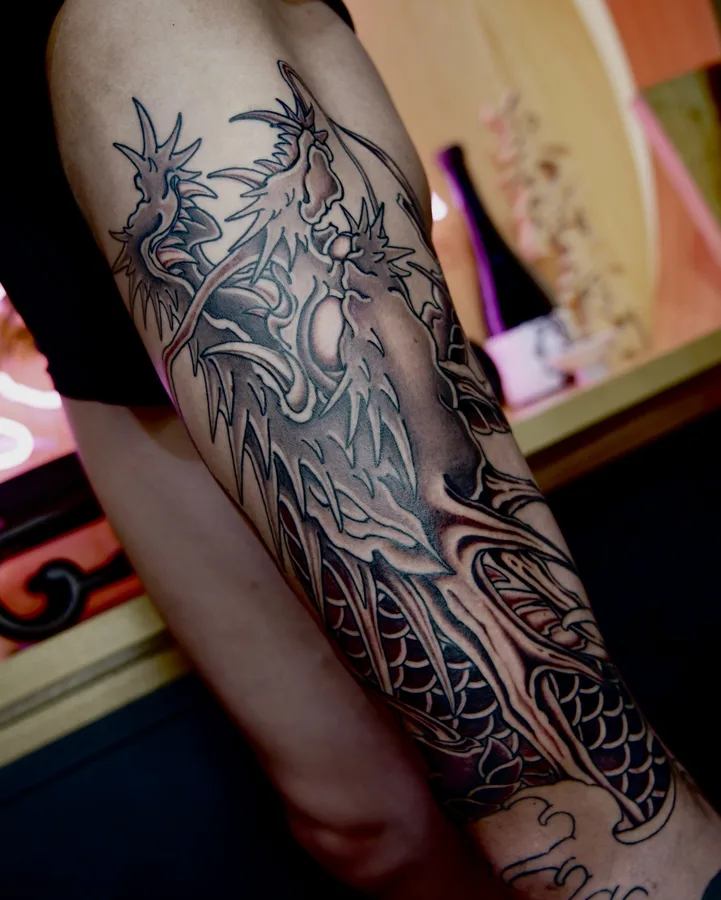 Rising dragon | MARIYA
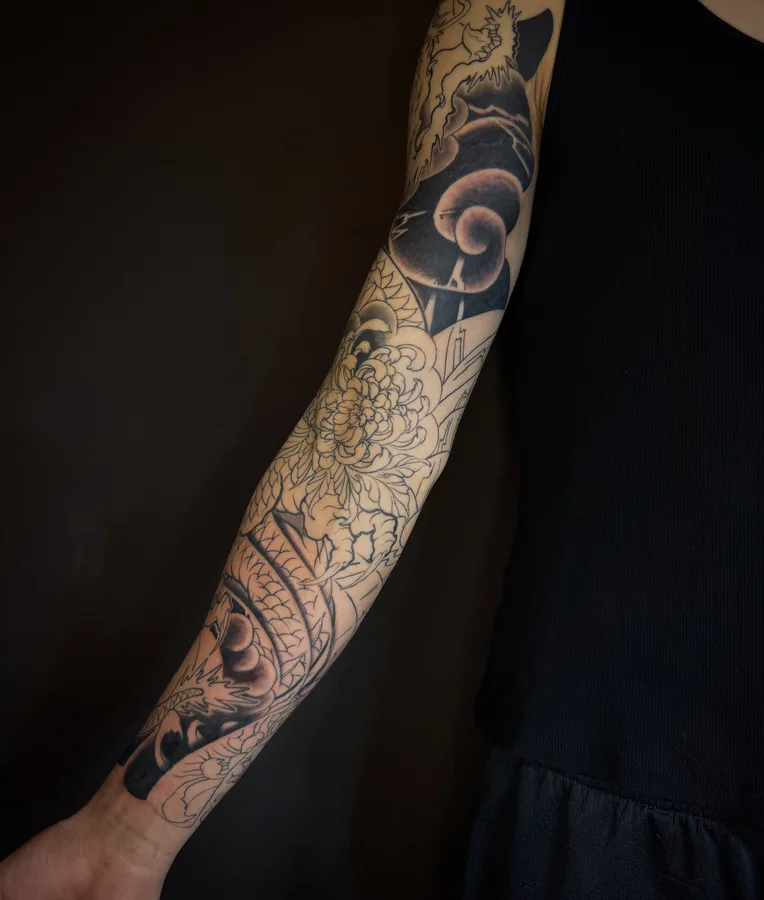 Rising dragon and chrysanthemum | 彫旭 Horiaki
Images are quoted from works by artists listed on tattooers.jp (as of November 16, 2026). Tap an image to open the work.
Artist pages: ALIEN TATTOO KOBE / Ki / MARIYA / Horiaki
ALIEN TATTOO KOBE / Ki noted on the rising dragon in progress that this session alone took 4.5 hours, with one more to finish. Even a dragon running down the thigh takes time. Few works on the site use the words "rising dragon" in their descriptions, so this section leans on primary sources, and we found no descriptions that back up the "descending dragon" readings.
Dragon Tattoo Claws: Three, Four or Five?
Chinese records confirm that claw numbers once marked rank. Japanese dragons often have three claws, but there has never been a rule that they must.
Here is what museums and Chinese sources record:
- In 1297, large dragons covering a whole garment were banned, though small dragons on the chest or back were still allowed, and in 1315 the five-clawed, two-horned dragon was made exclusive to the emperor. Under the Ming dynasty (1368–1644), officials were granted four-clawed dragons called mang, and under the Qing dynasty (1644–1911), officials even called dragons of identical form mang [3]
- Qing rules of the mid-18th century allowed only the emperor and the heir apparent to wear five-clawed dragons, but in the 19th century these rules were often overlooked [8]
- In 19th-century China, five claws could stand for the emperor and those closest to him, and four claws for lower royalty [5]. Despite the rules, five-clawed dragons circulated widely in the late Qing [9]
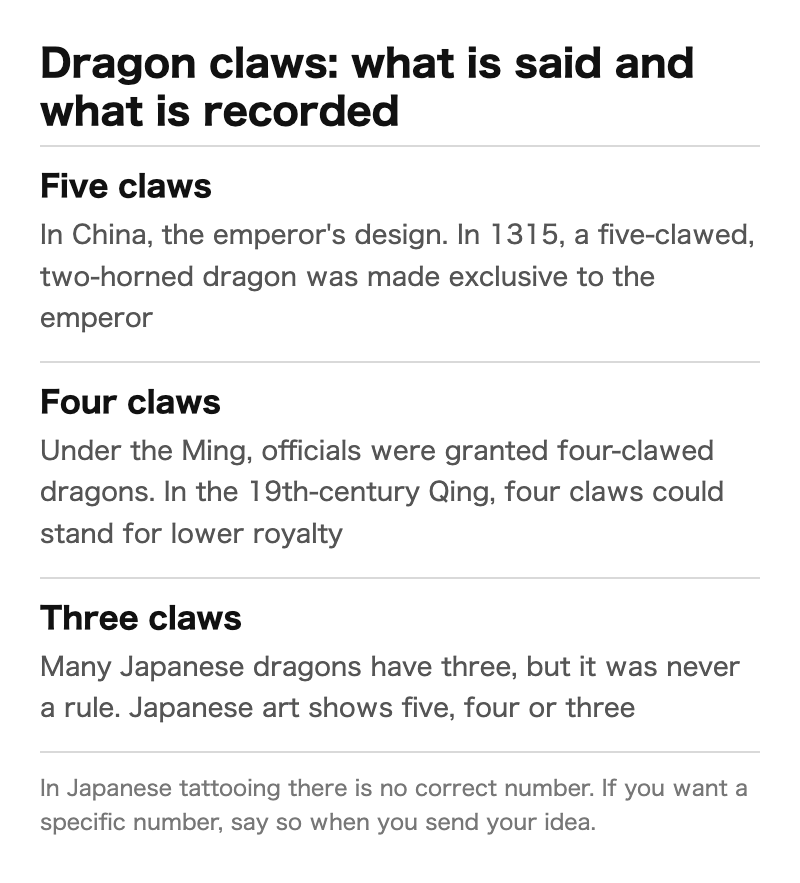 Figure: tattooers.jp editorial team
What about Japan? Lecture notes by Toru Kato of Meiji University say that Japanese dragons often have three claws, a trace of the Tang-era dragon from before China regulated claw numbers. But because Japan's central government never accepted investiture as a vassal of the Chinese emperor, it had no reason to defer to him, and the dragons in Japanese art have three, four or five claws. The notes call the popular claim that "Japan was only allowed three claws" unhistorical [7]. A Japanese encyclopedia entry even describes the dragon with "five toes on each of its four feet" [1].
So the five-claw rule belongs to Chinese imperial history, and Japanese tattooing has no "correct" number of claws. The dragons listed on tattooers.jp vary from work to work. If you care about the number, say so when you send your idea, so it is settled at the design stage.
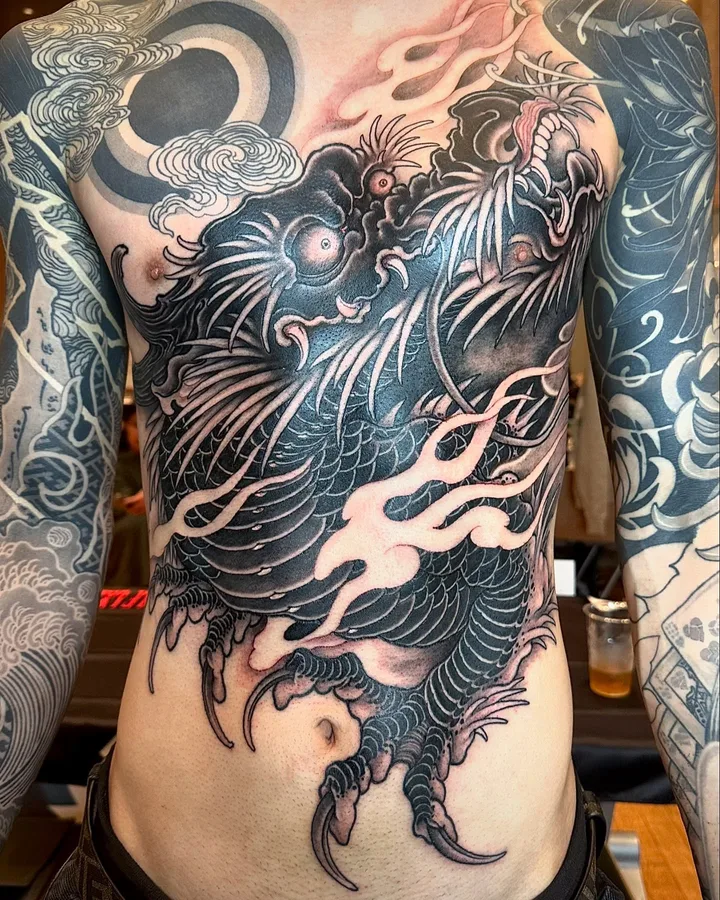
Images are quoted from works by artists listed on tattooers.jp (as of November 16, 2026). Tap an image to open the work.
Artist pages: Manabu Shinshu
A black dragon coiled around a sword is Kurikara, a dragon king regarded as a form of Fudo Myoo (the fierce Buddhist guardian Acala). It is shown as a black dragon wrapped in flames around a sacred sword, and in the Edo period (1603–1868) gamblers wore it on their backs [11]. The Japanese term kurikara monmon, a Kurikara tattoo on the back, later came to mean tattoos in general [12]. Fudo Myoo also has his own Sanskrit character, the zodiac guardian's character for the Rooster year: see bonji tattoos and zodiac guardian deities.
Clouds, Waves, the Jewel and the Tiger: Reading the Background
In works where the dragon is the main subject, more than half (53%) include waves or clouds, and about a third (34%) include flowers such as cherry blossoms or peonies (counted from tags, more than one per work). Among Japanese traditional works alone, waves or clouds appear in about 62%.
| Drawn with the dragon | Share |
|---|---|
| Waves or clouds | 52.6% |
| Flowers (cherry blossom, peony, chrysanthemum, maple, lotus and others) | 33.5% |
| Figures, warriors | 15.9% |
| Oni (demons) | 9.0% |
| Tiger | 3.8% |
| Koi | 3.2% |
| Hannya mask | 2.9% |
| Phoenix | 2.3% |
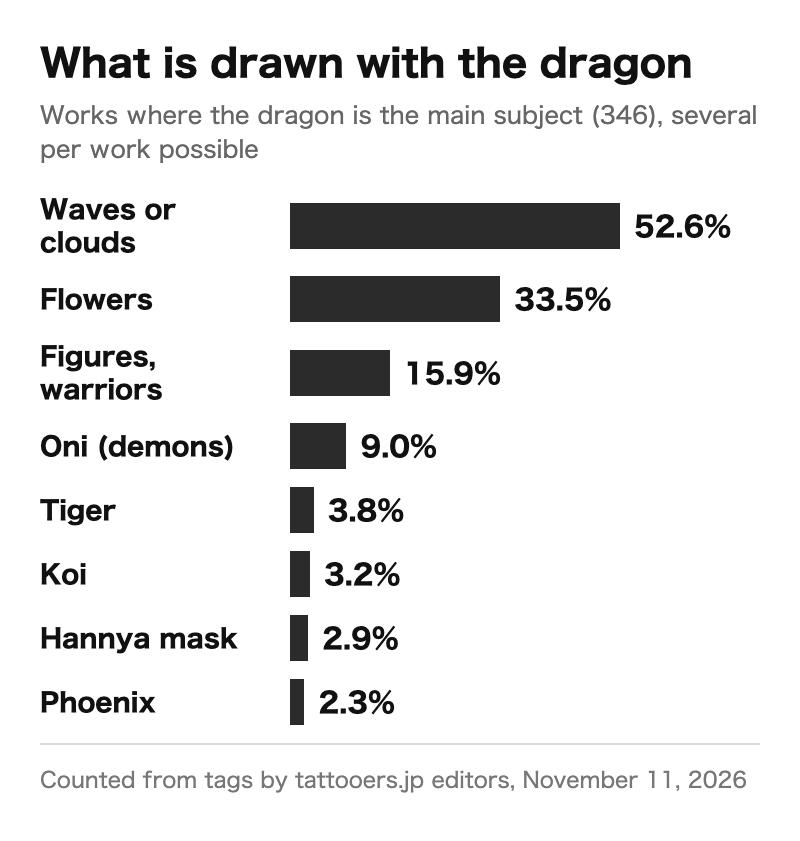 Figure: counted by tattooers.jp editors (November 11, 2026)
Here is how to read each element:
- Clouds: a dragon in clouds, or a dragon riding clouds up into the sky, has its own name in Japanese art: unryu, the "cloud dragon" [15]. A Chinese classic says that "clouds follow the dragon, and wind follows the tiger" [15]. In a tattoo, clouds fill the skin around the dragon and set the flow of the piece
- Waves: no fixed meaning is recorded for waves around a dragon. Since the dragon is said to live in water [1], waves place it in its home element, and like clouds they fill the background
- The jewel: the ball a dragon holds or chases is often compared to the nyoi hoju, the Buddhist wish-granting jewel. It is said to grant any wish, and one account places it in the brain of a dragon king [10]. Some people read a dragon gripping the jewel as "seizing your wishes", but that is a tattoo-world reading
- The tiger: in East Asian art the dragon and tiger were seen as special creatures representing heaven and earth, and were often painted together [16]. In tattoos they can face each other in one picture, or be split across the body, for example a dragon on the arm and a tiger on the chest
- Flowers: cherry blossoms and maple leaves add the season and soften the dragon's force. See Japanese flower tattoos.
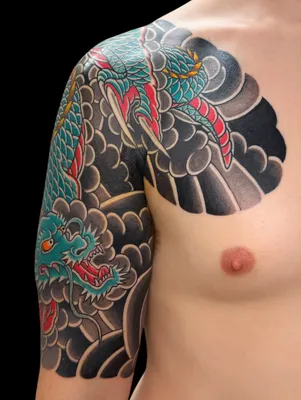 Cloud dragon | 彫也 HORINARI
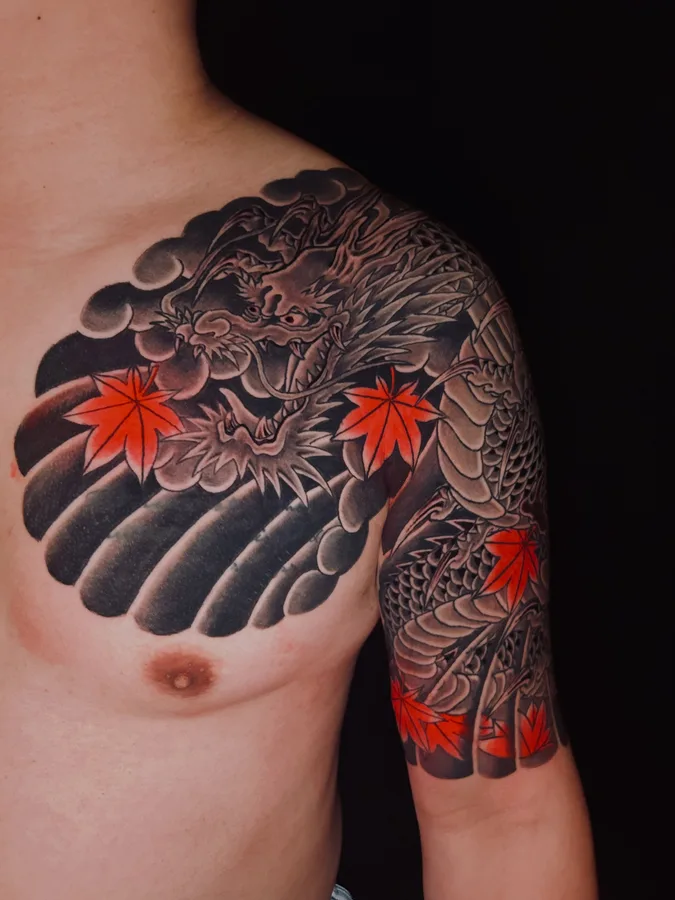 Clouds and maple | 彫武 Horitake
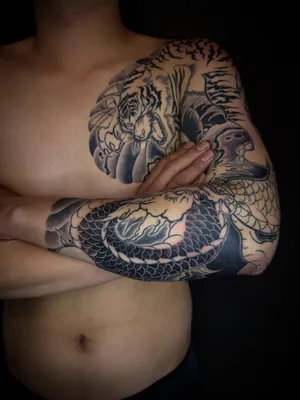 Dragon on the arm, tiger on the chest | 彫旭 Horiaki
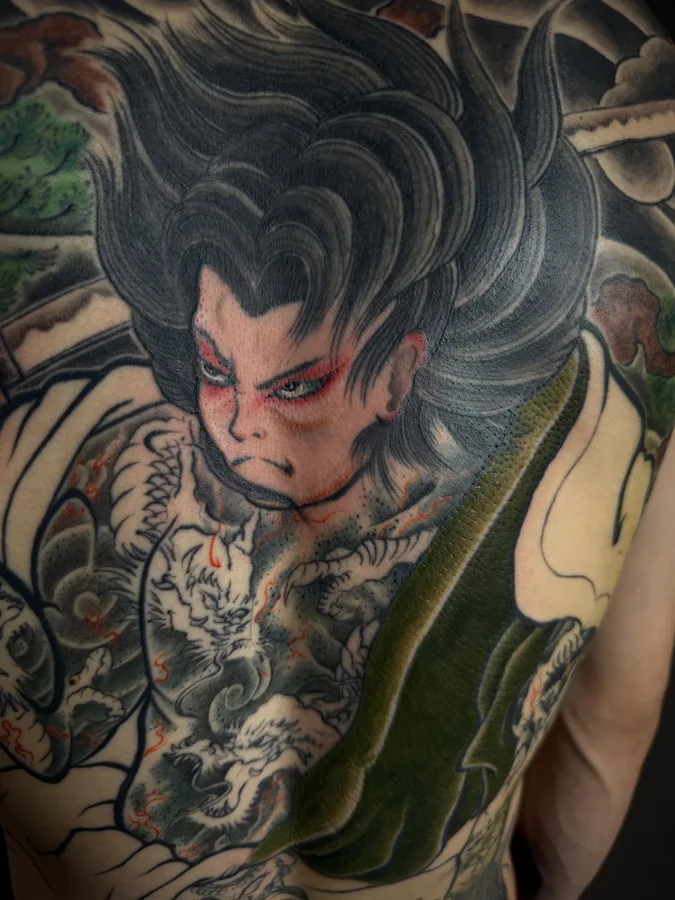 Shi Jin, Nine Dragons | 彫旭 Horiaki
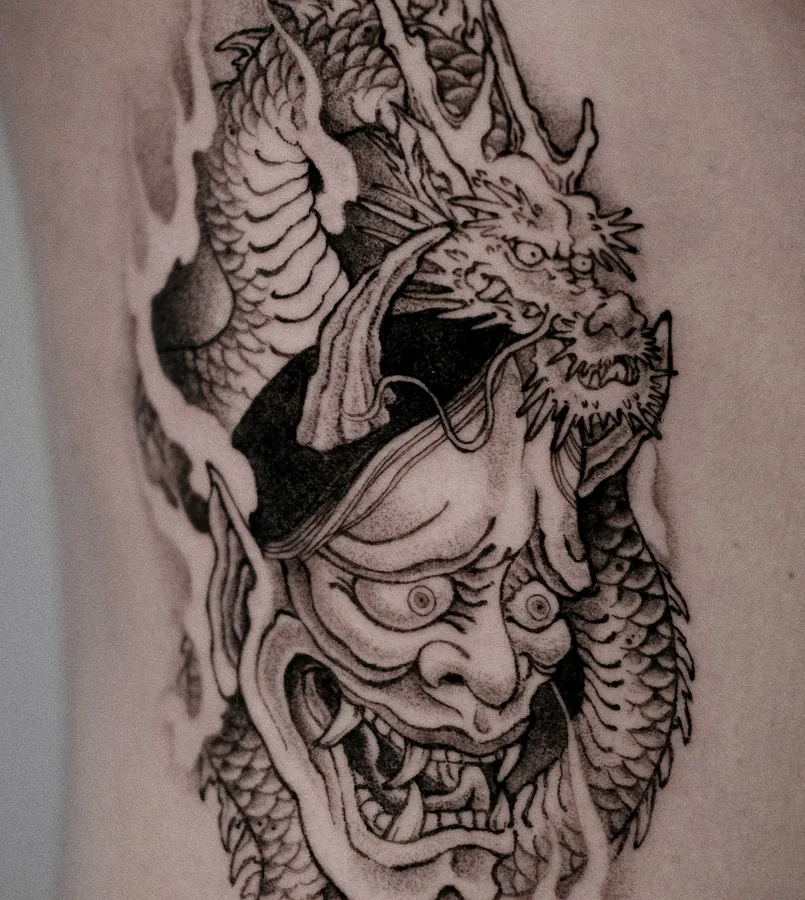 Dragon and hannya | siru
Images are quoted from works by artists listed on tattooers.jp (as of November 16, 2026). Tap an image to open the work.
Artist pages: HORINARI / Horitake / Horiaki / siru
Works with figures include some where the dragon is not the main subject. Shi Jin, known as "Nine Dragons" in the Chinese classic Water Margin, is a hero with nine dragons tattooed on his body [14]. Utagawa Kuniyoshi's prints of Water Margin heroes were so popular that they set off a craze for tattoos in Edo (old Tokyo) [13].
Tigers, koi, hannya masks and phoenixes each appear in only a few percent of dragon works. Classic pairings such as dragon and tiger, or the koi that climbs a waterfall to become a dragon, are explained in Japanese tattoo meanings. Browse clouds, waves, tigers, koi, cherry blossoms, hannya masks and samurai and warriors on tattooers.jp.
Where People Put Dragon Tattoos: 407 Works on tattooers.jp
As of November 11, 2026, 407 works on tattooers.jp were tagged "dragon" (our editorial count; the number keeps growing as artists add work). We calculated shares from the 346 where the dragon is the main subject, leaving out works led by a qilin, lion, koi or snake, or by other pictures.
Among works where the dragon is the main subject, the arm is the most common placement at 44%, followed by the back (20%), leg (11%), chest (9%) and shoulder (8%). Each work is counted once, by its main placement. The six placements below cover about 96%; the rest are the lower back, ankle or unspecified.
| Placement | Share | What the works look like |
|---|---|---|
| Arm | 43.6% | Wrapped from shoulder to wrist. Some spread from the shoulder onto the chest |
| Back | 19.9% | A single dragon across the whole back, with clouds or waves filling the space |
| Leg | 11.0% | Running long and vertical, from thigh to shin |
| Chest | 9.2% | Linked from the chest to the shoulder and arm |
| Shoulder | 8.4% | From the shoulder over the chest or upper arm |
| Stomach and side | 3.5% | Vertical, from the side down toward the hip |
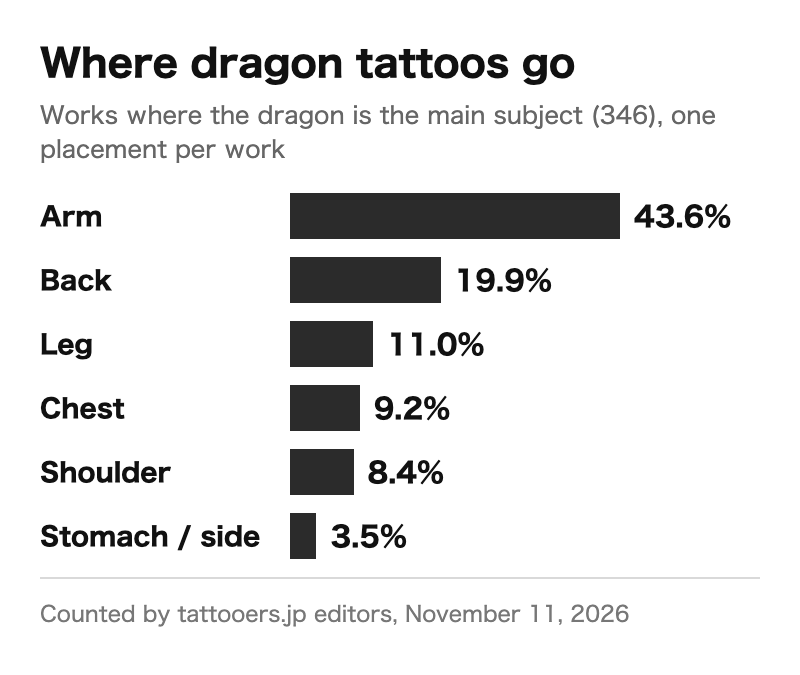 Figure: counted by tattooers.jp editors (November 11, 2026)
Splitting by style makes the difference clear. Dragons that include Japanese traditional style (about 83% of the total) go on the back 23% of the time, while dragons that are neither Japanese traditional nor neo-Japanese go on the back only about 4% of the time and on the leg in about one in five (21%). Non-Japanese dragons are on the arm in about half of cases (51%).
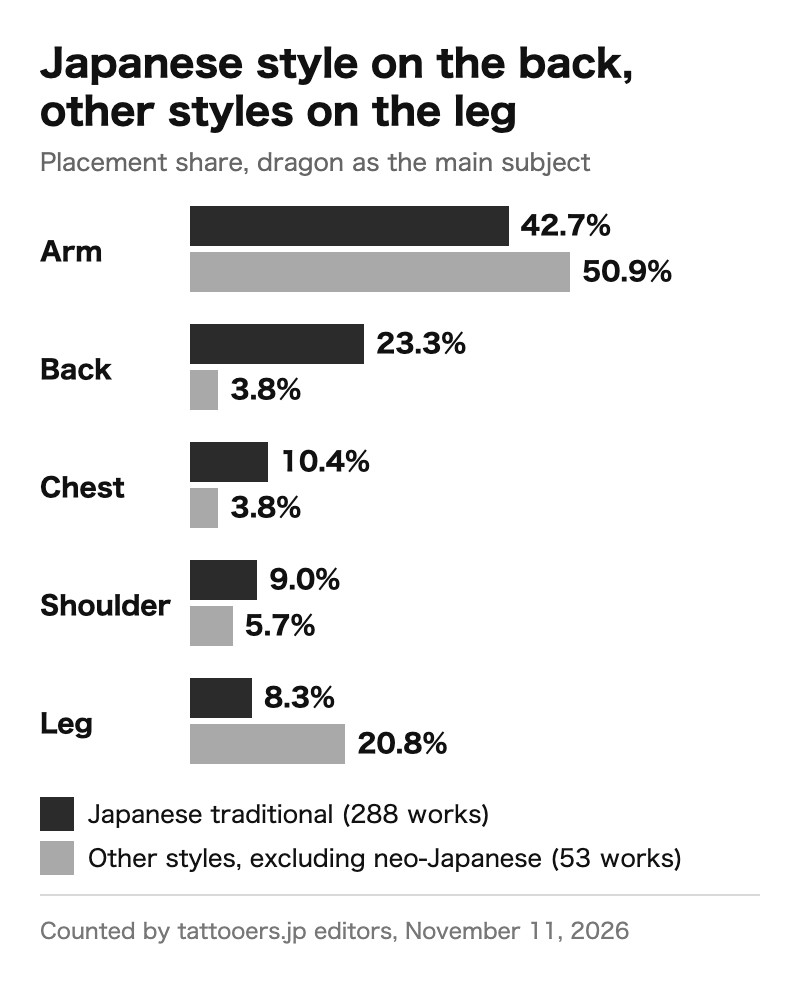 Figure: counted by tattooers.jp editors (November 11, 2026)
Could one prolific artist skew the numbers? Recounting without the artist with the most dragon works, Japanese-style back pieces are 25% and arms overall 43%, so the pattern holds.
A dragon's body is long, so it suits placements with length. On a full back the body winds with the head near the shoulder; on an arm or leg it wraps around, with the head at the shoulder or thigh.
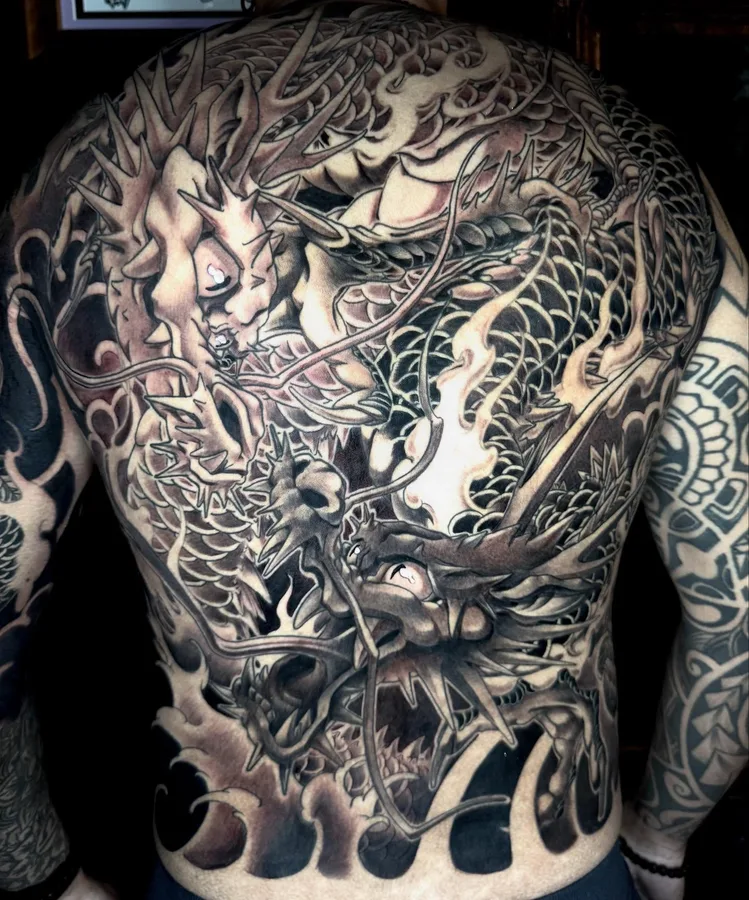
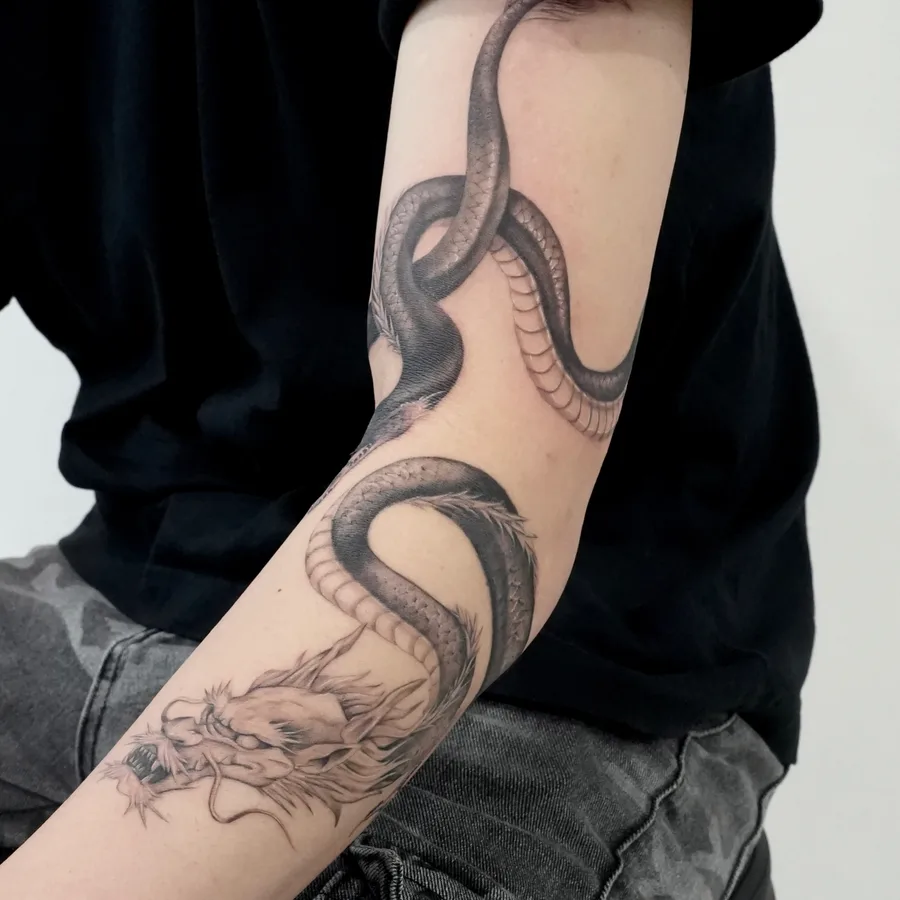
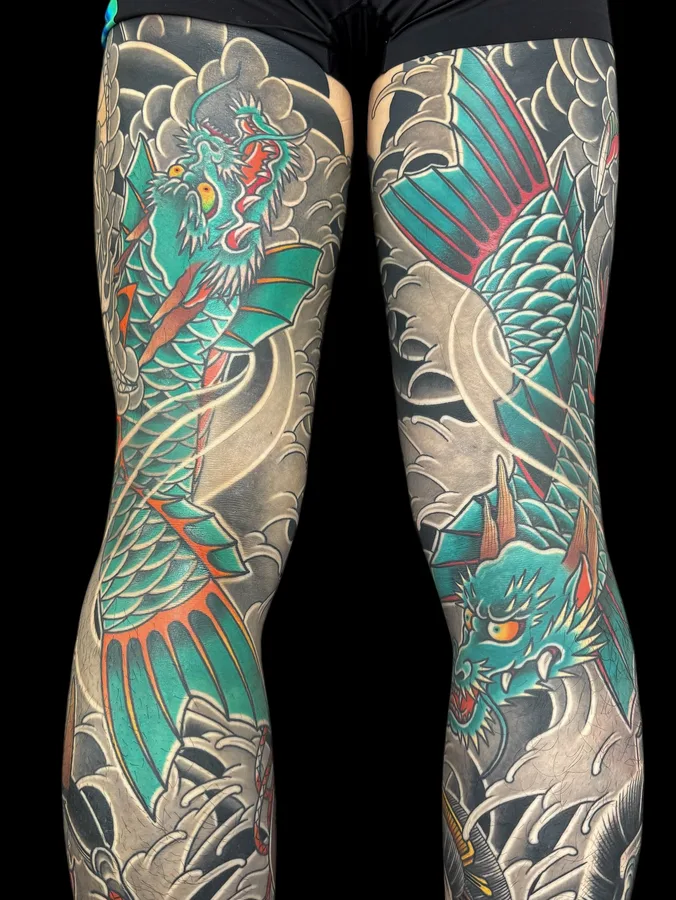
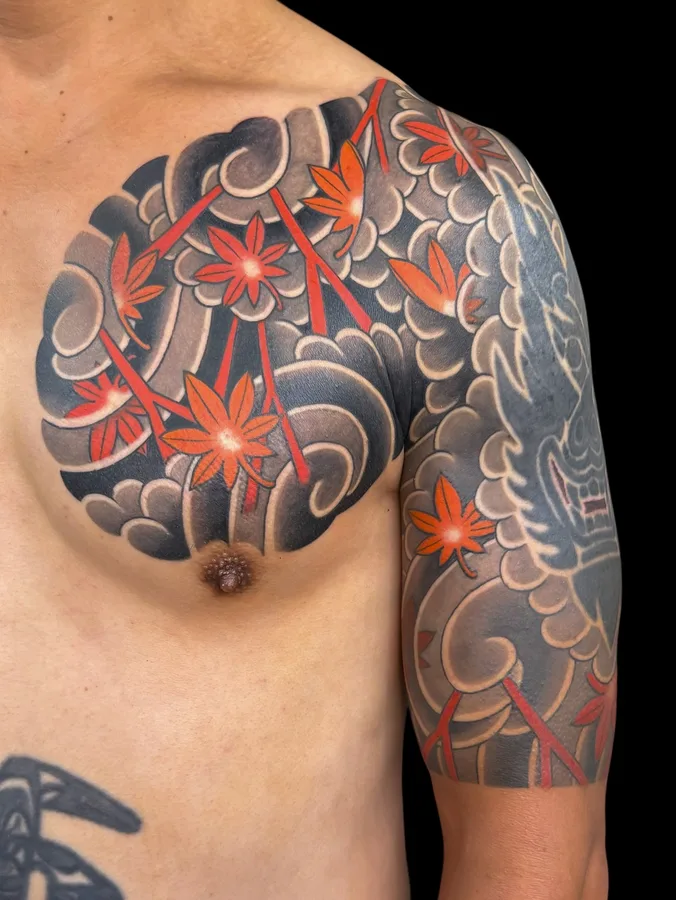
Images are quoted from works by artists listed on tattooers.jp (as of November 16, 2026). Tap an image to open the work.
Artist pages: KENT / Kyo / HORINARI
A large dragon almost never finishes in one session. KENT's black and white dragon back piece, made for a client from France, was outlined in an earlier visit and then finished in three days. Kyo's arm dragon took three sessions; the artist gave the front and sides volume and balanced the back symmetrically, so it reads from every angle. For a wrapping dragon, think about how it looks from the side and back, not just the front.
Session time varies a lot. Shingun's dragon across the chest was a one-day finish. Size and the number of sessions drive the cost; see the tattoo price guide for ranges and tattoo pain by body part for how each spot feels. Browse works by back, arm and leg.
Planning a dragon in Japan? Tell us your dates, the placement and the kind of dragon you want, and we match you with an artist. We message you on Instagram within 48 hours, and the ¥15,000 deposit is fully refunded if we can't match you.
Beyond Traditional: Neo-Japanese, Black and Gray, Fine Line, Tribal
A little over 80% of the dragons are Japanese traditional, and the rest come in many styles: neo-Japanese, black and gray, fine line, old school and tribal.
- Neo-Japanese: traditional Japanese imagery with fresher color or composition, often on the arm or leg
- Black and gray: scales and clouds drawn in shades of black ink only. Powerful without color
- Fine line and small: dragons in thin lines. Works tagged fine line, minimal or one-point make up about one in 13 (8%) of the dragon-led works
- Old school and tribal: bold lines or designs based on vintage flash. Tribal dragons appear in the work of Japanese artists too (tribal here is a modern style, not one of Japan's Indigenous tattoo traditions)
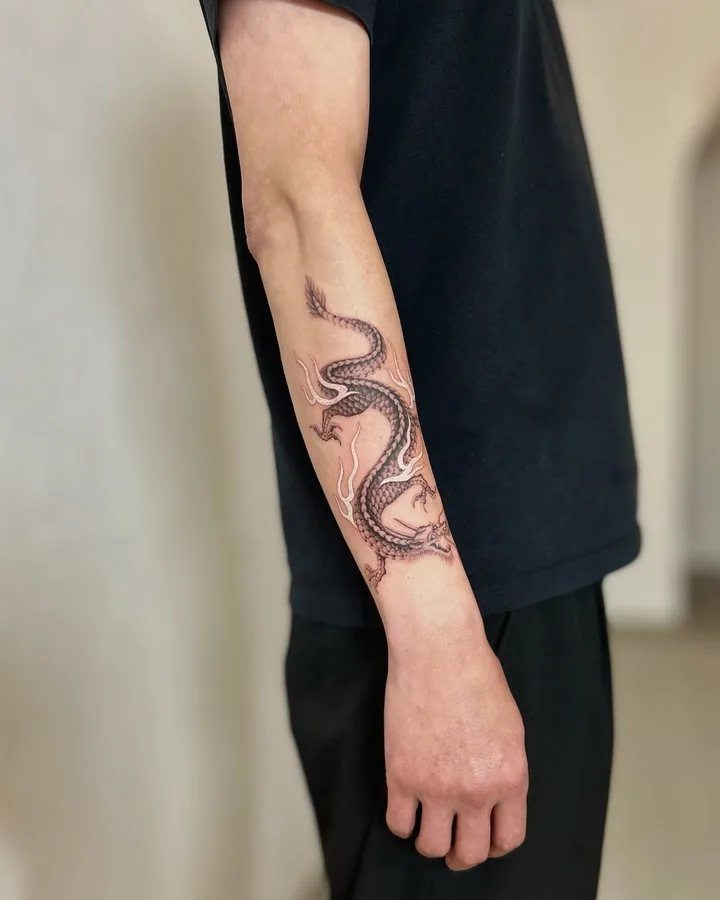 Based on vintage flash | Motoi Tattooer
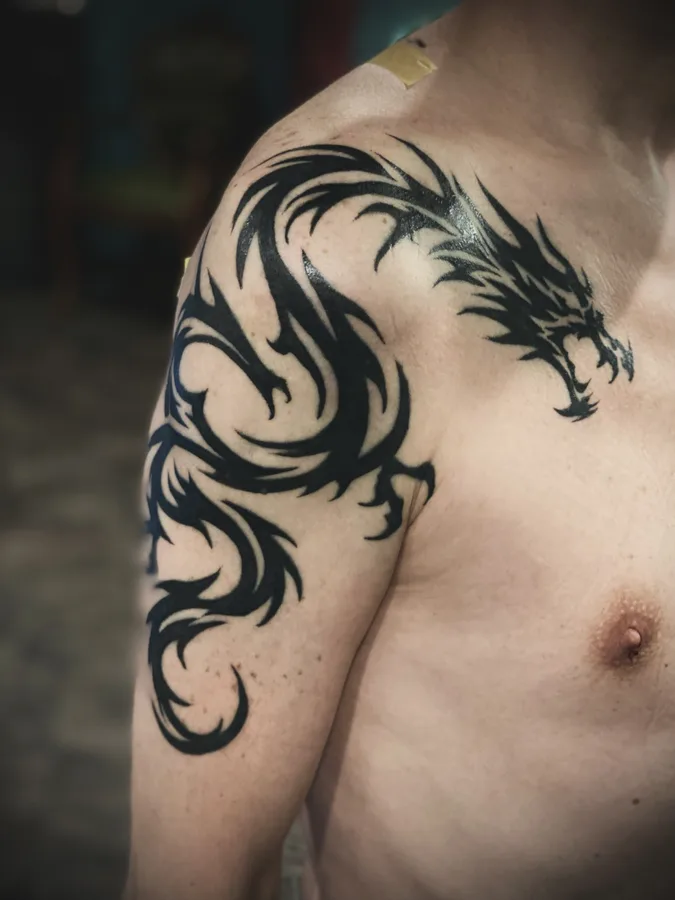 Tribal | ToM [DRAGON HEART TATTOO]
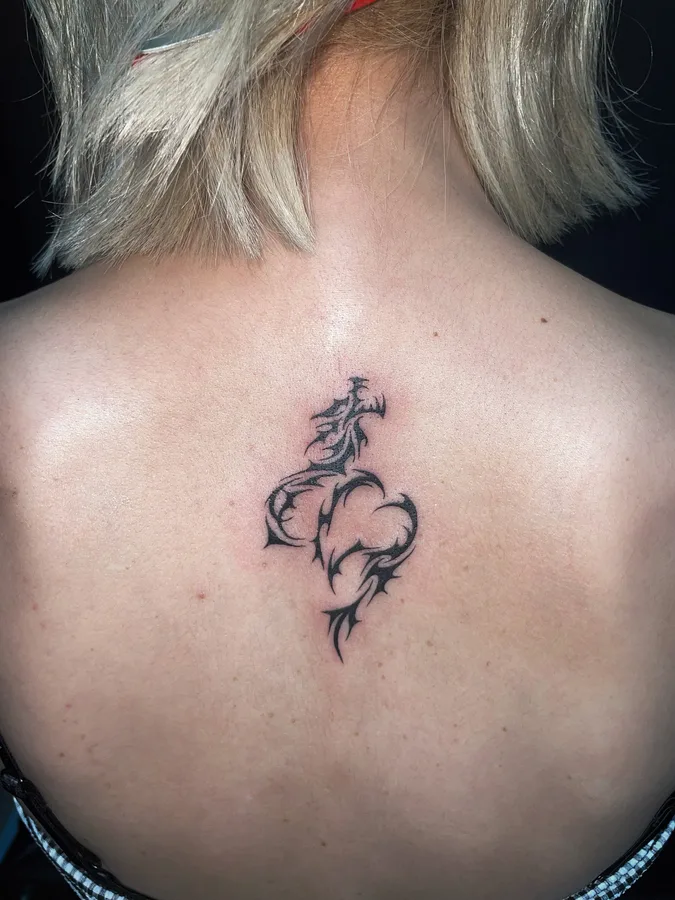 Small tribal | SOU
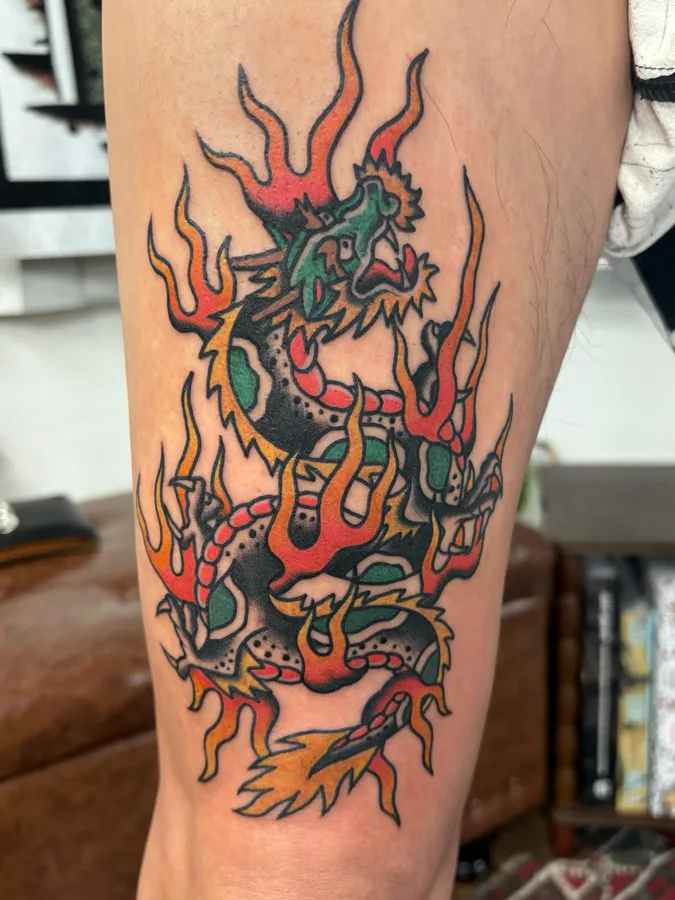 Old school with flames | NATSUKO
Images are quoted from works by artists listed on tattooers.jp (as of November 16, 2026). Tap an image to open the work.
Artist pages: Motoi Tattooer / ToM / SOU / NATSUKO
On color, works that include color (47%) and black and gray (52%) are roughly even; 11% include both.
Motoi Tattooer's dragon wearing glasses was drawn to a client's order, and the artist notes that the design is based on a flash dragon by K. Akamatsu, a tattoo artist active around 1910. You can start from an old design or a picture you love. For more on flash itself, see our guide to flash tattoos (Japanese).
Compare styles in old school, black and gray, fine line, tribal and neo-Japanese. Traditional pieces are in Japanese style tattoos.
The Face and Eyes Change the Whole Dragon
Where you put the dragon's face and where its eyes look changes the impression of the whole piece. A dragon facing straight out (a "frontal dragon") hits hardest; a dragon in profile shows off the flow of its body. Some works are just a large dragon head.
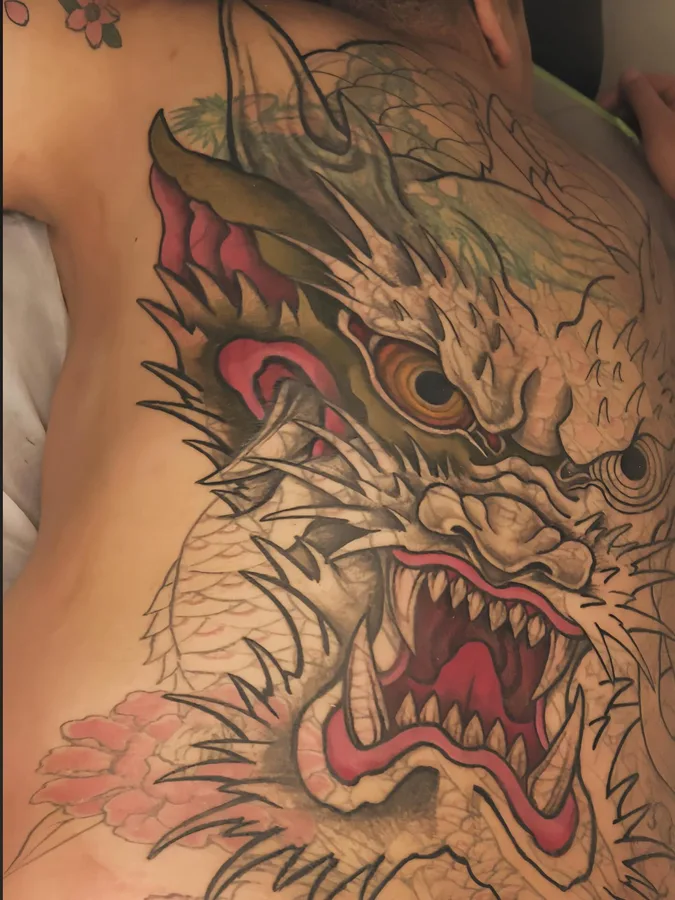 Frontal dragon | 緑 Midori
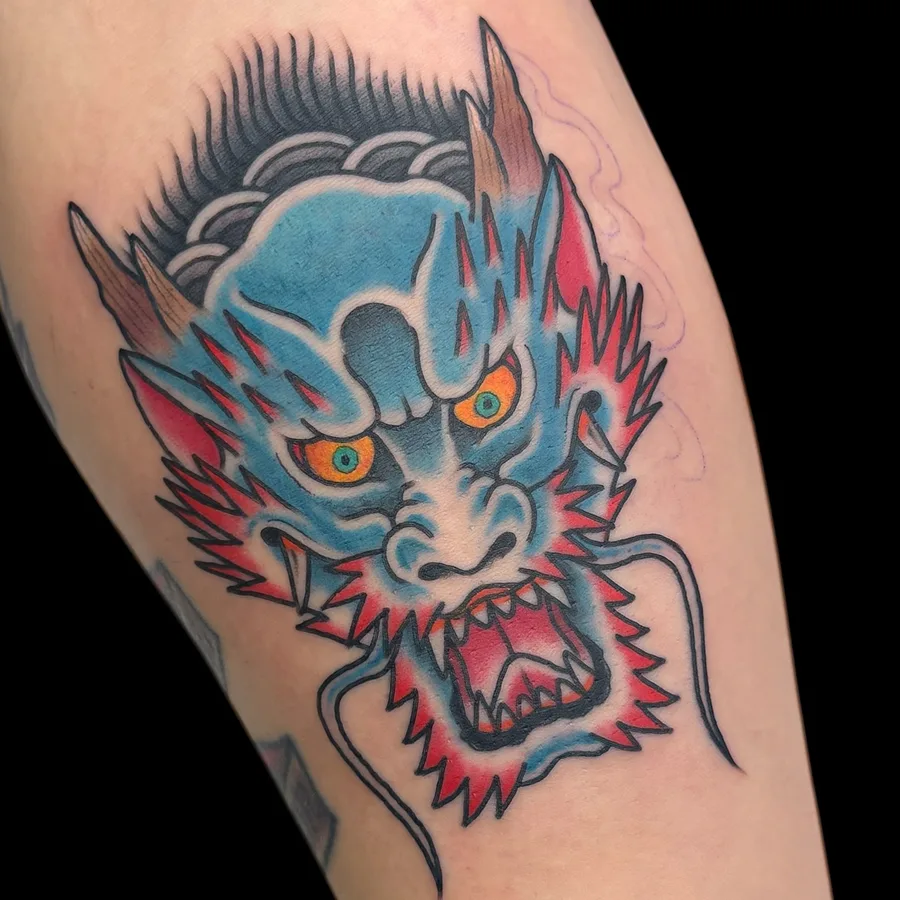 Blue dragon head | 彫也 HORINARI
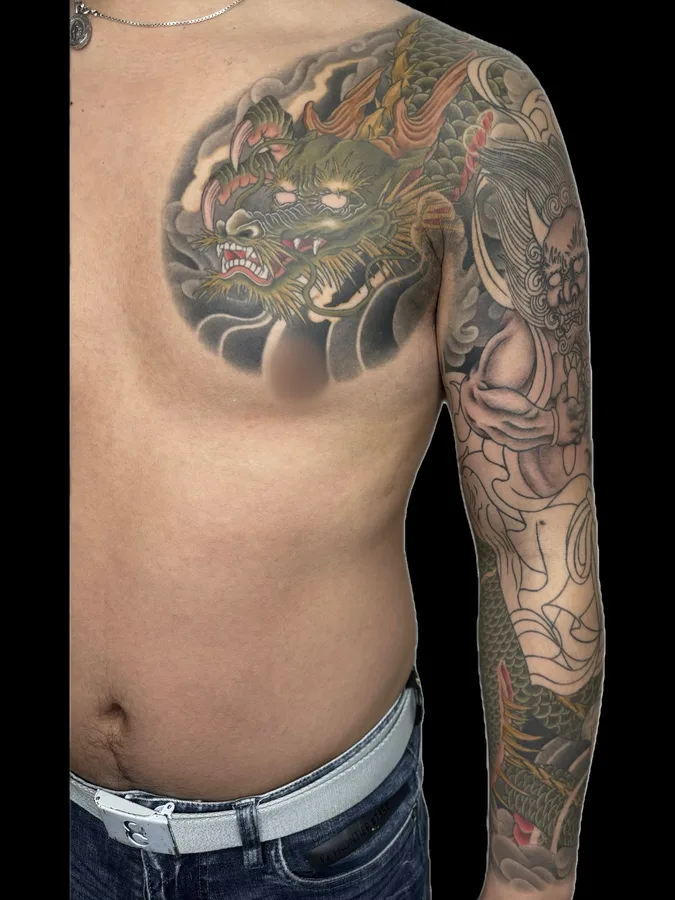 Dragon and Raijin | tomo
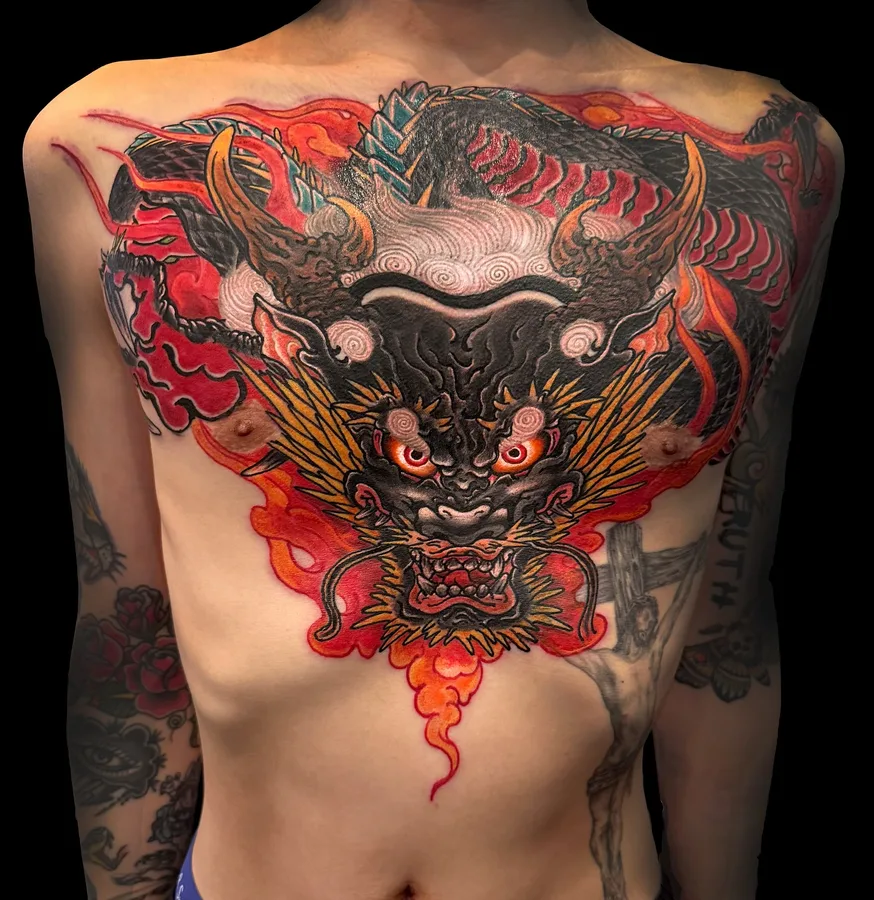 Dragon face on the chest | Shingun
Images are quoted from works by artists listed on tattooers.jp (as of November 16, 2026). Tap an image to open the work.
Artist pages: Midori / HORINARI / tomo / Shingun
Some people build meaning into the eyes. Ryo Takanami, singer and guitarist of a Japanese rock band, decided with his artist that the dragon on his arm would glare back at him, so that on stage its eyes would be watching him. The story is in his interview (Japanese).
If you want the dragon to carry a meaning, think about who its eyes look at, and whether you or other people will see it. That usually settles the placement.
Planning a Japanese Dragon Tattoo in Japan
Decide five things before you send your idea: placement and size, the flow and head position, what goes with the dragon, color, and how many sessions you can fit in.
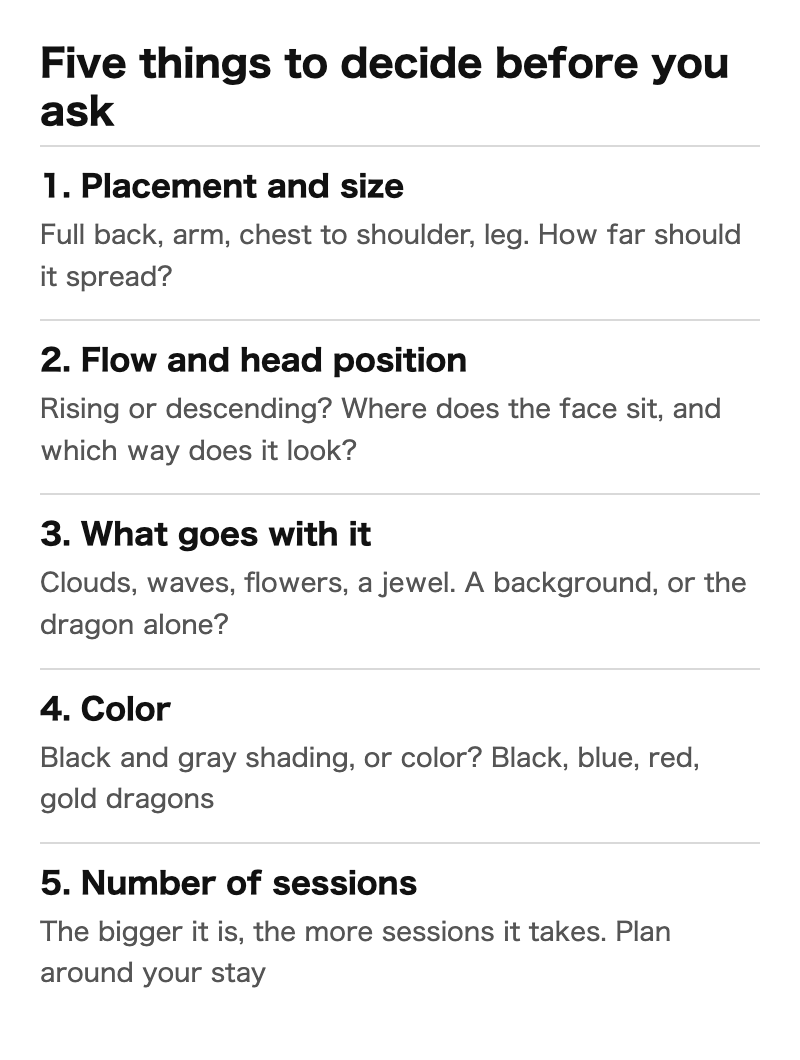 Figure: tattooers.jp editorial team
- Placement and size: full back, arm, chest to shoulder or leg. The longer the dragon, the more powerful it looks, and the more sessions it needs
- Flow and head position: rising or descending, where the face sits and which way it looks
- What goes with it: clouds, waves, flowers or a jewel. A background, or the dragon alone
- Color: black and gray shading or color. Black, blue, red and gold dragons are all common
- Sessions: a large dragon will not finish in one visit. Tell us how long you are in Japan and whether you can come back
If you have a reference picture, even a Western dragon, include it and say "I want this dragon in Japanese style". In Japanese tattooing it is common to name the main subject and let the artist propose the composition.
Some people want a dragon to hide an old tattoo. kazz wrote of the gold dragon back piece below that clouds were worked in so the covered area would not overlap the dragon's body. Because a dragon is long and its surroundings can be filled with clouds or waves, it can be shaped to the area you need to hide. Whether a cover-up works depends on how dark and large the old tattoo is; mention it in your request. You can also see artists who do cover-ups.
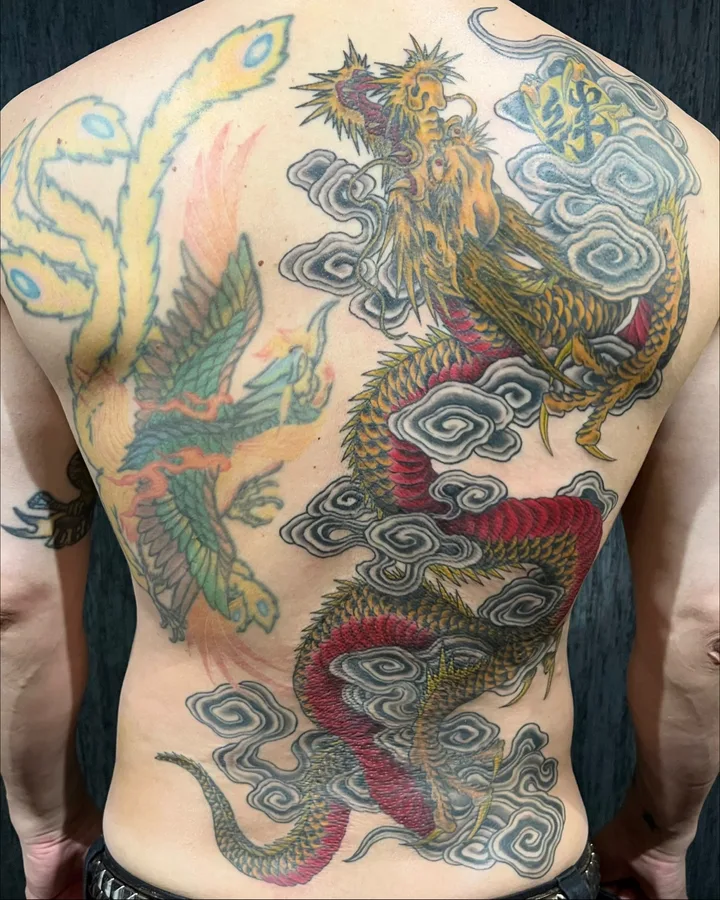
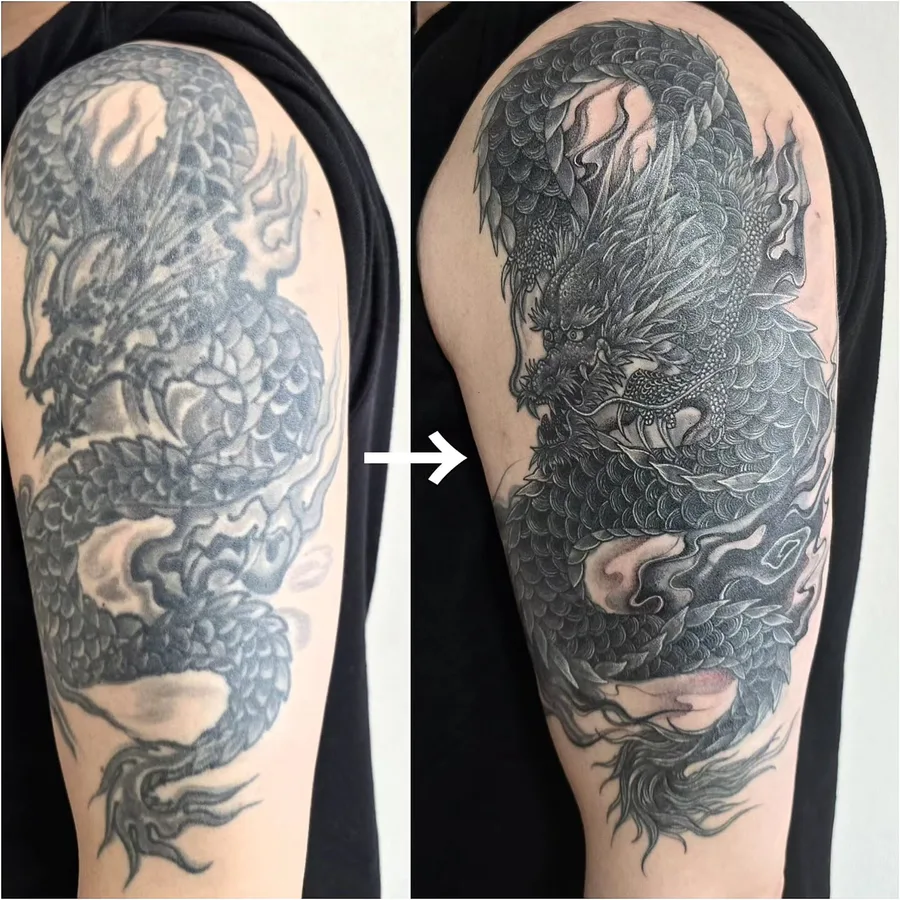
Images are quoted from works by artists listed on tattooers.jp (as of November 16, 2026). Tap an image to open the work.
On tattooers.jp you do not contact artists yourself. Put your dates, placement, size and reference pictures in the inbound request form, and we match you with an artist who fits. To get a feel for the range first, save three to five dragons you like from dragon tattoos and attach them: the face, the scales and the backgrounds differ a lot from artist to artist. You can also look through tattoo artists in Japan, artists in Tokyo and Osaka, and artists who tattoo by hand (tebori). Tattooing is for people 18 and over.
Frequently Asked Questions
Q. Can women get a dragon tattoo?
Yes. No motif is tied to gender. The works on tattooers.jp include vertical black dragons on the back and small fine-line dragons. Line weight, color and size change the impression a lot, so choose by style.
Q. Can a dragon tattoo be small?
Yes, but a dragon has a lot of detail in its face and scales, so the smaller it is, the more must be left out. Artists differ on how small a face or scales can go before they blur, so give the size you have in mind in your request. On the site, fine-line dragons are often on the arm or leg.
Q. Is a rising or descending dragon unlucky?
Neither is recorded as unlucky. In tattooing, the rising dragon is linked with momentum and success, and the descending dragon with blessings and protection, but at Ueno Toshogu Shrine the dragon facing down is the one called rising [6]. Choose the flow you like.
Q. How many claws should a Japanese dragon have?
There is no rule. Five claws were reserved for the Chinese emperor [3], and Japanese dragons often have three, but Japanese art shows three, four or five [7]. If you want a particular number, say so when you send your idea.
Q. How long does a dragon tattoo take?
It depends on size and detail. Artists on tattooers.jp describe a chest dragon finished in one day, a back piece finished in three days after an earlier outline session, and an arm dragon finished in three sessions. One in-progress session took 4.5 hours. The artist estimates time and sessions after seeing your design; see the tattoo price guide for costs.
Summary
- A Japanese dragon tattoo is most often chosen for strength, protection and rising in life. No meaning is fixed; read what sources record separately from what the tattoo world says
- Rising dragons usually head up and descending dragons down, but at Ueno Toshogu Shrine the dragon facing down is the one called rising. The "blessings" and "protection" of the descending dragon are tattoo-world readings
- Five claws were the Chinese emperor's design. Japanese dragons often have three, but there is no rule; Japanese art shows three, four or five
- Clouds and waves fill the background, the jewel is the wish-granting jewel, and the tiger pairs with the dragon as heaven and earth
- Of the dragons on tattooers.jp, 44% are on the arm, 20% on the back and 11% on the leg. Japanese-style dragons favor the back, other styles the leg
The same dragon looks very different from artist to artist, from brush-like dragons to red-dominated ones:
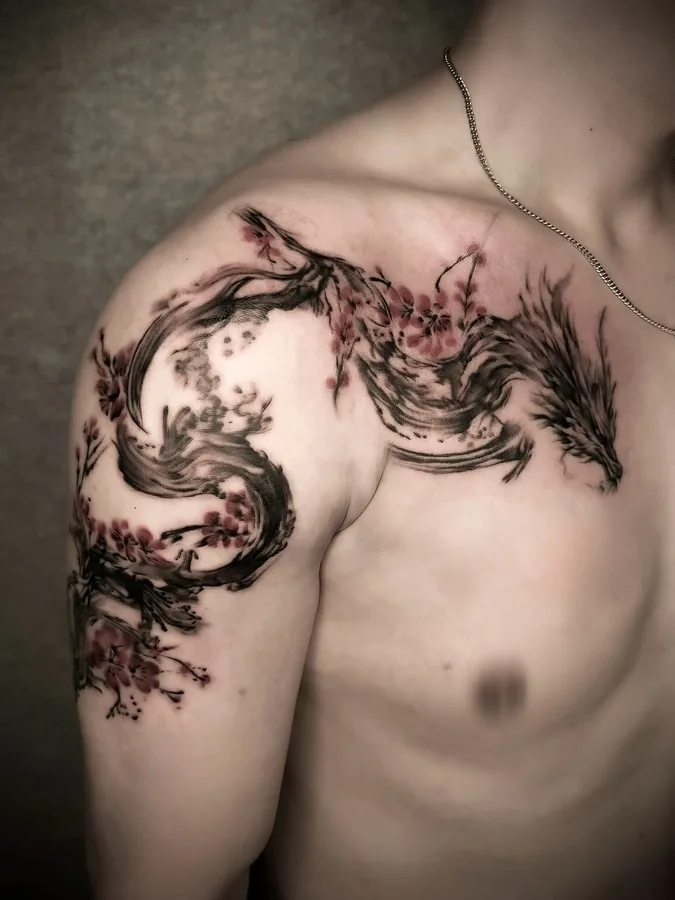 Brush-style dragon and cherry blossoms | HAZE
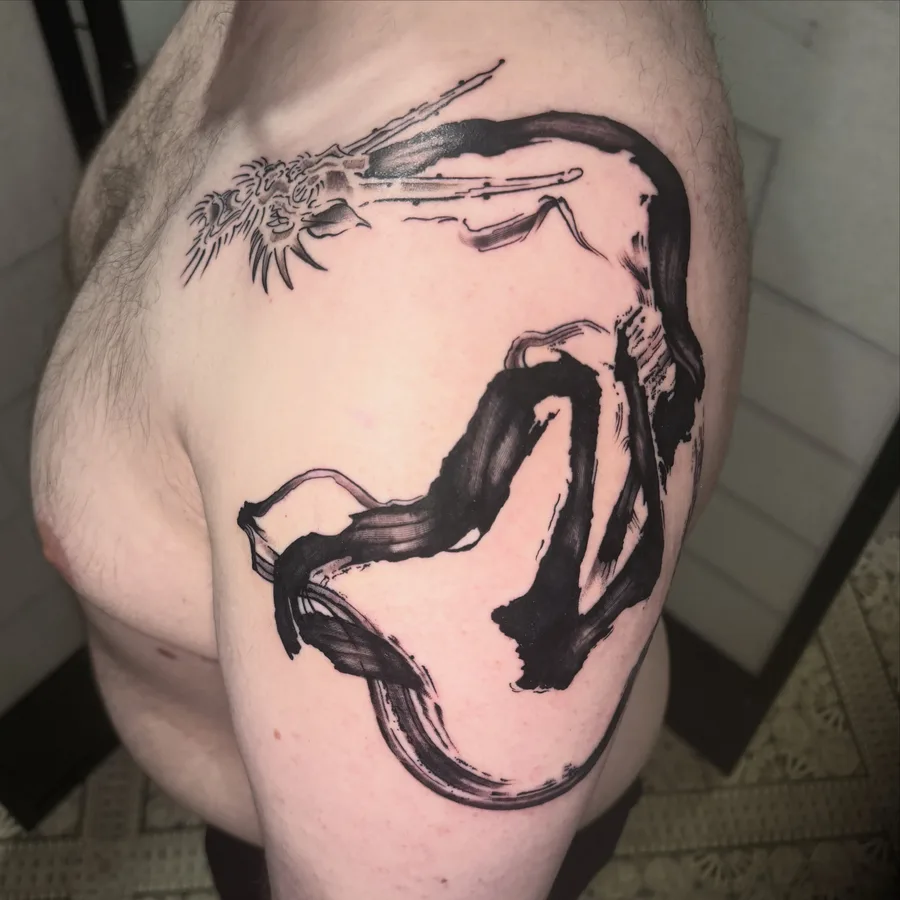 Abstract black dragon | はち Hachi
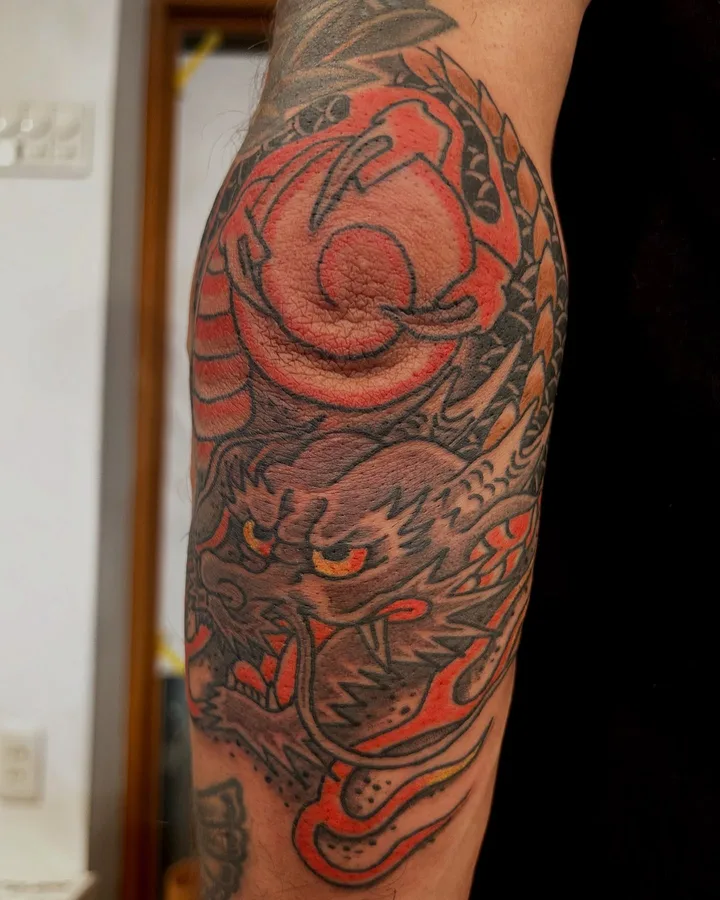 Red dragon face | Megu
Images are quoted from works by artists listed on tattooers.jp (as of November 16, 2026). Tap an image to open the work.
Artist pages: HAZE / Hachi / Megu
Want a dragon tattooed in Japan? Get matched with an artist in Japan: tell us your dates and idea, and we message you on Instagram within 48 hours. The ¥15,000 deposit is fully refunded if we can't match you. You can also browse dragon tattoos and Japanese style tattoos on tattooers.jp.
References
Many sources are Japanese dictionaries and museum pages; titles are our translations. Links open external sites.
- Kotobank (Shogakukan Digital Daijisen; Heibonsha World Encyclopedia, revised edition; Shogakukan Nipponica; Britannica International Encyclopedia). "Dragon" (Japanese). Accessed November 16, 2026.
- Kotobank (Shogakukan Digital Daijisen and others). "Toryumon (Dragon Gate)" (Japanese). Accessed November 16, 2026.
- Kyoto National Museum (1998). The emperor's dragon (Museum Dictionary, Japanese). Accessed November 16, 2026.
- The Metropolitan Museum of Art. Roof-tile end with dragon (Ming dynasty). Accessed November 16, 2026.
- National Museum of Asian Art (Smithsonian). Summer Chaofu for a Top-Rank Prince. Accessed November 16, 2026.
- Japan Tourism Agency. Ueno Toshogu Shrine Kara-mon gate (history and features) (Multilingual Commentary Database, Japanese). Accessed November 16, 2026.
- Toru Kato (Meiji University). East Asian art theory (lecture notes, Japanese). Accessed November 16, 2026.
- The Metropolitan Museum of Art. Man's Audience Robe (Chaofu) (Qing dynasty). Accessed November 16, 2026.
- Cooper Hewitt, Smithsonian Design Museum (2017). Five-Clawed Dragon. Accessed November 16, 2026.
- Kotobank (Shogakukan Digital Daijisen; Britannica International Encyclopedia). "Nyoi hoju (wish-granting jewel)" (Japanese). Accessed November 16, 2026.
- Otani University. Kurikara (Buddhist terms in everyday life, Japanese). Accessed November 16, 2026.
- Kotobank (Shogakukan Digital Daijisen and others). "Kurikara monmon" (Japanese). Accessed November 16, 2026.
- Ota Memorial Museum of Art (2016). Kuniyoshi Heroes: The Water Margin All Together (September 3 to October 30, 2016, Japanese; archived copy on the Wayback Machine). Accessed November 16, 2026.
- Art Research Center, Ritsumeikan University. Kumonryu Shishin (Shi Jin, Nine Dragons) (ArtWiki, Japanese). Accessed November 16, 2026.
- Kotobank (Shogakukan Digital Daijisen; Heibonsha Jitsu). "Unryu (cloud dragon)" (Japanese). Accessed November 16, 2026.
- Kyoto National Museum (2022). New Year special exhibition: Tigers, celebrating the zodiac animal (January 2 to February 13, 2022, Japanese). Accessed November 16, 2026.
The counts, placements and tag shares are tattooers.jp editorial counts based on the 346 works, out of the 407 works publicly tagged "dragon" on tattooers.jp as of November 11, 2026, in which the dragon is the main subject. Our editors judged each work by eye, so read the shares as tendencies. Artists' words are paraphrased from their work descriptions. Meanings combine readings recorded in dictionaries and museums with interpretations heard in the tattoo world; they are not fixed meanings.
