Can you go to an onsen with tattoos? Often yes, but there is no nationwide onsen tattoo rule: each facility decides, and "tattoo OK" can mean anything from "come as you are" to "only if our two stickers cover it." More places, including some large hotel chains, have dropped their tattoo bans since 2025, while many still refuse tattoos of any size.
Lists of tattoo-friendly onsen go out of date quickly, so this guide covers what has changed, how to read a facility's official rules (including the Japanese phrases you will see), and how cover stickers work. Facts are as of November 2026. Always check the facility's own page before you go.
Looking for places to go? Our tattoo-friendly onsen, sento and sauna map lists facilities across Japan with their official wording and the date we checked it. For Tokyo, see the Tokyo map or our guide to tattoo-friendly onsen, sento and saunas in Tokyo.
What Changed in 2025 and 2026
The big change is that hotel chains and large facilities have started lifting tattoo restrictions officially. Read closely, though, and most still attach conditions. These are the announcements we read on the facilities' own websites:
- October 1, 2026: The Moon Beach Museum Resort in Okinawa adopted guidelines with "no special restrictions" on tattoos, but says it may ask guests to avoid showing tattoos that could intimidate or upset others. This is a hotel-wide policy, not an onsen announcement [1]
- March 1, 2026: Mitsui Fudosan Hotel Management changed its large-bath rules and removed tattoo restrictions at 24 hotels in Japan with large baths, under The Celestine Hotels, Mitsui Garden Hotels and sequence brands [2]. Check the page of the hotel you book as well [3]
- December 13, 2025: Alpenblick Resort in Niigata opened its onsen and spa to guests with tattoos. It asks you to wear its own stickers, but says they do not have to cover everything [4]
- October 1, 2025: Hakone Kowakien Yunessun's Mori no Yu baths began accepting tattoos that two of its own (paid) stickers can cover completely. That notice does not give the sticker size [5]
- April 1, 2025: Konohana no Yu, a day spa in Gotemba near Mt. Fuji, lifted its tattoo restriction. Members of organized crime groups are still refused [6]
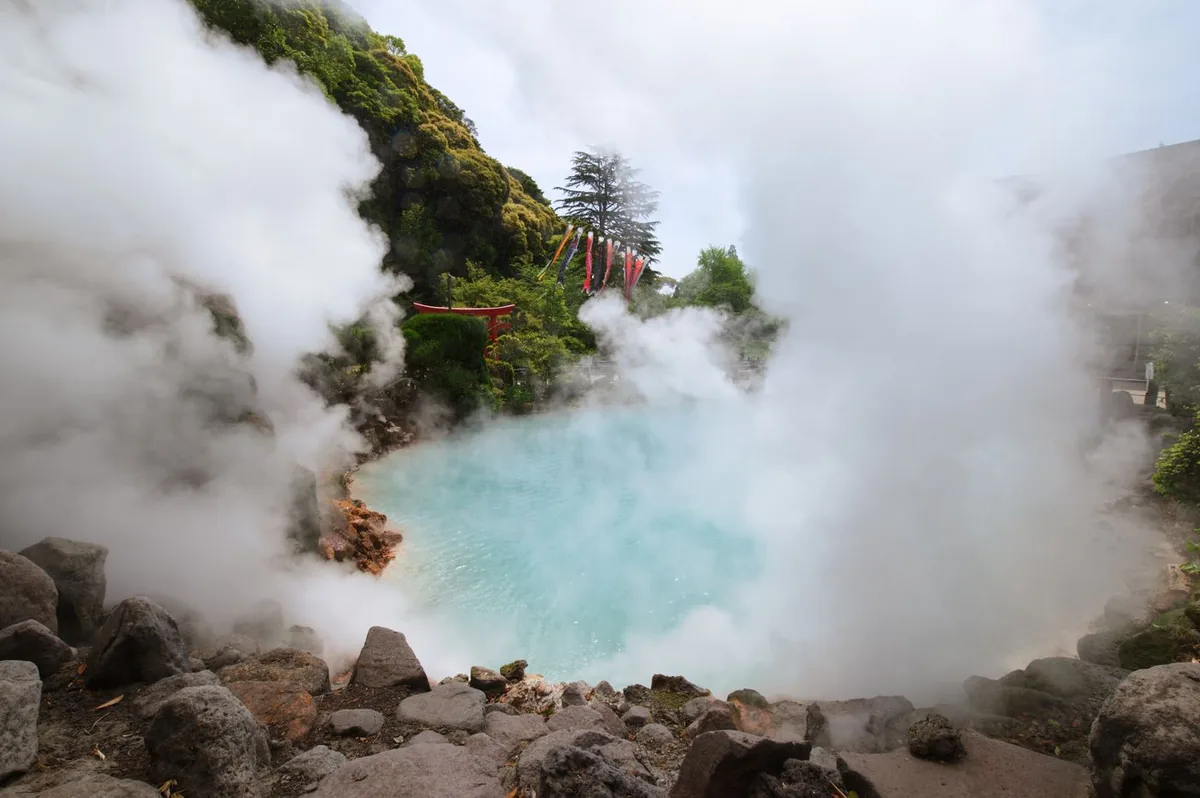 Photo: Han Sen / Pexels. A hot spring source in Beppu, Oita, not a bathing facility. Cover photo: Jeremy Wong / Pexels
Rules change in both directions. A place that turned you away last year may welcome you now, and the reverse can happen too. Check the current page, not your memory or an old blog post.
How many onsen allow tattoos?
There is no recent official figure. The number you often see, 56% refusing, comes from a 2015 Japan Tourism Agency survey of hotels and ryokan (traditional inns): 581 of 3,768 facilities answered. Of those, 55.9% refused guests with tattoos, 30.6% did not, and 12.9% allowed them under conditions such as covering with stickers [9].
In October 2026 we read the official rules of 19 onsen and spas in Tokyo, Yokohama and Hakone: 10 refused, 8 allowed tattoos with conditions, and 1 allowed them only for guests bathing alone. The groups and years differ, so neither number tells you how things stand across Japan today. Treat "tattoo-friendly" lists as a place to find candidates, not as a percentage.
What the 2016 Government Notice Says, and What It Does Not
In 2016 the Japan Tourism Agency told hotel and onsen associations that "refusing to let someone bathe only because they have tattoos is not appropriate." It is often quoted as if it settled the question, so it helps to know what it actually covers [7].
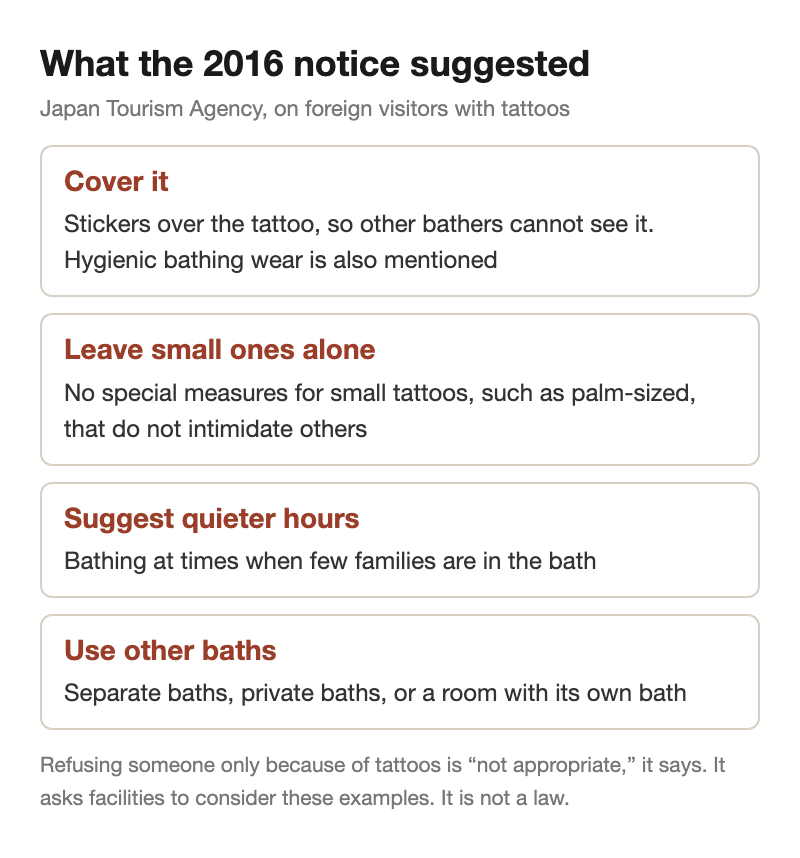
- It is about foreign visitors. The title is "on responding to foreign travelers with tattoos bathing"
- It is a request, not a law. It notes that people have tattoos for religious, cultural and fashion reasons, that tattoos cause no hygiene problem, and asks each facility to consider its own approach
- It gives examples, not rules. Covering with stickers, no special measures for small (for example palm-sized) tattoos, suggesting quieter hours, and pointing guests to private baths or rooms with their own bath. A facility does not have to adopt any of them
In 2017 the government also told the Diet (Japan's parliament) that having a tattoo, by itself, is hard to read as a "contagious disease" or an act "harmful to public hygiene" under the Public Bathhouse Act [8]. That is about how the law is read. It does not address whether a facility may set its own rules. For the longer history of tattoos and the law in Japan, see irezumi vs tattoo.
Read the Official Rules in Four Steps
Do not stop at "tattoo OK." Ask who the rule is for, which bath it covers, what the conditions are, and whether the facility can still say no. Among the 19 facilities we read, rules labeled "with conditions" varied a lot.
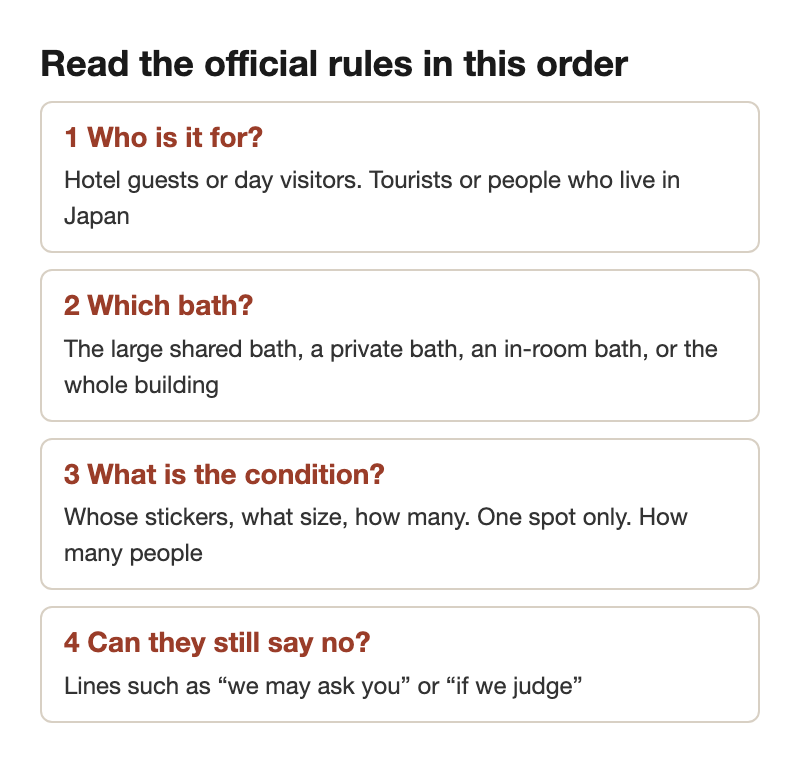
Three things are easy to miss:
- "OK for tourists" may not include people who live in Japan. One spa in Shinjuku, Tokyo, lets male foreign tourists in with one of its stickers, but refuses men who are Japanese or foreign residents of Japan, whatever the size. It has a separate rule for women [19]. If you live in Japan, read the fine print, or ask
- Half the "with conditions" places do not give a sticker size. Of the 8 conditional facilities we read, only 4 gave sizes in centimeters. If the page does not say, you have to ask
- Branches of the same chain can word their rules differently. The Kobe branch of one onsen chain tells guests to use its stickers as they are, without cutting them; the Tokyo Toyosu branch's page does not say this [13][14]. Read the page for the branch you are going to
Japanese Words You Will See in Onsen Rules
Many rules are only in Japanese, or the English version is shorter. These are common phrases from official facility pages, with romanization and what they usually mean. The wording varies, so use this to find the right line, then check with the facility.
| Japanese | Romanization | What it usually means |
|---|---|---|
| 入れ墨 / 刺青 / タトゥー | irezumi / irezumi or shisei / tatū | Tattoo. Signs often list more than one |
| お断り / ご入館をお断りします | o-kotowari / go-nyūkan o o-kotowari shimasu | Refused / you may not enter |
| 大きさに関わらず | ōkisa ni kakawarazu | Regardless of size. Small tattoos are refused too [22][23] |
| シール・ペイントを含む / タトゥーシール | shīru, peinto o fukumu / tatū shīru | Including temporary stick-on or painted tattoos. Not the same thing as cover stickers [13][16] |
| シール等をつけてのご利用もお断り | shīru nado o tsukete no go-riyō mo o-kotowari | Covering it with stickers or tape does not help [22][23] |
| 制限を撤廃 / 特別な制限を設けない | seigen o teppai / tokubetsu na seigen o mōkenai | Restriction removed / no special restrictions. Read the next sentence [1][2] |
| カバーシール◯枚で覆える場合 | kabā shīru ◯-mai de ōeru baai | Allowed if ◯ cover stickers can cover it. If they cannot, you cannot go in [13][15][16] |
| 完全に覆う | kanzen ni ōu | Must be covered completely [5][15] |
| 当館指定 / フロントで販売 | tōkan shitei / furonto de hanbai | Our designated stickers / sold at the front desk. Your own may not count [5][15][20] |
| 1か所のみ | ikkasho nomi | One spot only [20] |
| 外国人観光客のみ | gaikokujin kankōkyaku nomi | Foreign tourists only. Residents of Japan may be excluded [19] |
| おひとりであれば | o-hitori de areba | Only if you come alone [21] |
| ご配慮をお願いする場合がございます | go-hairyo o onegai suru baai ga gozaimasu | We may ask you to be considerate, for example to cover up [1] |
| 判断した場合 | handan shita baai | "If we judge that..." The facility keeps the right to refuse [12] |
| 大浴場 | daiyokujō | The large shared bath |
| 貸切風呂 / 家族風呂 | kashikiri-buro / kazoku-buro | A private bath you reserve for your group, by the hour |
| 客室露天風呂 | kyakushitsu roten-buro | An open-air bath in your own room |
| 時間帯 | jikantai | Time slot. Some places allow tattoos only at set hours |
| 反社会的勢力 / 暴力団 | hanshakaiteki seiryoku / bōryokudan | Organized crime groups. Commonly refused, tattoos or not |
Private baths come in two kinds: one in your room that you can use anytime, and one you book by the hour [25]. "Tattoo OK in private baths" is common, but not guaranteed, so ask about that too. For examples of set-hour rules, see our Tokyo guide.
Cover Stickers: Multiply Size by Number
At places that accept tattoos "if covered with stickers," the area you are allowed to cover differs about fourfold. These are limits from official facility pages; the area is our calculation.
| Sticker limit | Area | Source |
|---|---|---|
| One 10 x 15 cm sticker | 150 cm² | [17] |
| Two 8 x 10 cm stickers | 160 cm² | [18] |
| Two 11 x 20 cm stickers | 440 cm² | [13][15] |
| Four 10 x 15 cm stickers | 600 cm² | [16] |
| Eight 8 x 10 cm stickers | 640 cm² | [12] |
[12] applies to its facilities that day visitors also use.
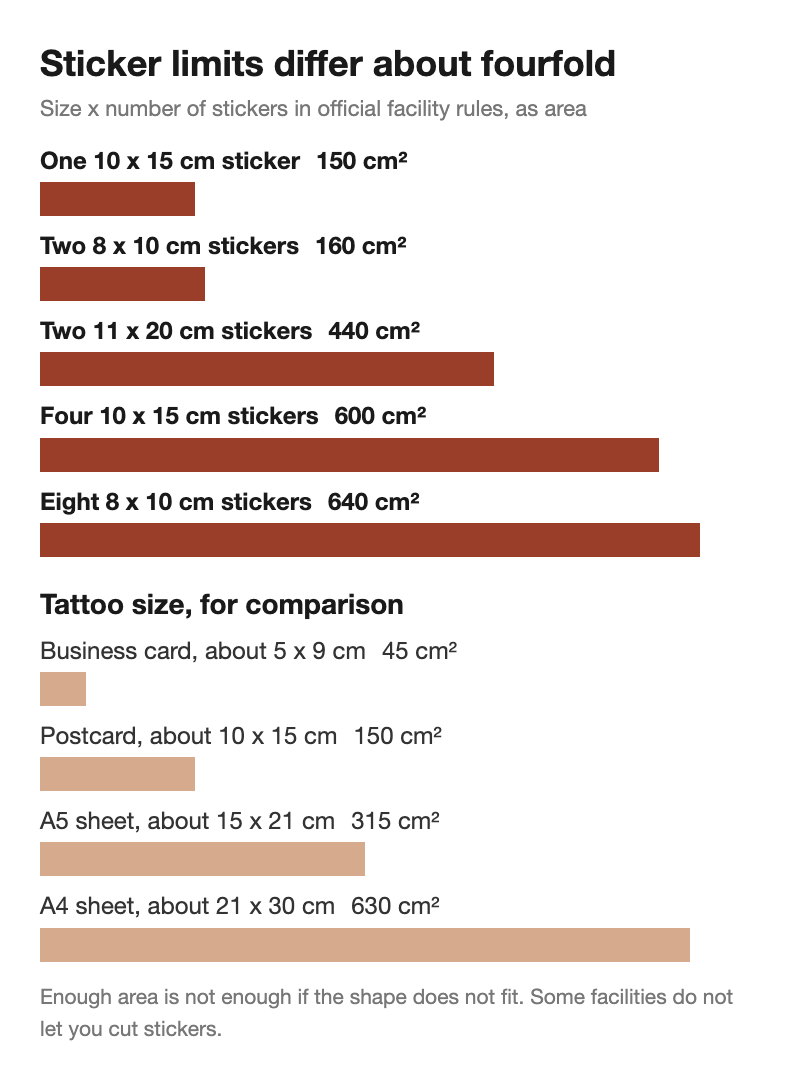
Area alone does not tell you whether you will get in. Check four things:
- Measure the longest length and width. A photo with a ruler next to the tattoo makes it easy to explain when you ask
- Hold a piece of paper the size of the sticker over it. Long, thin designs can fit the area but not the shape
- Count each separate tattoo. Several small ones can use up the sticker limit, and some places allow one spot only [20]
- Check whether it must be fully covered. Some places do not require full coverage [4]; others make it the condition [5][15]
Two more points. Some places accept only the stickers they sell, so the ones in your bag may not count [5][15][20]. And some want stickers on the whole time you are inside, not only in the bath [13]. How to choose, apply and remove stickers is covered in how to cover tattoos in Japan.
A business-card-sized piece fits within every limit above. Pieces like these are small enough for a single sticker to cover:
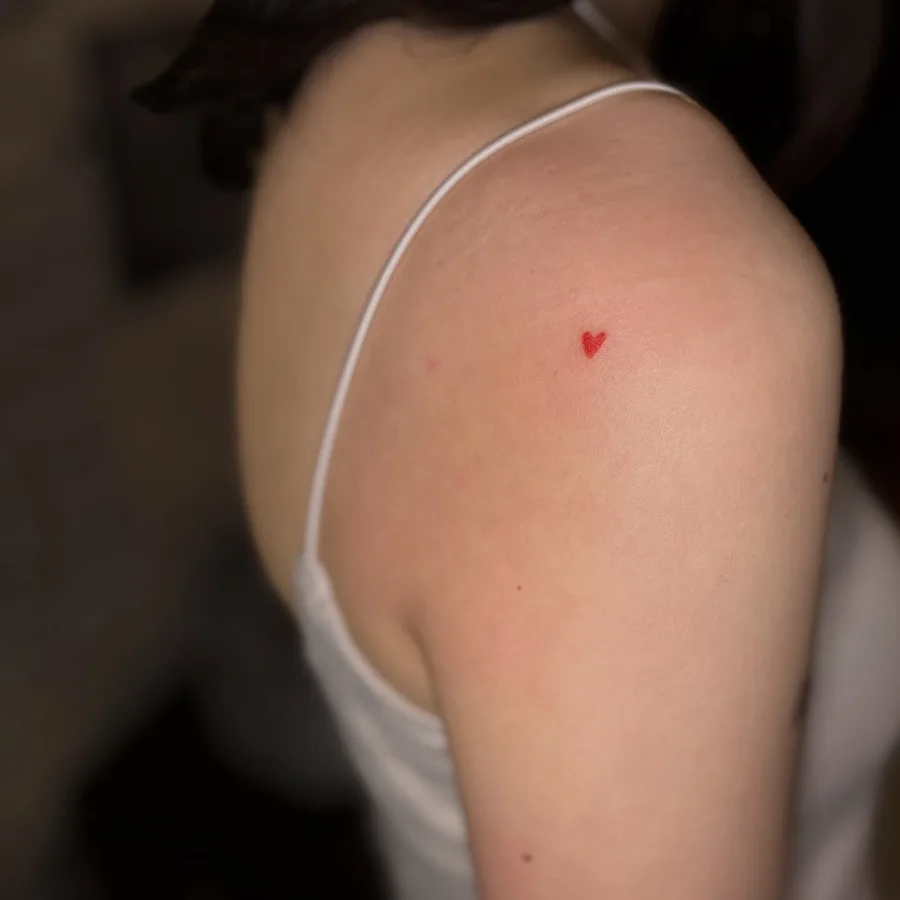
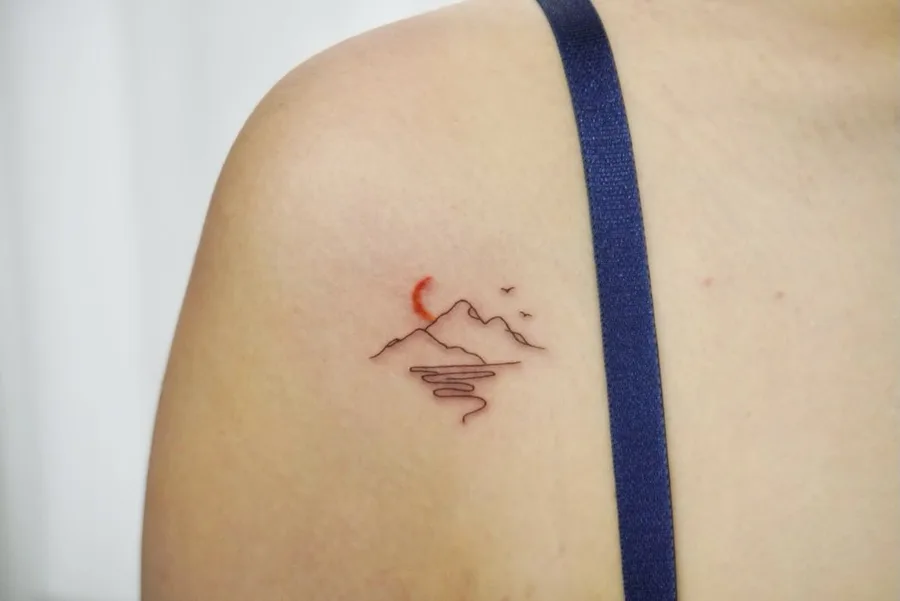
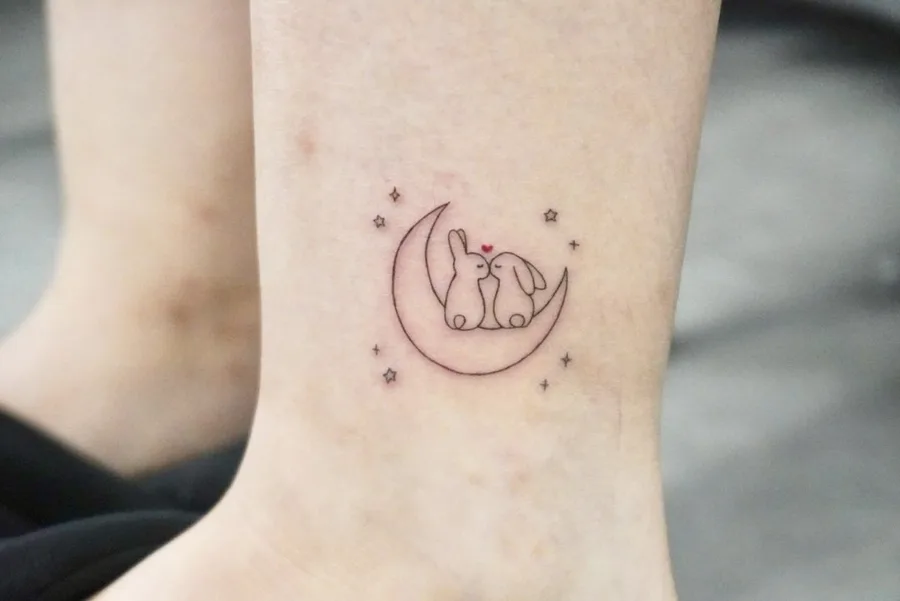
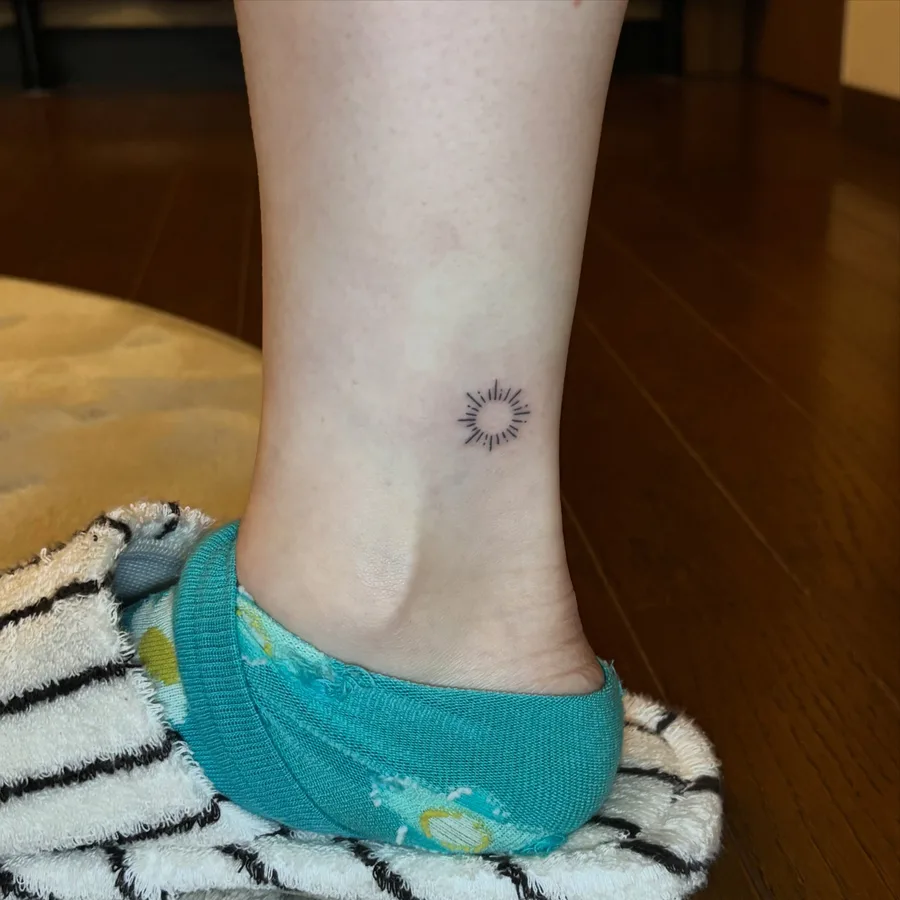
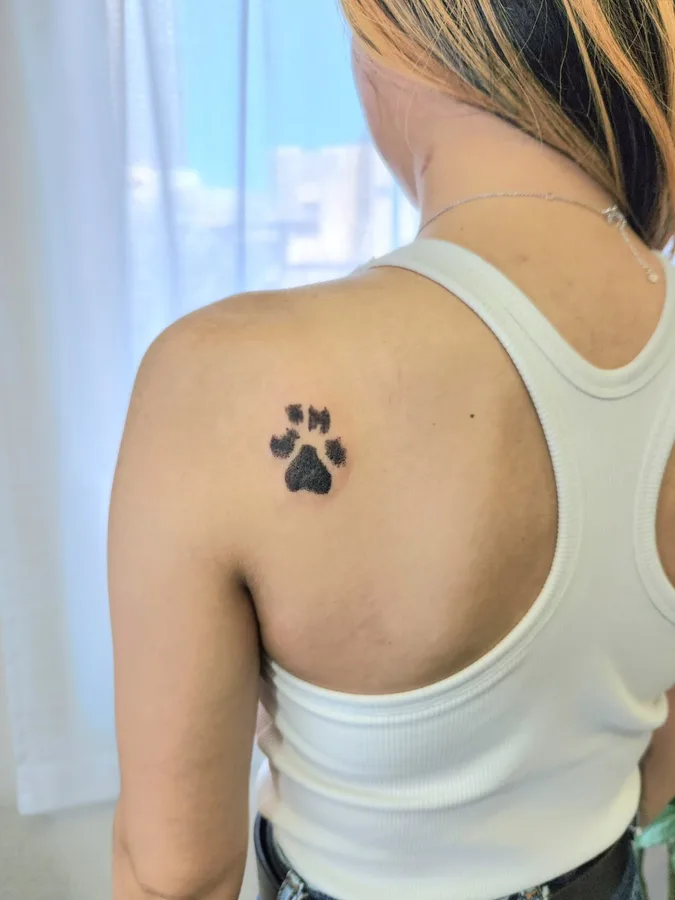
Images are quoted from works by artists listed on tattooers.jp (as of November 16, 2026). Tap an image to open the work.
Artist pages: kana / SOU / Take. More small pieces are in one-point tattoos, shoulder tattoos and ankle tattoos. Even a tiny tattoo can be refused where the rule says "regardless of size."
Large Pieces: Look Beyond Stickers
A full back piece or a sleeve will not fit under any of these sticker limits, by area or by shape. Pieces like these:
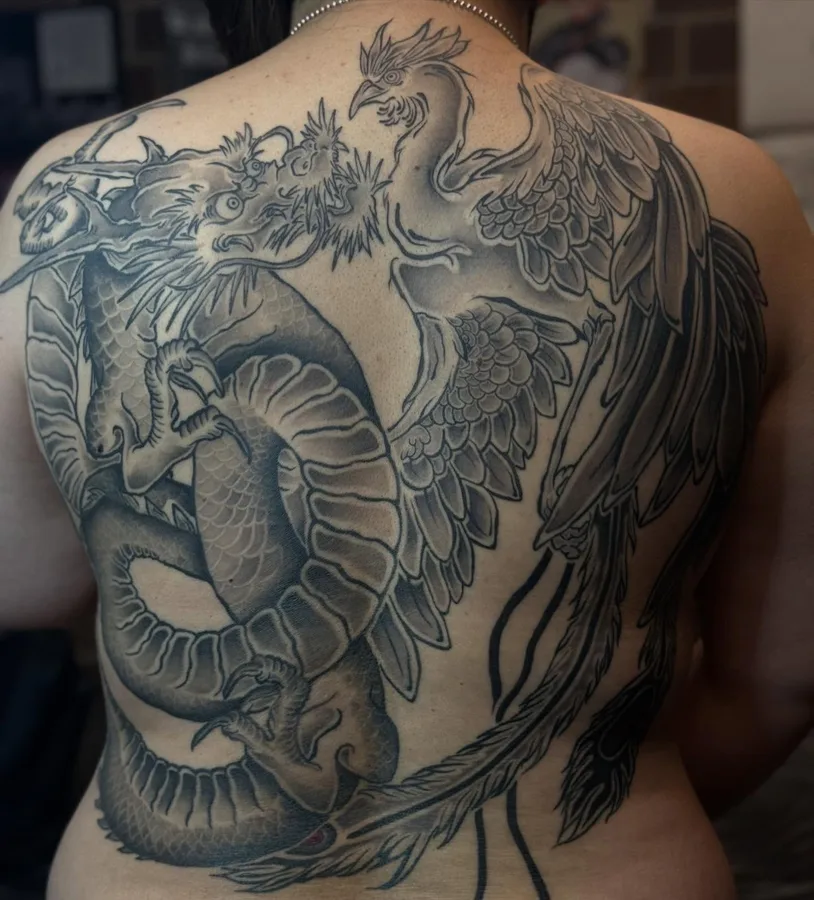
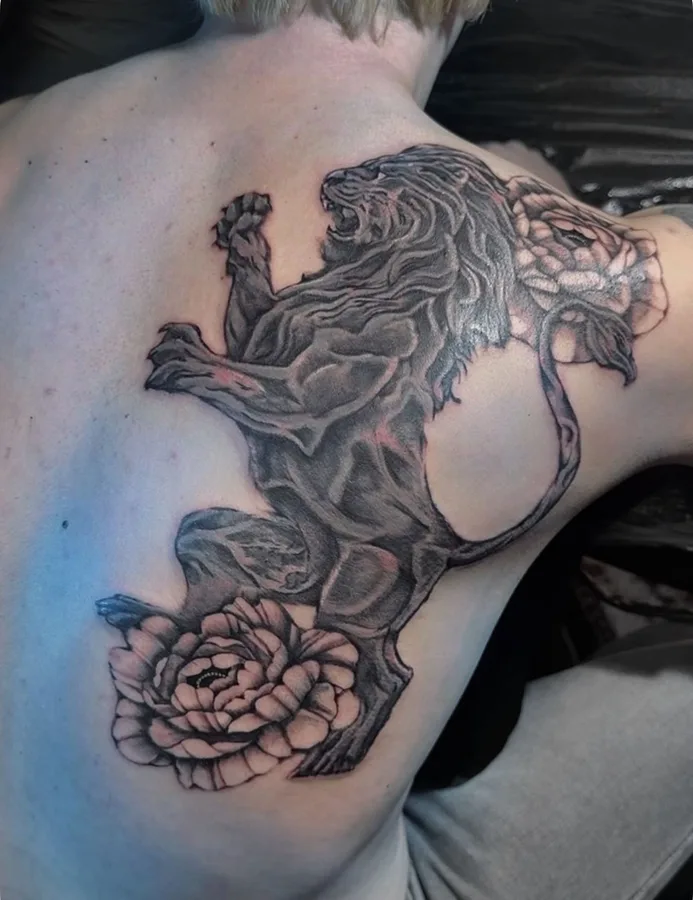
Images are quoted from works by artists listed on tattooers.jp (as of November 16, 2026). Tap an image to open the work.
Artist pages: Amane.【彫豹】 / ALIEN TATTOO KOBE / 㐂. More are in back tattoos.
With a piece this size, skip the sticker places and look for:
- Private baths or a room with its own bath, which the 2016 notice also mentions and some ryokan offer [7][25]
- Places with no size limit. In Kinosaki Onsen, the official tourism site says all seven of its public bathhouses accept tattoos of any size without covering, while the baths at inns may have their own rules [10]. Oita Prefecture's official tourism site has a feature on tattoo-friendly hot springs [11]
- Facilities marked "allowed" on our tattoo-friendly map, where you can check the exact wording
Ask With Sizes, Not "Is It OK?"
"Are tattoos OK?" gets you a yes or no, not the conditions. Give the size, the place on your body and the bath you want to use, then ask for the conditions. For hotels and ryokan, email or the booking site's message function is best, because you get the answer in writing.
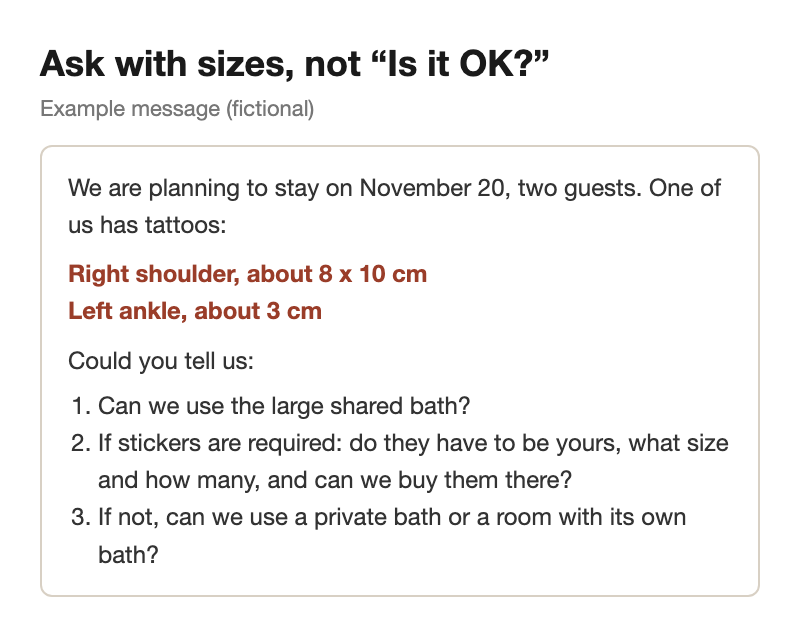
A template you can copy. Change the parts in brackets:
We are planning to stay on [date], [number] guests.
One of us has tattoos:
- [Right shoulder], about [8 x 10] cm
- [Left ankle], about [3] cm

Could you tell us:
1. Can we use the large shared bath?
2. If stickers are required, do they have to be yours?
   What size and how many are allowed, and can we buy them there?
3. If not, can we use a private bath or a room with its own bath?
If you live in Japan and the page only mentions tourists, add: "We live in Japan. Do the same conditions apply?"
Three tips:
- Do not start with "It's small." People picture different sizes. Give centimeters
- Name the bath. The same facility can have different rules for the large bath, private baths and swimwear areas. Yunessun, for example, posts separate guidance for Mori no Yu and its swimwear zone [5]
- If the answer is no, do not argue. The rules are the facility's call. Ask about private baths, and if there are none, look elsewhere
Fresh Tattoos and the Day of Your Visit
If your tattoo is new, stay out of the bath until it has fully healed, whatever the rules say. A private bath does not change this: the problem is the healing skin, not the facility's rule. If you are getting tattooed on a trip to Japan, plan your onsen days for before the session, or for a later trip. For the rest of the planning, see our first tattoo guide. When it is safe to soak again is covered in tattoo aftercare while traveling in Japan. If redness or swelling continues, or a sticker irritates your skin, see a doctor.
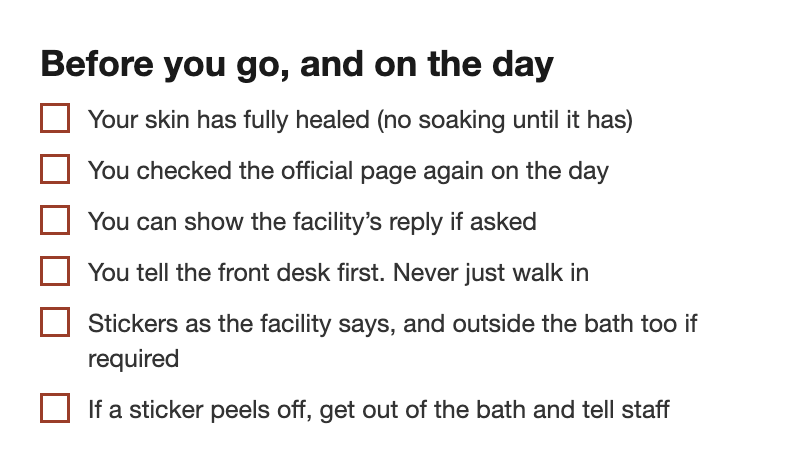
Some facilities ask anyone who enters without saying anything to leave [13][23]. One that sells stickers asks guests to put them on clean, dry skin, and to get out of the bath and tell staff if one peels off [24].
Frequently Asked Questions
Q. Will an onsen refuse me for one small tattoo?
It can. Some facilities say they refuse tattoos "regardless of size" [22][23]. On the other hand, the Japan Tourism Agency's ryokan Q&A says some inns decide case by case, for example treating a single small tattoo as no problem [25]. Ask, and give the size in centimeters.
Q. Can I bring my own cover stickers?
It depends on the facility. Some accept only the stickers they sell at the front desk [5][15][20]. Ask before you count on your own. For choosing and applying stickers, see how to cover tattoos in Japan.
Q. Can I wear something over my tattoo in the bath?
Ask the facility first. The 2016 notice mentions hygienic bathing wear as one option [7], but at least one hotel group describes the bath cover it allows as made for covering surgical scars [12]. Swimwear is generally not worn in the bath itself [25].
Q. Is it illegal for an onsen to refuse me?
There is no single legal answer. The government has said a tattoo alone is hard to treat as a disease or a hygiene risk under the Public Bathhouse Act, and the Japan Tourism Agency has said refusing foreign visitors only for tattoos is not appropriate. They do not address whether a facility may set its own rules [7][8].
Q. Where can I find onsen that accept tattoos?
Use our tattoo-friendly map, which shows each facility's official wording and the date we checked it, and our Tokyo guide. Then confirm on the facility's own page.
Summary
With tattoos and onsen, the question is less "can I go in?" than "under what conditions?"
- Read the rule in order: who it is for, which bath, what conditions, and whether they can still refuse
- Compare sticker limits by size times number, and check the shape with paper
- Ask with centimeters and the bath you want to use, not "Is it OK?"
- Never soak a fresh tattoo, and never walk in without telling the front desk
Planning a tattoo in Japan and want to keep onsen in your trip? Size and placement matter more than anything else. Tell us your idea, size and dates in our counseling form and we match you with an artist. We message you on Instagram within 48 hours. You can also browse the artists on tattooers.jp.
References
These are the primary sources and official facility pages used in this article. Facility pages are as of the date we checked them. Titles of Japanese pages are our translations.
- The Moon Beach Museum Resort. Guidelines regarding body art (September 23, 2026). Checked November 6, 2026.
- Mitsui Fudosan Hotel Management. Regarding bathing restrictions related to tattoos. Checked November 6, 2026.
- Mitsui Garden Hotel Okayama. Large bath (Japanese). Checked November 6, 2026.
- Alpenblick Resort. On guests with tattoos using the onsen and spa (Japanese, November 25, 2025). Checked November 6, 2026.
- Hakone Kowakien Yunessun. Entry to Mori no Yu for guests with tattoos (Japanese, September 27, 2025). Swimwear area guidance: FAQ. Checked November 6, 2026.
- Konohana no Yu. Partial change to bathing rules (Japanese). Checked November 6, 2026.
- Ministry of Health, Labour and Welfare, notice of March 18, 2016, attaching the Japan Tourism Agency notice of March 16, 2016. On responding to foreign travelers with tattoos bathing (Japanese, PDF). Checked November 12, 2026.
- House of Representatives. Government answer on bathing in public bathhouses by people with tattoos (Japanese, February 21, 2017). Checked November 6, 2026.
- Kanko Keizai Shimbun. Japan Tourism Agency explores responses to tattooed bathers as foreign visitors increase (Japanese, October 31, 2015). Report on the agency's survey results. Checked November 6, 2026.
- Visit Kinosaki (official tourism site of Toyooka City). Tattoo Friendly Onsen of Kinosaki. Checked November 6, 2026.
- Visit Oita (official tourism site of Oita Prefecture). Tattoo-Friendly Hot Springs Special Feature. Checked November 6, 2026.
- Hoshino Resorts. FAQ: about the hotels (Japanese). Checked November 6, 2026.
- Tokyo Toyosu Manyo Club. Entry for guests with tattoos (Japanese). Checked November 6, 2026.
- Kobe Harborland Onsen Manyo Club. Entry for guests with tattoos (Japanese). Checked November 6, 2026.
- Maenohara Onsen Saya no Yudokoro. FAQ (Japanese). Checked November 6, 2026.
- Natural Hot Spring Heiwajima. Prices and rules (Japanese). Checked November 6, 2026.
- Hotel Gyokusen. Rules for the large bath (Japanese). Checked November 6, 2026.
- Grand Mercure Lake Hamana Resort & Spa. Hot spring and large bath (Japanese). Checked November 6, 2026.
- Thermae-yu Shinjuku. User guide (Japanese). Checked November 6, 2026.
- Spadium Japon. FAQ (Japanese). Checked November 6, 2026.
- Hakone Yumoto Onsen Tenzan Tohji-kyo. FAQ (Japanese). Checked November 6, 2026.
- Keio Takaosan Onsen Gokurakuyu. FAQ (Japanese). Checked November 6, 2026.
- Super Sento Yudokoro Kasai. FAQ (Japanese). Checked November 6, 2026.
- Natural Hot Spring Hinata no Yu. Why are tattoos not allowed in onsen? (Japanese, August 6, 2026). Checked November 6, 2026.
- Japan Tourism Agency. Ryokan Q&A (Japanese). Checked November 6, 2026.
"Our reading of 19 facilities" means the tattooers.jp editorial team read and classified the official pages of 19 onsen and spas in Tokyo and in Yokohama and Hakone (Kanagawa) as of October 30, 2026. We did not call the facilities. It is not a random sample and does not represent all of Japan. Areas are calculated maximums.
